How to Chip and Pitch Around the Green


Learning how to chip in golf, and knowing when to switch to a pitch instead, is the fastest way to stop wasting strokes around the green. Here’s the setup, stroke, and club selection for both shots, plus how to tell which one a given situation actually calls for.
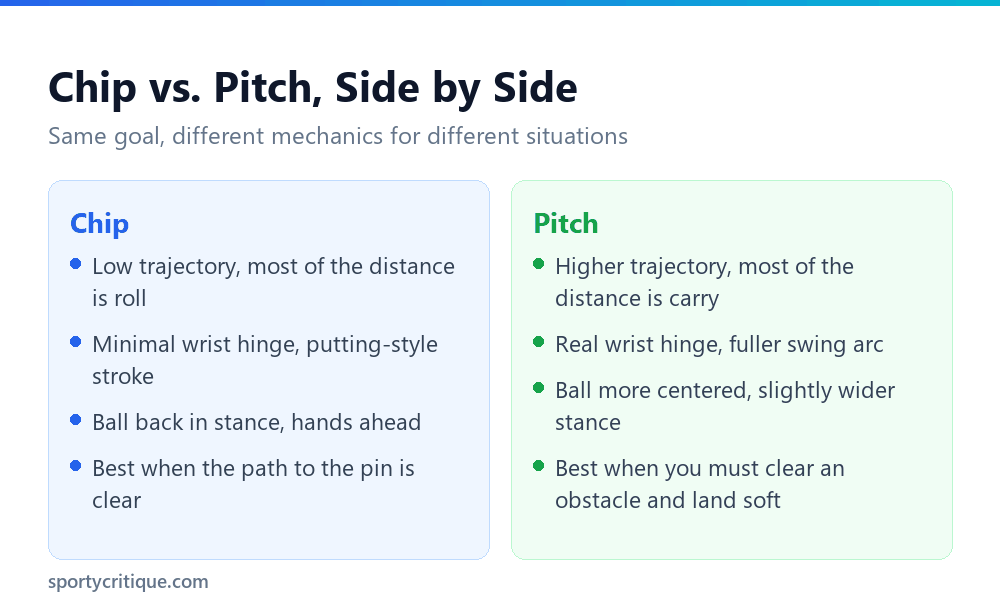
To chip in golf, set up like a putt with the ball back in your stance, hands slightly ahead, and make a small, arms-and-shoulders stroke that lands the ball just onto the green and lets it roll to the hole. Use a pitch shot instead of a chip when you need the ball to fly higher and land softer, usually because there’s a bunker, rough, or slope between you and the flag that a low, rolling chip can’t carry over.
Most short-game strokes lost around the green come down to picking the wrong shot, not bad technique. A chip that should have flown over a bunker gets skulled into the sand, or a pitch that should have released and rolled gets spun back off the green. Here’s how to actually tell the two shots apart, set up for each one, and pick the right club so you’re not guessing under pressure.
- →A chip flies low and rolls a lot; a pitch flies higher and rolls very little on landing
- →Chip setup mirrors a putting stroke: minimal wrist hinge, ball back, hands ahead
- →Pick the landing spot first, then work backward to figure out which club gets it there
- →The 1:3 rule (air time to roll time roughly one part flight to three parts roll for a chip) is a useful starting reference, not a rigid formula
- →A pitch needs more wrist hinge and a longer swing to generate the height a chip doesn’t need
Table of Contents
Chip vs. pitch: how to tell which shot you need
The deciding factor is what’s between your ball and the flag, plus how much green you have to work with. If you’ve got a clear, short-cut path of fringe or fairway between you and the pin, a chip that lands quickly and rolls out is the simpler, lower-risk choice. If there’s a bunker, thick rough, or a false front in the way, or the pin is cut close to your edge of the green with little room to roll out, you need the ball in the air longer and landing softer, which means a pitch.
Chip shot setup and stroke
Pitch shot setup and stroke
Picking the right club for a chip
Club selection for a chip is really about picking how much roll you want, since the stroke itself barely changes across clubs. A less-lofted club like a 7 or 8-iron produces a lower flight and more roll, useful when you have plenty of green to work with. A more-lofted club like a pitching wedge or gap wedge flies a bit higher and rolls less, useful when the pin is closer to your side of the green. Many players oversimplify this into “one chipping club” and just vary the length of the stroke instead, which works fine once you’ve practiced the feel, but understanding the club options gives you more precision when the situation calls for it.
💡 Pro tip: If you only practice with one club for chipping, a pitching wedge or 9-iron is a reasonable default. It gives a moderate flight-to-roll ratio that works for most situations, and you can vary stroke length to fine-tune distance rather than switching clubs constantly.
Common mistakes around the green
⚠️ Watch out: Scooping or trying to lift the ball into the air with your wrists is the single most common fault in both shots. The club’s loft is built to launch the ball; your job is to deliver a descending strike and trust the design, not add lift yourself.
A second common mistake is decelerating through impact, especially on pitch shots where players get tentative about how far the ball will fly and slow the club down right before contact. That deceleration is what causes thin, bladed shots that fly across the green. A shorter, committed swing beats a longer, hesitant one every time.
Third: picking up your head too early to see where the shot went. This causes the upper body to rise during the stroke, which lifts the club and produces thin contact. Keep your eyes on the spot where the ball was for a beat after you feel contact.
Practicing at home
A SKLZ Quickster Chipping Golf Net gives you a repeatable target to practice landing spots without needing a full short-game area. Set it up in a backyard or garage and focus specifically on hitting your intended landing spot rather than the target itself, since that’s the skill that actually transfers to the course. Ten minutes a day of focused chip and pitch reps, using real or foam practice balls, builds the distance control that’s difficult to develop only on the course between real rounds.
- ✓Pick your landing spot before you pick your club
- ✓Keep the stroke length matched going back and through
- ✓Trust the club’s loft instead of trying to scoop the ball up
- ✓Practice both shots, not just the one you’re more comfortable with
- ✕Aim at the hole on a chip instead of the actual landing spot
- ✕Decelerate through impact out of fear of hitting it too far
- ✕Use a full-swing grip pressure on a shot that needs a quiet, controlled stroke
- ✕Assume every greenside shot calls for the same club and swing
A simple drill to build feel for both shots
Drop five balls at the same spot just off the green and pick one target landing spot. Hit all five with a chip, then hit all five again with a pitch to the same landing spot using a different club. Compare how far each shot rolled out after landing in the same place. This single drill does more to build an intuitive sense of the flight-to-roll relationship for each shot type than hitting random shots at different targets, because it isolates the one variable, shot type, that actually determines how the ball behaves after landing.
Reading the green before you commit to a shot
Before you pick a club, walk far enough onto the green to check the slope between your likely landing spot and the hole. A chip that lands on a downslope rolls out noticeably farther than the same stroke on flat ground, and an upslope kills roll fast. Reading this before you swing, not after watching the ball roll past the hole, is what separates players who consistently leave themselves tap-in putts from players who are constantly long or short.
Grain and green speed matter too, though less dramatically than slope. A fast, closely mown green needs a shorter, softer stroke than the same shot on a slower green, and grain running toward you adds a small amount of extra resistance to the roll. None of this needs to be precise science; a quick visual check and a practice stroke or two while you’re standing over the ball is usually enough to calibrate.
Building distance control without a full short-game area
Most golfers never develop reliable distance control on chips and pitches simply because they don’t practice enough repetitions with a specific landing spot in mind. You don’t need a full practice facility for this. A flat patch of yard, a towel or the chipping net mentioned above as a landing reference, and 15 to 20 minutes twice a week builds far more usable feel than an hour of aimless range chipping once a month.
Vary the distance between reps rather than hitting the same shot repeatedly. Real rounds rarely give you the same distance twice in a row, so training only one fixed yardage teaches a stroke length that doesn’t transfer well to the unpredictable distances you’ll actually face on the course.
Track your results loosely, even just a mental note of how many of ten reps landed within a few feet of the target spot. That simple feedback loop, repeated over a few weeks, tends to close the gap between how a player thinks they chip and how they actually perform under the light pressure of a real round.
What’s the difference between a chip and a pitch in golf?
A chip flies low and rolls a lot after landing, using a putting-style stroke with minimal wrist hinge. A pitch flies higher and rolls very little, using more wrist hinge and a longer swing to clear obstacles and land softly.
What club should I use to chip?
A pitching wedge or 9-iron is a reasonable all-purpose choice. Less-lofted clubs like a 7 or 8-iron produce more roll; more-lofted wedges produce less roll, useful when the pin is close to your edge of the green.
Why do I keep chunking or skulling my chip shots?
The two most common causes are scooping with your wrists instead of trusting the club’s loft, and lifting your head too early to watch the shot, which raises your upper body and the club with it.
How much should the ball roll on a chip?
A common starting reference is roughly one part air time to three parts roll for a standard chip, though this varies by club and green speed. Use it as a starting point, not a rigid formula.
Do I need a lob wedge to chip and pitch well?
No. A pitching wedge and sand wedge cover most greenside situations. Setup and strike quality matter far more than having a specialty wedge in the bag.
As an Amazon Associate, we earn from qualifying purchases through links on this page.