Best Pool Table Felt: Worsted vs Woolen Cloth Compared


The best pool table felt depends on how seriously the table gets played. Worsted cloth, like Simonis’s 760 and 860 lines, plays noticeably faster and holds up longer before pilling, making it the standard choice for tournament and league tables. Woolen cloth, like Championship’s Saturn II, costs less, plays slower, and is the common, perfectly reasonable choice for a casual home table that doesn’t need tournament-speed consistency. Four real cloths across both types, from $124 to $473, are compared below.
Pool table felt gets treated as an afterthought by a lot of buyers, something to replace when it wears out with whatever’s cheapest, rather than something that changes how the table actually plays. That’s a mistake. The difference between worsted and woolen cloth is not subtle once you’ve played on both; it shows up in every roll, every bank shot, and every stun shot on the table.
Neither type is objectively better in every situation. A worsted cloth on a casual family table that gets played twice a year is overkill for the price. A woolen cloth on a serious player’s daily table will feel sluggish and inconsistent compared to what they’re used to at a pool hall or league night. The right choice depends on how the table actually gets used.
- →Worsted cloth (Simonis 760, 860) is tightly woven from combed wool fibers, plays faster, and resists pilling
- →Woolen cloth (Championship Saturn II) has a fuzzier, looser weave, plays slower, and costs less
- →Worsted is standard on tournament and serious league tables; woolen is common and perfectly fine for casual home play
- →Price scales with weave grade and cloth size, from roughly $124 for a woolen 8ft kit to $473 for a premium worsted 9ft kit
- →Cloth size must match the table exactly (7ft, 8ft, or 9ft); an incorrect size won’t install correctly
Table of Contents
What Worsted and Woolen Actually Mean
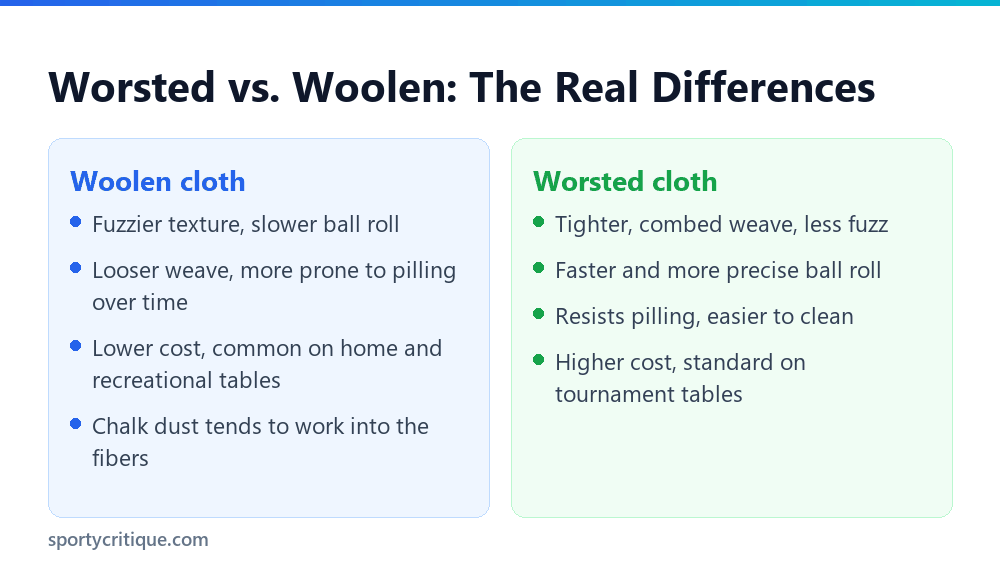
Woolen cloth is made primarily from wool fibers with a relatively loose weave, which leaves a slightly fuzzy, textured surface. That texture is exactly what makes it slower: more surface area and friction between the cloth and the ball. It’s also the reason chalk dust tends to settle into the fibers over time rather than staying on the surface where it can be brushed off easily.
Worsted cloth starts from the same basic fiber but goes through combing and a tighter weaving process, which produces a smoother, flatter surface with far less fuzz. Less surface texture means less friction, which is the direct mechanical reason worsted cloth plays faster and more precisely. It also resists pilling, the small fuzzy balls of fiber that develop on woolen cloth with heavy use, which is a large part of why worsted cloth holds its playing characteristics longer.
How the Speed Difference Actually Feels
Worsted cloth is sometimes called speed cloth for a reason: balls roll noticeably farther and faster for the same stroke on worsted than on woolen. For a player used to a woolen home table, the first few shots on a worsted-covered table tend to overshoot, since the stroke calibration built on the slower surface doesn’t translate directly.
That extra speed also means more precision is possible, not less. A tighter weave transmits spin and English more consistently, since there’s less fiber texture to disrupt the ball’s roll. That’s a real advantage for a player working on position play or bank shots, where small inconsistencies in roll compound into missed shots. For casual play where nobody’s tracking position that closely, the extra precision matters a lot less than the extra cost.
4 Real Cloths, Compared
Durability and Care Differences
Woolen cloth’s looser weave means it shows wear faster under regular play. Chalk buildup, pilling near common contact areas like the head spot, and gradual fuzzing along frequently used rail paths are all more visible on woolen cloth within a year or two of steady use. None of that makes it a bad choice for a casual table; it just means budget cloth is genuinely a consumable that gets replaced more often than worsted cloth would need to be.
Worsted cloth’s tighter weave sheds chalk more easily during a normal brush-down and resists the pilling that eventually roughens woolen cloth’s surface. A well-maintained worsted cloth on a table that isn’t seeing daily heavy play can reasonably last several years before needing replacement, compared to a more typical one-to-two-year cycle for woolen cloth under similar conditions.
💡 Pro tip: Regardless of cloth type, brushing the table after each session and vacuuming with a felt-safe attachment periodically extends the life of either type meaningfully. Cloth replacement cost is high enough on worsted specifically that basic maintenance pays for itself over a couple of years.
Does Cloth Type Affect the Break?
A hard break transfers a lot of energy through the cloth in a small area, and the two cloth types respond to that differently. Worsted cloth’s tighter weave holds up better under repeated hard breaks over time, since there’s less loose fiber for the cue ball to dig into on contact. Woolen cloth can show visible wear near the head spot faster on a table that gets a lot of hard, repeated breaks, since that’s the exact spot absorbing the most repeated impact.
Beyond durability, the break itself plays a bit differently on worsted cloth too: balls scatter faster and roll farther off contact, the same speed effect that shows up throughout regular play. Players used to breaking on woolen cloth sometimes find their break shots run long the first few times on a worsted table, for the same reason ordinary shots overshoot during the adjustment period.
Installation: DIY Cost vs. Professional Cost
Buying the cloth is only part of the cost. A self-installed replacement adds nothing beyond the cloth price, basic staples, and the time involved, which for a first attempt often runs several hours of careful, patient work. Professional installation typically adds a separate labor charge on top of the cloth cost, but it removes the risk of wrinkles, uneven tension, or misaligned pocket cuts that a first-time DIY installer is more likely to run into.
For woolen cloth in the $100 to $150 range, a DIY mistake is a relatively low-stakes way to learn the process, since a full redo costs less than a single professional install would have. For worsted cloth at $300 or more, the math shifts: a botched installation wastes a much larger amount of money, which is why many players choose to pay for professional installation specifically once they’ve decided to invest in worsted cloth.
📊 Note: Watch a full installation video for the specific table type before starting, not just a general pool table felting tutorial. Slate-bed tables, the most common type for a real pool table, install differently than the particleboard-bed tables sometimes sold as budget or children’s tables, and using the wrong technique can damage either the cloth or the table bed.
Basic tools for a DIY install include a staple gun, a wide putty knife or specialized felt tool for tucking the cloth into rail channels, and a way to stretch the cloth evenly as it’s stapled down. None of it is exotic or hard to source, but the technique for keeping tension even across the whole bed while stapling takes practice to get right on the first attempt, which is the actual skill professional installers are charging for rather than any special equipment.
Getting the Size Right
Pool table cloth is sold cut to specific table sizes, most commonly 7ft, 8ft, and 9ft, and the cut has to match the table exactly. A cloth cut for the wrong table size won’t stretch and install correctly, and buying the wrong size after a table’s exact dimensions weren’t checked is one of the most common, entirely avoidable mistakes in a felt replacement project.
⚠️ Watch out: Measure the actual playing surface, not the table’s outer dimensions, before ordering replacement cloth. A table advertised as “8ft” sometimes has playing-field dimensions that don’t match another manufacturer’s 8ft table exactly, and the cloth needs to match the real measurement, not just the marketing size.
Which One Actually Makes Sense
- ✓Choose worsted (Simonis 760/860) for a table played regularly or seriously
- ✓Choose woolen (Championship Saturn II) for a casual, infrequently played home table
- ✓Budget for more frequent replacement if choosing woolen for a heavily used table
- ✓Measure the exact playing surface before ordering any replacement cloth
- ✕Assuming worsted is always “better” regardless of how the table gets used
- ✕Buying woolen for a table that sees daily serious play and expecting worsted-level consistency
- ✕Ordering by the table’s marketed size without measuring the actual playing field
- ✕Skipping regular brushing and assuming any cloth type is maintenance-free
The decision ultimately comes down to an honest read of how the table gets used, not which option sounds more impressive on paper. A table that hosts weekly league practice earns back the cost difference in consistency and cloth lifespan; a table that mostly sits covered between family gatherings doesn’t need that same investment to be perfectly enjoyable to play on.
Frequently Asked Questions
Is worsted cloth worth the extra cost for a casual home table?
Usually not. The speed and precision advantages of worsted cloth matter most to players practicing position play or competing regularly. A casual table that sees occasional, relaxed play doesn’t need tournament-speed consistency, and woolen cloth handles that use case well at a lower cost.
How often does pool table felt need to be replaced?
It depends heavily on use and cloth type. A heavily played woolen cloth might need replacement within a year or two, while a well-maintained worsted cloth on a moderately used table can last several years. Visible pilling, chalk that won’t brush out, and noticeably slower or inconsistent roll are the signs it’s time.
Can I install pool table felt myself?
Yes, though it’s a genuinely fiddly job involving stretching and stapling the cloth evenly around the rails and pockets without wrinkles or gaps. Many players choose to have it professionally installed, especially on a worsted cloth where the higher cost raises the stakes of a botched DIY install.
Does cloth color affect play?
No, color is purely cosmetic and doesn’t affect speed, durability, or how the ball rolls. Tournament Blue and Standard Green are common because they’re traditional, not because either color plays differently from the other.
Is Simonis the only worsted cloth brand worth buying?
No, but it’s the most widely recognized and used across tournament and league play, which is why it shows up as the default comparison point. Other manufacturers make worsted cloth too; the underlying worsted-versus-woolen distinction and the speed and durability differences it produces matter more than the specific brand name on the label.
As an Amazon Associate, we earn from qualifying purchases through links on this page.