How to Play Table Shuffleboard: Rules, Scoring, and Tactics

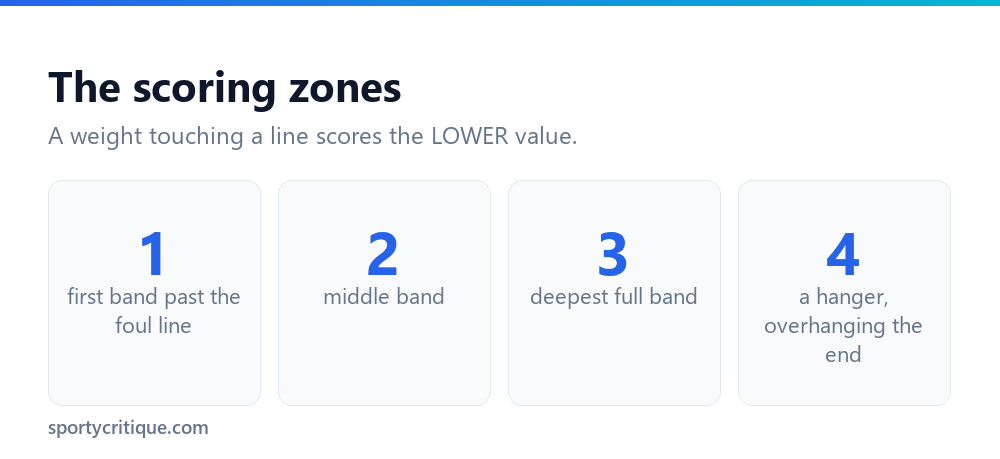
Table shuffleboard is played on a long waxed wooden table where you slide metal-and-resin weights with your hand. Both players shoot from the same end, alternating, four weights each. Scoring zones are worth 1, 2, 3, with a hanger overhanging the far edge worth 4. The rule everyone gets wrong: only one player scores per round — whoever has the weight furthest down the table — and they count only the weights sitting beyond their opponent’s best. Games go to 15 singles, 21 doubles.
🎯 Shuffleboard Hub: Explore all 18 table reviews, wax speed guides, and scoring tutorials in our Complete Shuffleboard Resource Hub.
This is the shuffleboard you’ll find in American bars: a long hardwood table, a scattering of silicone beads, and eight heavy pucks. It’s a different sport from the outdoor court game that shares the name, and it’s the one most people mean when they say “shuffleboard.”
It’s also deceptively tactical. The basic idea takes a minute; the scoring rule that makes it a strategy game takes slightly longer, and most casual players never learn it — which is why bar games so often end in a disagreement about who won.
- →Both players shoot from the same end, alternating, four weights each per round.
- →Only the player with the furthest weight scores — the other scores nothing.
- →A hanger overhanging the end is worth 4, the maximum for one weight.
- →Knocking opponents off is legal and often worth more than placing your own weight.
- →Every table has a different speed. Calibrate before you compete.
- →The hammer — shooting last in a round — is a genuine advantage.
Table of Contents
The table, the weights, and the wax
A regulation table is 22 feet long, though bar and home tables commonly run 9, 12, 14, or 16 feet. The playing surface is hard maple, finished to a gloss and crowned very slightly — the surface isn’t perfectly flat, which is part of why weights drift and why every table has its own character.
The weights (also called pucks) are metal discs with a plastic or resin cap, about 2.5 inches across, and they come in two colours — typically red and blue — four of each. They’re heavier than they look, which is exactly why beginners overshoot: the instinct is to push hard, and a heavy object on a low-friction surface needs almost no force at all.
The wax is the part nobody explains properly. Despite the name, table shuffleboard “wax” isn’t wax — it’s tiny silicone or plastic beads, sometimes called sand, powder, or cheese depending on the region. They act like microscopic ball bearings between the weight and the wood, which is what allows a heavy puck to travel twenty feet from a gentle push.
Powders come in numbered speeds, and a table’s feel depends entirely on which is on it and how recently. This is why a shot that worked perfectly at one bar sails off the end at another — and why our table cleaning guide matters more than it sounds for anyone with a table at home.
How a round is played
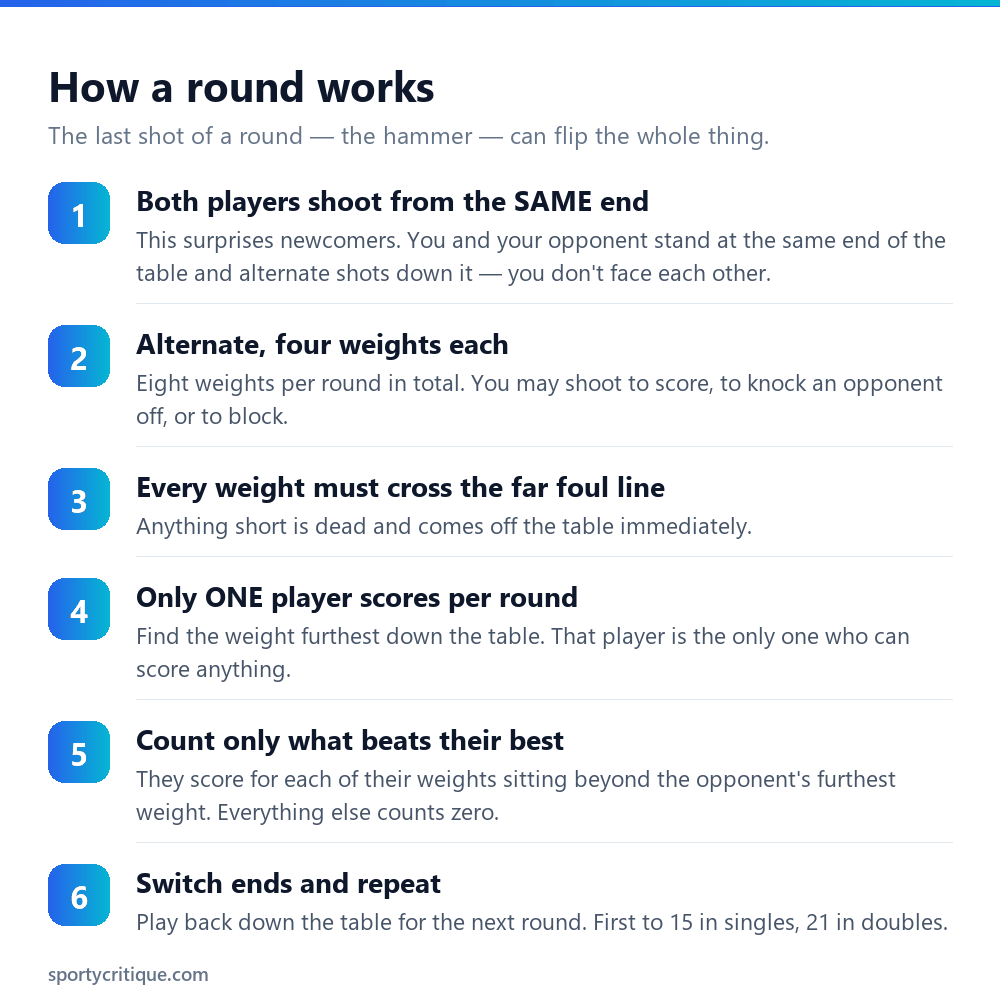
The detail that surprises everyone new to the game: both players shoot from the same end. You don’t stand at opposite ends throwing at each other. You and your opponent stand together at one end, alternate shots down the table, and then walk to the other end to play the next round back the other way.
Each round uses eight weights, four per player. You shoot alternately, and each shot can do one of three jobs: place a weight in a scoring zone, knock an opponent’s weight off the table or out of position, or park a weight somewhere awkward to block their lane. Choosing between those three is the whole game.
A weight that fails to cross the far foul line is dead and removed immediately. This matters more than beginners expect, because the fear of overshooting makes people underthrow, and an underthrown weight is worth exactly as much as one that flew off the end — nothing.
Scoring: only one player scores
Here’s the rule that transforms the game, and the one most casual players have never heard.
At the end of a round, find the single weight furthest down the table. Its owner is the only player who can score. They then count each of their own weights sitting beyond the opponent’s furthest weight. Everything else — including their own weights that don’t clear the opponent’s best — scores zero.
So a board where you have three weights in scoring zones and your opponent has one hanger can score 4–0 against you. Most groups would call that 6–4. Our scoring guide works through a full example, and it’s worth reading before your next game if only to settle future arguments.
Your opponent can have three weights in scoring zones and get nothing. That single rule is what turns shuffleboard from a sliding contest into a strategy game.
The strategic consequence is that removal is often worth more than placement. If your opponent has a strong weight deep in the 3 zone, you don’t need to out-place it precisely — knocking it off the table erases their entire round. That’s why good players spend so many shots aiming at other weights rather than at empty space.
Technique: push, don’t throw
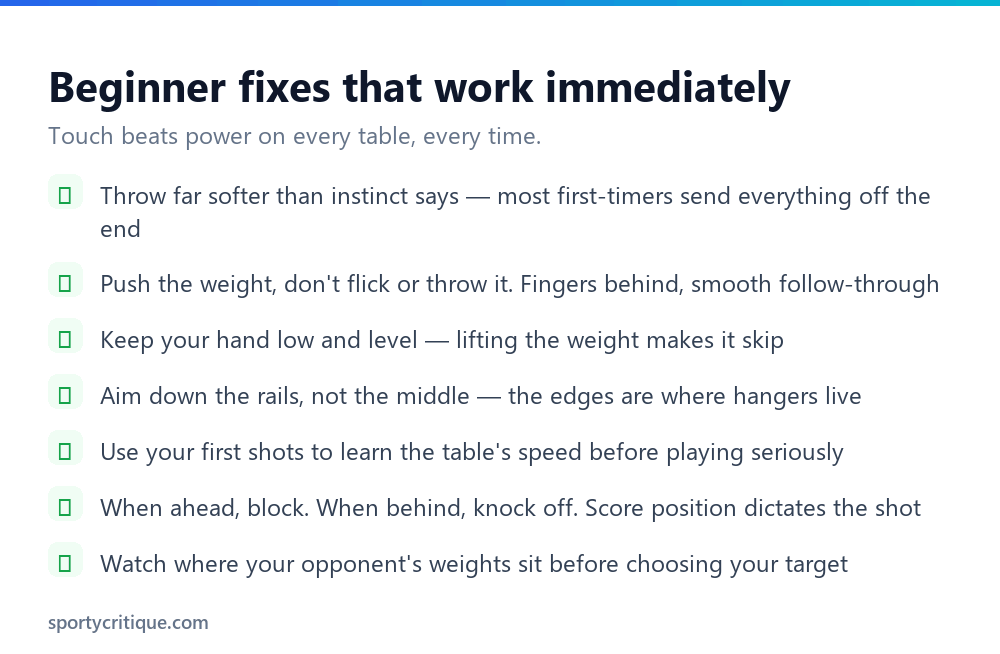
The delivery is a smooth push, not a throw or a flick. Place your fingers behind the weight, keep your hand low and level with the surface, and push forward with a steady follow-through toward your target. The wrist stays quiet — flicking introduces spin and inconsistency.
Keep the hand low. Lifting as you release makes the weight land rather than slide, and a weight that lands skips unpredictably. The release should feel like you’re setting the weight down onto a moving surface.
Aim down the rails. The edges of the table are where the highest-value shots live — a weight travelling along the rail is protected from being knocked sideways, and hangers happen at the corners. It’s also where the crown of the table works with you rather than against you.
And throw far softer than feels right. This is the single biggest beginner problem. A shuffleboard weight needs remarkably little force, and almost every first-timer sends their first four straight off the end. Start by aiming to barely reach the first scoring zone and build up from there.
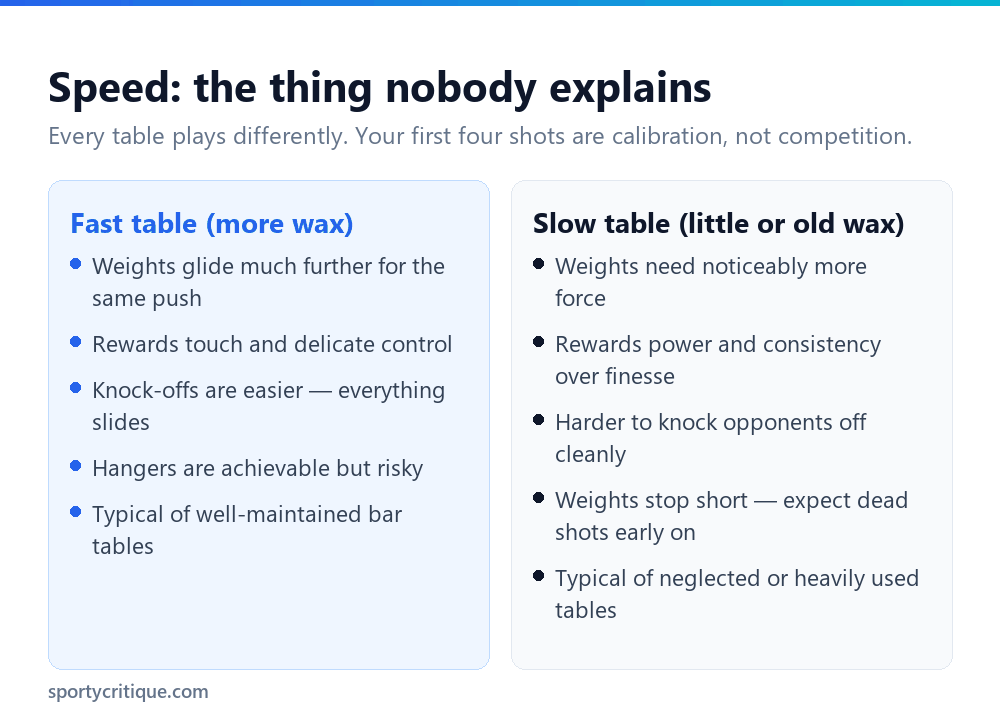
💡 Pro tip: Treat your first round on any unfamiliar table as calibration rather than competition. Four shots tells you whether it’s fast or slow, and that information is worth more than any technique adjustment. Regulars at a bar have an enormous advantage purely because they know their table’s speed.
Basic strategy
Once you know that only the leader scores, the tactics follow logically.
- Knock their lead weight off — it erases their whole round
- Take risks on deep placements and hangers
- A round where they score 0 is worth more than one where you score 2
- Park a weight just past the foul line to obstruct their lane
- Protect your deep weights rather than adding more
- Deny the round rather than winning it big
- Shooting last means you see the whole board first
- Knock off, slide past, or place — with full knowledge
- Plan the round around having it or not
- Place early weights that must be dealt with
- Build a position they have to spend shots removing
- Every shot they spend clearing is one not spent scoring
Our strategy guide goes further into shot selection, but the single most useful habit for a new player is to look at the board before every shot and ask one question: is the highest-value shot here placing my weight, or removing theirs? Beginners almost always default to placing, which leaves strong opponent weights sitting untouched.
Doubles, and the variant games
Doubles changes the geometry rather than the rules. Partners stand at opposite ends of the table, each shooting two weights per round toward their partner’s end. Scoring is unchanged — leader-only, counted from the far end — but the target rises to 21 and the team total is what accumulates.
The practical consequence is that you spend half of each round unable to do anything except watch from twenty feet away. Good pairs use that: the player at the receiving end can see the board far better than the shooter and calls what’s needed. Pairs who treat doubles as two people taking turns tend to lose to pairs who treat it as one continuous plan.
Beyond standard play, table shuffleboard has several established variants worth knowing, because bars play them often and they change the game meaningfully:
If you’re introducing someone to the game, start with Knock Off rather than standard rules. It gives a beginner something useful to do with a badly weighted shot — aim at your opponent — instead of watching weights sail off the end for twenty minutes. Tap and Draw is the opposite: the best game for actually improving, because every shot forces you to judge distance precisely.
Bar rules and how they vary
Table shuffleboard is a bar game first and a codified sport second, so house rules vary considerably. Worth agreeing before you start:
📊 Note: If you’re playing somewhere unfamiliar, ask the regulars rather than assuming. Shuffleboard house rules are held with real conviction, and the argument is always more awkward at 14–13 than it would have been before the first shot.
Frequently asked questions
Do both players shoot from the same end in table shuffleboard?
Yes — in singles you and your opponent stand at the same end, alternating shots down the table, then switch ends for the next round. In doubles, partners stand at opposite ends. This catches out anyone expecting to face their opponent across the table.
What is a hanger in shuffleboard?
A weight that comes to rest overhanging the far edge of the table without falling off. It’s worth 4 points, the maximum for a single weight, and it requires a weight to travel the full length and stop within a fraction of an inch of dropping. Some bar house rules ignore hangers entirely, so it’s worth confirming.
Can you knock your opponent’s weights off the table?
Yes, and it’s central to good play. Because only the player with the furthest weight scores, removing their lead weight can wipe out their entire round in one shot. Beginners often think it’s unsporting; experienced players consider it the point of the game.
Why do my weights keep flying off the end?
You’re pushing far too hard. A shuffleboard weight is heavy and the waxed surface is extremely low-friction, so it needs much less force than instinct suggests. Start by aiming to barely reach the first scoring zone, and treat your first four shots on any new table as calibration.
What is shuffleboard wax actually made of?
Not wax — tiny silicone or plastic beads, also called sand, powder, or cheese. They sit between the weight and the wood like microscopic ball bearings. Powders come in numbered speeds, which is why the same shot behaves completely differently from one table to another.
What’s the difference between bar and table shuffleboard?
Nothing — they’re the same game. ‘Bar shuffleboard’, ‘table shuffleboard’, and ‘indoor shuffleboard’ all describe the wooden-table version played with hand-slid weights. The genuinely different game is deck or outdoor shuffleboard, played on a court with cues and discs, which our main shuffleboard guide compares side by side.
- →Shuffleboard scoring in full — with a worked example
- →Strategy and how to win — knock-offs, blocks, and the hammer
- →Cleaning and waxing a table — the fix for a slow board
- →How to play shuffleboard — both versions compared
- →Best shuffleboard tables — sizes and what matters