Shuffleboard Glossary: Hammer, Hanger, Kitchen, and Other Terms

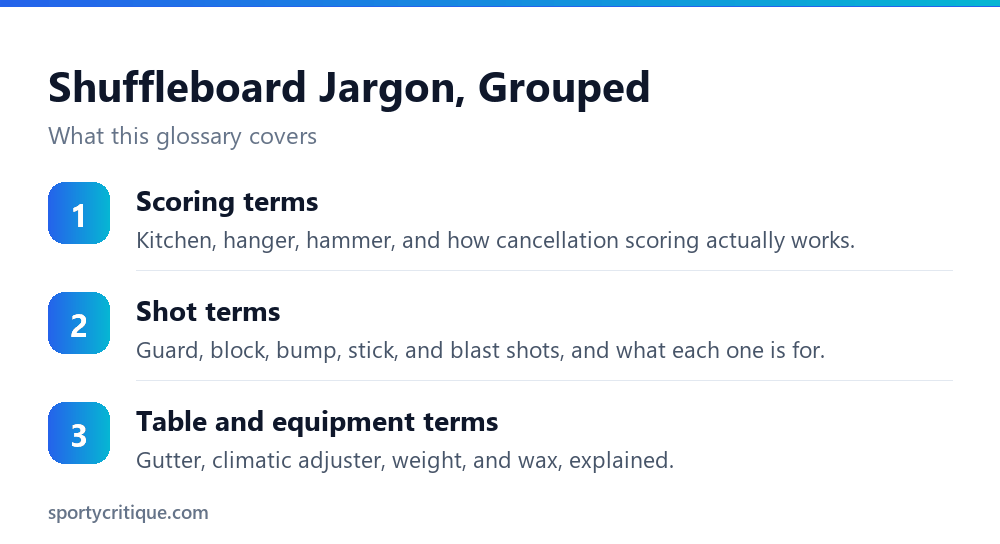
A hammer is the last shot of a frame, a hanger is a puck resting on the edge of the table without falling off, and the kitchen (also called 10-off) is the scoring zone closest to the players that subtracts 10 points if a puck lands there. Those three terms come up constantly in shuffleboard rules and commentary, and this glossary covers them along with every other common scoring, shot, and equipment term a new player is likely to run into.
Shuffleboard’s rulebook isn’t complicated, but its vocabulary is dense with terms that don’t explain themselves, and most rules articles assume a reader already knows them. This is the reference to check when a term shows up mid-explanation somewhere else and needs a quick, accurate definition instead of a guess from context.
- →Kitchen (or 10-off) is the closest scoring zone to the player and subtracts 10 points if a puck lands there
- →A hanger rests on the table’s back edge without falling off and scores the maximum 4 points
- →The hammer is the last shot of a frame, a real strategic advantage since it’s thrown with full information
- →Scoring uses cancellation: only the leading player’s pucks beyond the opponent’s nearest puck actually count
- →Climatic adjusters correct for the board’s seasonal warping from humidity and temperature, separate from wax choice
Table of Contents
Scoring Terms
Kitchen (10-Off)
The kitchen, also called 10-off, is the scoring zone closest to the player’s own standing area, positioned beyond the highest-value zones rather than before them. A puck that slides too far and lands in the kitchen doesn’t score zero; it subtracts 10 points from that player’s total, which makes overshooting a real penalty, not just a wasted turn.
Hanger
A hanger is a puck that comes to rest hanging over the table’s far edge without falling off entirely. It’s the highest-value standard scoring position, worth 4 points, and it’s also the riskiest shot to attempt deliberately, since a slightly harder push sends the puck off the table and out of play entirely for zero points.
Hammer
The hammer is the final shot of a frame or round. Whoever throws it does so with full knowledge of every puck already on the board, which is a genuine tactical advantage: the hammer can be used to knock an opponent’s leading puck out of scoring position, guard a leading puck of your own, or simply add points, all with complete information the earlier shots in the frame didn’t have.
Cancellation Scoring
Cancellation scoring is the rule that only one player scores per frame, not both. Whichever player has the puck closest to the far edge is “leading,” and only that player’s pucks that sit beyond the opponent’s nearest puck actually count. Every puck on either side that doesn’t meet that condition cancels out and scores nothing, regardless of which zone it landed in.
💡 Pro tip: Cancellation scoring is the single most common source of confusion for new players, since it means a puck sitting in a high-value zone can still score zero if the opponent has anything closer to the edge. Checking who’s actually “leading” before assuming any puck’s zone value counts avoids most scoring disputes.
Shot Terms
These shot names describe intent, not a fixed technique. The same basic push motion becomes a guard shot, a blast shot, or a stick shot purely based on target and force, which is part of why shuffleboard strategy discussions lean so heavily on this vocabulary. Naming the shot communicates the plan in a single word instead of a full sentence.
Newer players often default to guard shots and straightforward pushes into an open zone, since those require the least precision to execute reasonably well. Blast and stick shots reward more practiced control, since misjudging force on either one can knock a favorable puck out of position instead of the intended target, turning a planned offensive shot into an accidental gift to the opponent.
Frame and Leading Puck
A frame is one complete round of play, from the first shot to the last (the hammer), after which the score is tallied and a new frame begins. “Leading puck” refers to whichever player’s puck sits closest to the far edge at the end of the frame; that player is the only one who can score, per the cancellation rule above. Some sources use “leader” to describe the player rather than the puck, but the meaning is the same.
Foot Fault
A foot fault happens when a player’s foot crosses the foul line at the edge of the standing area during a shot, which typically voids that shot for scoring purposes. The rule exists to keep the shooting distance consistent between players, the same underlying purpose a foot fault rule serves in tennis or bowling.
Table Shuffleboard vs. Deck (Outdoor) Shuffleboard Terms
Most of the terms above describe table shuffleboard, the indoor game played on a long wooden table with pucks slid by hand. Deck shuffleboard, the outdoor cousin played with long-handled cues on a paved or poured court, uses some overlapping vocabulary but a genuinely different scoring layout, and mixing the two up is a common source of confusion for anyone reading shuffleboard content without specifying which version is meant.
Deck shuffleboard’s scoring area is called the triangle, marked out in numbered zones rather than the linear zone-plus-kitchen layout used on a table. The triangle’s point values and layout come from a different tradition entirely, tied to the game’s history on cruise ships and retirement communities, and terms like “hammer” and “cancellation scoring” don’t carry over the same way, since deck shuffleboard typically scores every properly placed disc rather than canceling out non-leading pucks.
The cue used to push the disc down a deck shuffleboard court also has its own vocabulary separate from anything covered above, since table shuffleboard is played entirely by hand with no implement at all. A player new to one version of the game shouldn’t assume fluency in its terms transfers cleanly to the other, even though both share the shuffleboard name and a broadly similar goal of sliding an object into a scoring zone.
⚠️ Watch out: If a source doesn’t specify table or deck shuffleboard, check which scoring layout it’s describing before assuming a term like “kitchen” or “hammer” applies. The two games share a name and a general concept but diverge enough in actual rules that assuming they’re interchangeable leads to real misunderstandings about how a specific shot or zone works.
Table and Equipment Terms
Gutter
The gutter is the recessed channel running along both sides of the playing surface, typically around 5.5 inches wide, that catches pucks knocked off the main board so they don’t fall onto the floor. A puck in the gutter is out of play for that turn, similar to a blast-shot puck knocked entirely off the table.
Climatic Adjuster
Climatic adjusters are metal mechanisms built into the underside of a shuffleboard table that let an owner correct for the board’s seasonal warping, crowning upward or cupping downward as the wood responds to humidity and temperature. This is a separate fix from wax or powder choice; adjusters correct the shape of the board itself, not the surface’s speed.
Weight (Puck)
Weight is the traditional term for the metal-and-plastic discs players slide down the table, also commonly called pucks. The two terms are used interchangeably in most modern shuffleboard writing, though “weight” is the older, more traditional term and shows up more often in official rulebooks.
📊 Note: A worn or mismatched weight set changes how consistently pucks slide compared to a fresh, matched set. A full replacement set, something like a Shuffleboard Weights Puck Set of 8 ($49.99), is worth considering if an existing set has developed chips, uneven wear, or mismatched weights between pucks that should otherwise be identical.
Wax / Powder
Wax, sometimes called powder or speed sand, is the substance sprinkled across the playing surface to control how fast pucks slide. It’s a separate variable from climatic adjusters: wax affects surface speed and glide, while adjusters affect the physical shape of the board underneath it.
Quick Reference
- ✓Remember: kitchen/10-off subtracts points, it doesn’t score zero
- ✓Check who’s leading before assuming a puck’s zone value counts
- ✓Use shot terms (guard, block, blast) to communicate strategy quickly
- ✓Distinguish climatic adjusters (board shape) from wax (surface speed)
- ✕Assuming every puck on the board scores based on its zone alone
- ✕Confusing a hanger (edge, in play, 4 points) with a puck knocked into the gutter (out of play)
- ✕Treating “weight” and “puck” as two different pieces of equipment
- ✕Assuming wax fixes a warped board; that’s what climatic adjusters are for
Regional and club-level slang beyond these standard terms exists too, and varies enough from one venue to the next that it’s not practical to catalog exhaustively here.
Frequently Asked Questions
What does 10-off mean in shuffleboard?
It’s another name for the kitchen, the scoring zone closest to the player’s standing area. A puck landing there subtracts 10 points from that player’s score for the frame instead of scoring zero.
Is a hanger always worth more than a puck in the highest numbered zone?
Yes, a hanger is the maximum standard score at 4 points, higher than any numbered zone on the board. That’s exactly why it’s such a high-risk, high-reward shot to attempt on purpose.
Why does the hammer matter so much strategically?
Because it’s thrown last, with complete knowledge of every other puck’s position. A player throwing the hammer can knock out a leading opponent puck, guard their own leading puck, or add a scoring puck, all with information no earlier shot in the frame had access to.
What’s the difference between a guard shot and a block shot?
A guard shot protects a specific scoring puck behind it from being knocked out, while a block shot more generally obstructs the opponent’s path to a zone without necessarily protecting a specific puck. The distinction is about purpose more than technique.
Do table shuffleboard and deck shuffleboard use the same scoring terms?
No, only partially. Both games share the general concept of sliding a puck or disc toward a scoring area, but table shuffleboard’s kitchen-and-cancellation system and deck shuffleboard’s triangle layout are genuinely different scoring structures, so terms like “kitchen” and “hammer” are specific to the table version.
What’s a foot fault in shuffleboard?
It’s when a player’s foot crosses the foul line at the edge of the standing area during a shot, which typically voids that shot. It keeps the shooting distance fair and consistent between both players over the course of a match.
Bookmarking a glossary like this one is more practical than trying to memorize every term up front. Most players pick the vocabulary up naturally within a session or two of actual play, checking back here whenever an unfamiliar word comes up in a rules explanation, a commentary clip, or a conversation at the table.
As an Amazon Associate, we earn from qualifying purchases through links on this page.