Best Shuffleboard Wax and Powder, Ranked by Speed Rating


Finding the best shuffleboard wax for your table means matching a speed grade to your table’s length, not just grabbing whatever ranks first in a search. Two competing numbering systems exist and most buying guides don’t explain either one clearly. Here are four real products currently in stock, ranked slowest to fastest, with the table-length guidance to pick the right one the first time.
The fastest widely available shuffleboard wax is Sun-Glo’s #1 Super Glide, built for 16 to 22-foot tables and experienced players. For a typical home table under 14 feet, a slower grade like Sun-Glo Speed #5 gives you more control and fewer pucks skidding off the end. Speed numbering varies by brand: Sun-Glo runs 1 (fastest) through 7 (slowest), while the separate Ultra-Glide line runs T0 (slowest) through T5 (fastest). They are not interchangeable scales.
If you’ve shopped for shuffleboard wax for more than five minutes, you’ve probably run into two different numbering systems that don’t line up. This guide ranks four wax and powder products that are actually in stock on Amazon right now, tells you what each one is for, and untangles the naming confusion so you buy the right speed the first time.
One thing up front: nearly everything currently sold on Amazon under the shuffleboard-wax umbrella is Sun-Glo. The Ultra-Glide T0-T5/R1-R4 system used at most sanctioned tournaments (covered in detail in our companion explainer) is sold mainly through specialty shuffleboard retailers, not general marketplaces. That’s not a knock on either brand, it just means the practical buying decision for most home players comes down to picking the right Sun-Glo grade.
- →Sun-Glo numbers run backward from what most people expect: #1 is the fastest, #7 is the slowest
- →Ultra-Glide’s separate T0-T5/R1-R4 system runs the opposite direction, higher number means faster
- →Table length matters more than skill level when picking a grade; short tables need slower wax
- →Speed #5 and Speed 1.5 are the two most commonly recommended starting grades for home tables under 14 feet
- →A 2-pack or 3-pack of powder costs less per ounce and is worth it if you play more than once a week
Table of Contents
Why two different numbering systems exist
Sun-Glo, the brand you’ll actually find in stock on Amazon, numbers its wax 1 through 7, with 1 being the fastest and slickest and 7 being the slowest and most grippy. That’s the opposite direction from the Ultra-Glide system used in most tournament settings, which runs T0 (slowest) up to T5 (fastest), plus a separate R1-R4 nut-free line. There is no official conversion chart between the two; they’re made by different manufacturers with different silicone-to-filler ratios, so a Sun-Glo #3 isn’t precisely equivalent to any specific Ultra-Glide T-number, only roughly comparable in the medium-fast range.
⚠️ Watch out: Don’t assume a listing calling itself “tournament speed” or “pro grade” maps to a specific T-number from the Ultra-Glide chart. Read the actual named speed grade (Sun-Glo’s #1 through #7) and match it to your table length instead of trusting marketing language alone.
The four ranked, in stock right now
These are ordered slowest to fastest by Sun-Glo’s own numbering, since that’s what you’ll actually be choosing between if you’re buying today.
Sun-Glo Speed #5 (Five Star) Shuffleboard Powder Wax, 2-pack: $17.90
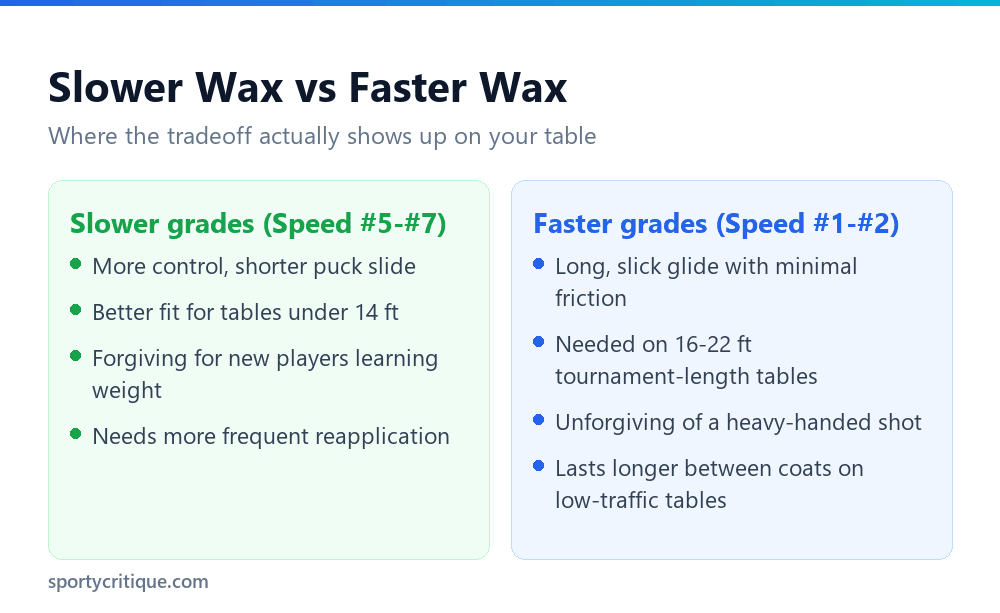
The Sun-Glo Speed #5 (Five Star) Shuffleboard Powder Wax, 2-pack is the slowest of the four and the one we’d point most new home-table owners toward first. It comes as a two-can pack, which matters because a slower grade is also the one you’ll reapply most often if your table sees regular use. On a table shorter than 14 feet, a faster grade turns nearly every shot into a puck sailing off the far end, and Speed #5 is specifically formulated to avoid that.
Sun-Glo Speed #3 (Brown Bear) Shuffleboard Powder Wax, 3-pack: $35.99
The Sun-Glo Speed #3 (Brown Bear) Shuffleboard Powder Wax, 3-pack sits in the middle of the range and is the one most club and bar tables actually run day to day. It’s sold as a 3-pack, which brings the per-ounce price down if you’re maintaining a table that gets played on several times a week. Speed #3 gives noticeably more glide than #5 without the control problems that show up once you get close to Speed #1.
Sun-Glo Speed 1.5 (Pro Series) Shuffleboard Powder Wax: $15.99
The Sun-Glo Speed 1.5 (Pro Series) Shuffleboard Powder Wax is a step up in speed from the standard grades, aimed at players who’ve outgrown Speed #3 or #5 and are playing on a table with enough length to use it. It’s a single can rather than a multi-pack, which makes sense as a way to test whether you actually want to commit to a faster surface before buying in bulk.
Sun-Glo #1 Super Glide Shuffleboard Powder Wax, 2-pack: $21.99
The Sun-Glo #1 Super Glide Shuffleboard Powder Wax, 2-pack is the fastest of the four, and it’s genuinely fast: on anything shorter than 16 feet, expect pucks to fly off the end regularly until you adjust your weight down substantially. This is the grade for full-length 20 to 22-foot tables and players who already know they want minimum friction. It comes as a two-can pack, which is reasonable since a table fast enough to need this grade is usually seeing serious, regular use.
Storage and shelf life
Powder wax doesn’t spoil in the way food does, but it does clump if it picks up moisture, and a can left open in a humid garage or basement will perform noticeably worse than one stored properly. Keep the lid sealed between uses and store the can somewhere dry and at roughly room temperature. If you open a can and the powder has formed hard clumps instead of pouring freely, break it up by hand before applying; clumped wax spreads unevenly and leaves patches of the table faster or slower than the rest.
An unopened can has a long practical shelf life, easily several years, which is part of why buying a multi-pack ahead of a busy season is a reasonable move rather than a wasted purchase. The main enemy isn’t time, it’s exposure to moisture once the can is opened.
Reading reviews for red flags before you buy
Star ratings alone don’t tell you much on shuffleboard wax listings, since a can that arrived with a damaged seal will tank a rating even if the product itself performs fine. Scan the written reviews for two specific complaints: powder that arrived clumped or hardened, which usually points to a warehouse storage issue rather than a defect in the product itself, and mismatched speed, where a buyer says a “fast” can played noticeably slower or faster than expected for its stated grade. A handful of those complaints on an otherwise well-rated listing is normal; a pattern of them across dozens of reviews is worth taking seriously before you buy that specific listing.
Matching grade to table length
Table length is the single biggest factor in picking a grade, more than skill level. A 9 to 12-foot table, common in home game rooms, plays a mid-tournament grade unplayably fast because there simply isn’t enough runway for the puck to slow down naturally. A 20 to 22-foot table does the opposite: a slow grade forces you to shove the puck hard to reach the scoring zones, which throws off touch and accuracy.
💡 Pro tip: When in doubt, buy one grade slower than the chart suggests. It’s easy to add a light second coat to speed a table up mid-session; it’s much harder to fix an overly fast table without stopping to clean and rewax.
Powder wax vs. silicone spray
All four products above are powder wax, the standard choice and the one that gives you the most control over final speed since you can apply it in thin or thick coats. Silicone spray exists as an alternative, mainly marketed for quick touch-ups between powder applications rather than as a full replacement. Spray tends to wear off faster under heavy play and gives you less room to fine-tune speed than powder does, so most tables, home or club, are better served sticking with powder as the primary surface treatment.
How much wax you actually need
A single 16-ounce can typically covers a standard 12 to 14-foot table for multiple applications, so even the single-can options above aren’t a one-time-use purchase. How often you need to reapply depends on how much the table gets played: a table used daily in a bar or game room may need a fresh coat every one to two weeks, while a home table played a few times a month can go a month or more between applications before the surface noticeably slows down.
Signs it’s time to rewax: pucks that used to slide smoothly start stopping short of where they used to, the surface looks dull or shows visible wear patterns down the center lanes, or you notice friction spots where players tend to release the puck most often.
- ✓Match the grade to your actual table length, not the fastest option available
- ✓Buy a multi-pack if the table sees regular weekly use
- ✓Apply a thin, even coat and add a second light coat if it’s still too slow
- ✓Keep a spare can on hand since reapplication is routine maintenance, not a one-time fix
- ✕Assume a listing’s marketing language tells you the real speed grade
- ✕Jump straight to the fastest grade before you’ve tested a middle one
- ✕Confuse Sun-Glo’s numbering with the Ultra-Glide T/R system when comparing charts
- ✕Overload the surface with wax expecting it to compound the speed effect; it doesn’t work that way
Common mistakes when buying wax for the first time
The most common mistake is buying based on a brand’s fastest-sounding product name without checking the actual grade number against table length. “Super Glide” and similar names sound appealing, but on a compact home table they create a surface that’s genuinely frustrating to play on, not a premium experience. The second common mistake is buying a single can for a table that gets played on multiple times a week and running out mid-season, which is why the multi-packs above are worth considering even at a higher upfront price.
A less obvious mistake: applying wax over an unclean surface. Dust, spilled drinks, and leftover old wax residue all interfere with how evenly a fresh coat spreads, which can make an otherwise correctly chosen grade play inconsistently from one end of the table to the other.
What’s the fastest shuffleboard wax you can buy on Amazon?
Among currently stocked options, Sun-Glo #1 Super Glide Shuffleboard Powder Wax, 2-pack is the fastest, rated Speed #1 on Sun-Glo’s scale. It’s meant for full 16 to 22-foot tables and experienced players; on a shorter home table it will send pucks off the end regularly.
Is Sun-Glo the same numbering system as Ultra-Glide T0-T5?
No. They’re separate systems from separate manufacturers. Sun-Glo runs 1 (fastest) through 7 (slowest); Ultra-Glide runs T0 (slowest) through T5 (fastest), plus a nut-free R1-R4 line. There’s no official conversion between the two scales.
How often should I rewax a shuffleboard table?
It depends on use. A table played daily in a bar setting often needs a fresh coat every one to two weeks. A home table played a few times a month can typically go four to six weeks before the surface noticeably slows down.
What grade should I buy for a 12-foot home table?
Start with Speed #5 or Speed #3 on the Sun-Glo scale. Those are the two most commonly recommended starting points for residential tables in the 12 to 16-foot range; you can move faster later once you know how the table plays.
Does powder wax or silicone spray work better?
Powder is the standard for full applications and gives more control over the final speed. Spray is mostly used for quick touch-ups between powder coats rather than as a primary treatment, since it wears off faster under regular play.
As an Amazon Associate, we earn from qualifying purchases through links on this page.