How to Defend in Foosball: Race Defence and Reading Shots

Good foosball defence covers space, not the ball. Use race defence — move your goalie and 2-bar together as a locked unit so there’s no gap between them — keep the figures upright and leaning slightly forward, and move laterally rather than rotating. Watch the position of the attacker’s trapped ball, not their hands: it tells you the angle before the shot starts. And clear with purpose, because a block that dribbles back to their attack isn’t a save.
Defence is half of foosball and roughly two percent of the practice anyone does. Everyone drills shots. Almost nobody drills holding a line, which is why a disciplined defender beats a flashy attacker far more often than the flashy attacker expects.
It’s also the fastest way to stop losing to people who spin. A spun shot is fast and random — and random loses badly to a defence that simply occupies the right space and doesn’t panic.
If you’re new to the game’s structure, read how to play foosball first; this guide assumes you know what the 2-bar and 5-bar are.
- →Race defence — goalie and 2-bar moving as one unit — is the system to learn first.
- →Cover space, not the ball. Chasing the ball is what opens the goal.
- →Move laterally. Rotating a defensive rod opens a gap underneath the figure.
- →Read the attacker’s trapped ball position, not their hands.
- →You cannot react to a foosball shot — it’s too fast. You anticipate or you don’t stop it.
- →A clearance that returns the ball to their attack is not a successful block.
Table of Contents
The core idea: cover space, not the ball
The instinct when someone sets up a shot is to move your defenders to where the ball currently is. It’s the wrong instinct, and it’s the reason most casual defence fails.
The ball isn’t going to stay there. A competent attacker moves it laterally precisely to drag you out of position, then shoots into the space you just left. If you follow the ball, you’re always one movement behind and you’re being steered.
Instead, defend the goal. Your job is to keep your figures between the ball and the net, covering the largest possible share of the goal mouth at all times. Sometimes that means barely moving while the attacker shuffles the ball around trying to provoke you. Patience is a defensive skill — arguably the defensive skill.
An attacker moves the ball sideways to make you move. If you move because they moved, you’re not defending — you’re being aimed.
Race defence: the system to learn
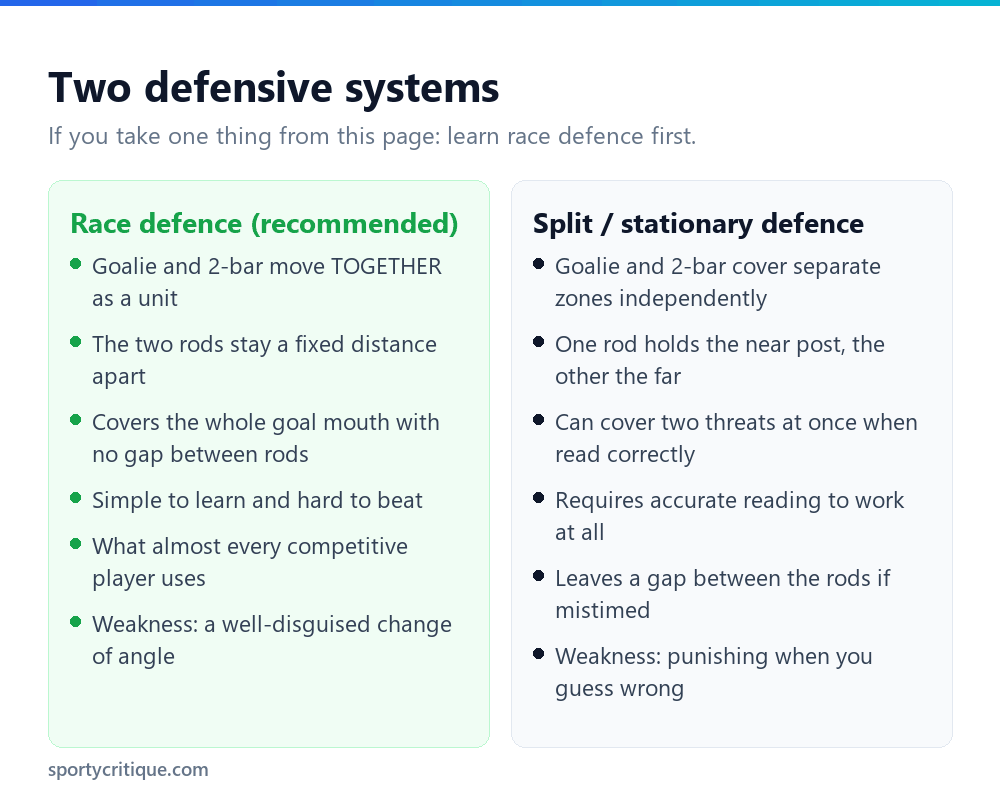
Race defence is the standard for good reason. You hold your goalie and 2-bar rods so they move together, maintaining a fixed relationship — typically with the 2-bar figures offset so that between the two rods, every lane to the goal is covered by someone.
When the attacker moves the ball, you slide both rods laterally together, as one unit. The goal mouth stays covered throughout because the rods never separate and never create a gap. It’s called race defence because the two rods race side to side in tandem.
The alternative — a split defence, where each rod guards its own zone independently — can theoretically cover more threats. In practice it requires reading the shot correctly, and when you read wrong you leave a clean gap between the two rods that a decent attacker will find every time. Learn race defence first; it’s forgiving, and it’s what most competitive players use anyway.
💡 Pro tip: Set your race defence spacing once and keep it. A common setup covers the two most-shot lanes with the 2-bar while the goalie covers the middle. Whatever you choose, consistency lets you move without thinking — and defence happens too fast for thinking.
Stance, grip, and the rotation mistake
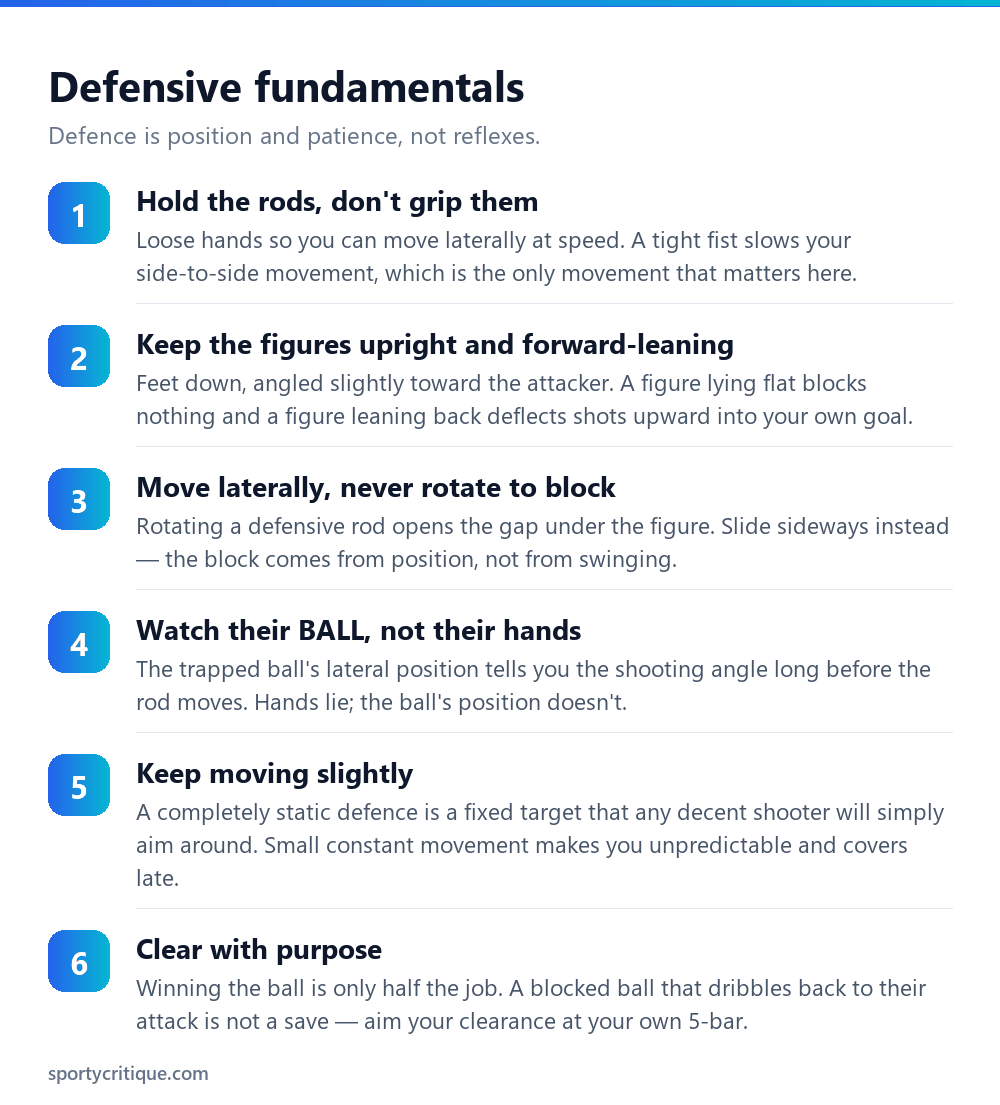
The most common technical error in foosball defence is rotating the rod to block. It feels natural — a ball is coming, so you swing the figures at it. But rotating lifts the figure’s foot off the playfield, and the gap that opens underneath is exactly the height of a foosball. Shots that would have hit a stationary figure roll straight under a rotating one.
Keep your defensive figures upright, feet down, leaning very slightly forward toward the attacker. A slight forward lean deflects blocked balls down and away rather than popping them up; figures leaning backward tend to loft blocked shots upward, and a surprising number of casual goals are scored off a defender’s own backward-leaning figure.
Grip loosely with both hands on your two defensive rods, and move them by sliding, not swinging. Your entire defensive movement vocabulary is lateral. The rotation you do need — for clearing the ball once you’ve won it — happens after the block, as a separate deliberate action.
⚠️ Watch out: Don’t hold your defence completely still either. A static defence is a fixed obstacle, and a good attacker will simply pick a gap and hit it. Constant small lateral movement makes you a moving target and means you’re already travelling when the shot comes — which covers ground you’d never cover from a standstill.
Reading shots: you can’t react, so anticipate

A foosball shot crosses the table faster than human reaction time. This is worth stating plainly because it changes what defence is: you are not going to see a shot and respond to it. Every successful block is either a shot that hit where you already were, or a shot you moved to intercept before it was struck.
So the skill is prediction, and prediction comes from watching the right thing. Beginners watch the attacker’s hands, which reveal little and can be deliberately faked. Watch the ball instead — specifically its lateral position on their rod. A ball being walked to the attacker’s left is setting up a pull shot; walked right, a push. The ball can’t lie about where it is, and it has to be somewhere before it can be shot.
Then there’s the pattern layer. Most players, especially under pressure, have one favourite shot they revert to. Watch two or three games and you’ll often find your opponent shoots the same way at every important moment. Cover that lane, accept that you’ll concede the others occasionally, and you’ll win most of the exchanges that matter. Our improvement guide covers building the two-shots-from-one-setup skill that defeats exactly this kind of reading.
Defending specific shots
Notice how many of the tells involve the ball’s position rather than the player’s body. That’s the whole lesson compressed: the setup is the information.
Defending the 5-bar: stopping the attack early
Everything above concerns the goal, but the best defence in foosball happens much earlier — at the midfield, before the attacker ever gets the ball. If your opponent can’t complete a pass from their 5-bar to their 3-bar, they never get a shot, and your goal defence never gets tested.
This is the part casual players don’t realise is defence at all. When the ball is on your opponent’s midfield, you’re not waiting — you’re actively working. Your own 5-bar sits between their midfield and their attack, and its job in that moment is to occupy the passing lanes. Move it laterally to shadow their trapped ball, keeping your figures where the gap is.
The tactical detail worth knowing: a passer needs a lane between two of your figures, and those lanes only exist in specific relative positions. If you keep your 5-bar figures moving in opposition to their ball — sliding right as they walk the ball left — you’re closing lanes faster than they can find them. Most turnovers at competitive level come from exactly this, not from spectacular saves.
Win the ball at the 5-bar and you’ve converted defence into your own attack in a single touch, with their defence still unset. It’s the highest-value defensive action in the game and it doesn’t look like defending at all, which is precisely why almost nobody practises it.
Clearing: the job isn’t done when you block
A block that leaves the ball bouncing around your defensive third is a delay, not a save. The attacker gets it back with your defence now scattered, which is often worse than conceding the original shot.
So treat the clearance as a real skill with a real target. Ideally you’re not just hoofing the ball away — you’re passing it to your own 5-bar, where you can trap it and start an attack. That turns defence into possession, and possession is how you actually win rather than merely survive.
The habit worth building: after every block, immediately look for your own midfield rather than watching where the ball went. Players who defend well but clear badly spend entire games under pressure, and they usually conclude they’re being outplayed when really they’re just never taking the ball off their opponent.
📊 Note: In doubles, this is the defender’s most valuable contribution and the most commonly botched. Your partner on the 5-bar is waiting for a clearance they can control. A wild clear that flies past them hands possession straight back — and they can’t fix it, because they can’t take your rods.
Frequently asked questions
What’s the best defence in foosball?
Race defence — moving your goalie and 2-bar together as a locked unit so no gap opens between them. It’s simple, forgiving, and it’s what most competitive players use. Split or zone defences can cover more in theory but punish you severely when you read the shot wrong.
Should I rotate my defenders to block?
No. Rotating lifts the figure’s foot off the surface and opens a ball-sized gap underneath, which is how shots that should have been blocked end up in the net. Keep the figures upright and leaning slightly forward, and move sideways instead. Rotation is for clearing once you already have the ball.
How do I stop someone who just spins the rods?
Hold a disciplined line and stop chasing. Spun shots are fast but essentially random, so they beat a defender who’s moving unpredictably and lose to one who’s occupying the right space. Set your race defence, keep small lateral movement, and let a decent share of their shots hit your figures. Spinning is also illegal in standard rules — worth agreeing before you start.
Where should I look when defending?
At the ball’s position on the attacker’s rod, not at their hands or their face. The ball’s lateral placement tells you the shooting angle before the shot begins, and it can’t be faked the way hand movement can. Once you’re comfortable with that, add the pattern layer — what does this specific opponent do under pressure?
Can the goalie score in foosball?
Yes, and good players use it. The goalie has a clear lane down the table and opposing defences are often unset after a save. It’s legal in standard rules, and it’s a genuine weapon rather than a novelty — on American three-figure goalie tables especially.
How much should I practise defence?
More than you do, which for most players is zero. A useful drill needs no opponent: set a ball rolling toward your goal from different angles and practise sliding your race defence to intercept, without rotating. Ten minutes of that beats an hour of shooting practice if your problem is conceding rather than scoring.
- →How to play foosball — rules, rods, and fundamentals
- →How to get better at foosball — solo drills and a practice routine
- →Playing professionally — how competitive foosball works