How to Get Better at Foosball: Drills That Actually Work

The fastest way to improve at foosball is to practise alone. Twenty focused minutes of trapping and passing drills beats hours of casual matches, because matches let you avoid your weaknesses while drills force you into them. Work the skills in order: trap the ball dead, move it laterally, build one reliable shot, then learn to pass from 5-bar to 3-bar. And stop spinning — it’s illegal, and it’s the habit that caps your ceiling.
Most people who want to get better at foosball try to get better by playing more foosball. It barely works, and the reason is worth understanding: in a match, you play to your strengths. If your trap is weak you’ll avoid trapping. If your passing is poor you’ll shoot from wherever the ball happens to land. Matches let you hide, and hidden weaknesses don’t improve.
Drills do the opposite — they put you in the exact situation you’re bad at, repeatedly, with no way around it. That’s uncomfortable, which is why almost nobody does it, which is why doing it works so well.
This guide assumes you know the basics. If you’re not sure what the 5-bar is or why spinning is banned, start with how to play foosball first.
- →Solo practice beats match play for improvement — matches let you avoid your weaknesses.
- →Trapping is the foundation. Everything else is guesswork without it.
- →One shot you can hit 8 times out of 10 beats four shots you hit half the time.
- →The 5-bar pass is where casual players plateau and never realise it.
- →Loose grip, wrist snap. A tight fist and an arm swing cap your speed and accuracy.
- →Getting worse temporarily is part of fixing a real habit — expect it and push through.
Table of Contents
The skill ladder
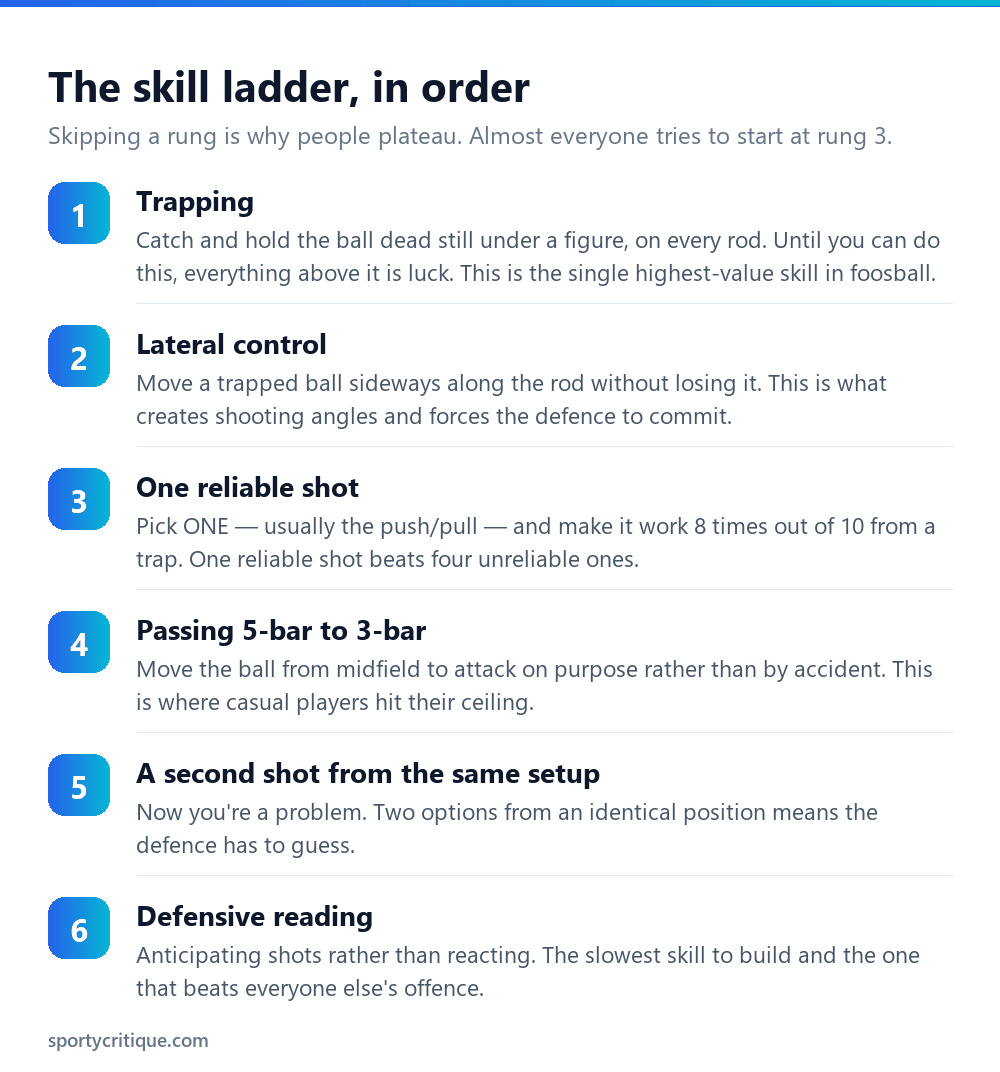
The order matters more than the content. Almost everyone tries to start at rung three — they want a shot, ideally an impressive one — and then wonder why it only works when the ball happens to arrive perfectly. It works when the ball arrives perfectly because they skipped the two rungs that let you make the ball arrive perfectly.
If you’re not sure where you are on the ladder, there’s a simple test. Have someone roll the ball to your 3-bar at moderate pace. Can you stop it dead, hold it, move it six inches sideways, and then shoot at a chosen corner? If any part of that breaks down, that’s your rung. Work there.
Matches let you avoid your weaknesses. Drills don’t. That’s the whole reason drills work and playing more doesn’t.
Solo drills that actually build skill
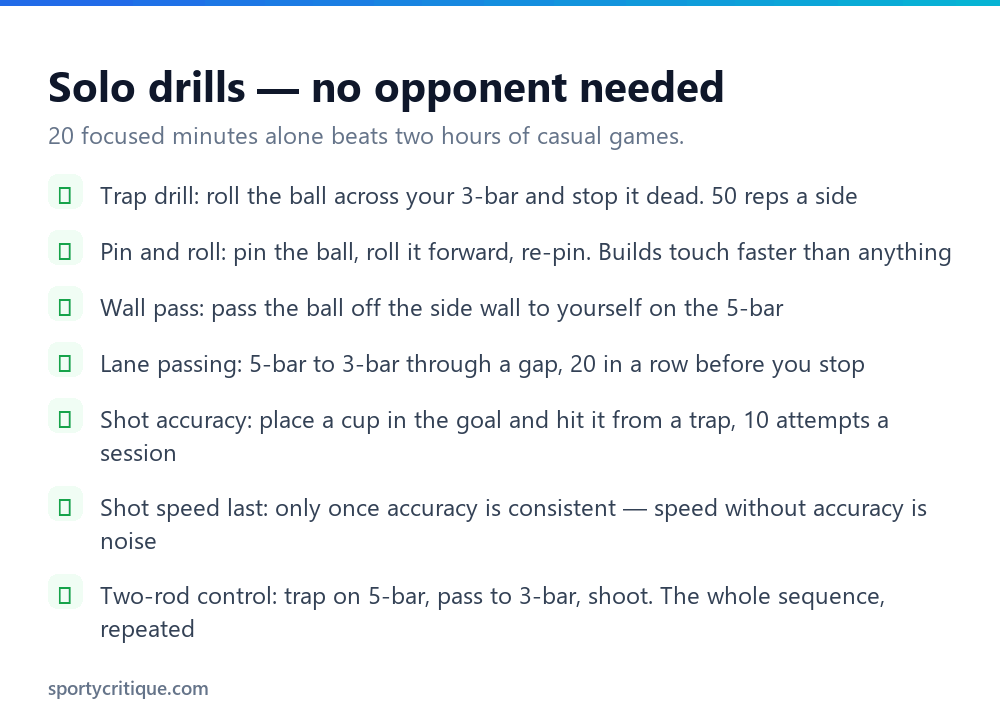
The beauty of foosball is that the table doesn’t need an opponent. You can do every foundational drill alone, and the feedback is immediate — either the ball stopped where you wanted or it didn’t.
Start with the trap. Roll the ball across your 3-bar figures and stop it dead under a foot. Not slowed down — stopped, motionless. Do fifty of these from each side. It’s tedious and it’s the single most valuable twenty minutes you can spend on a foosball table, because every other skill in the game assumes you can do it.
Then add movement. Once trapped, roll the ball laterally along the rod and re-trap it. This is what creates angles: a stationary ball in front of a stationary defence has nowhere to go, but a ball sliding sideways forces the defender to move and opens a lane. Lateral control is the difference between having a shot and having an option.
Then the pass. Trap on the 5-bar, find a gap between the opponent’s figures, and push the ball through to your 3-bar. Twenty in a row before you allow yourself to stop. This drill is where most people discover their real skill level, and it’s the one that transfers most directly to winning games.
💡 Pro tip: Set a timer for twenty minutes and pick two drills. Longer sessions produce sloppy repetitions, and sloppy repetitions groove sloppy technique — you’re actively training yourself to be worse. Short and sharp, several times a week, beats a monthly marathon.
The habits holding you back
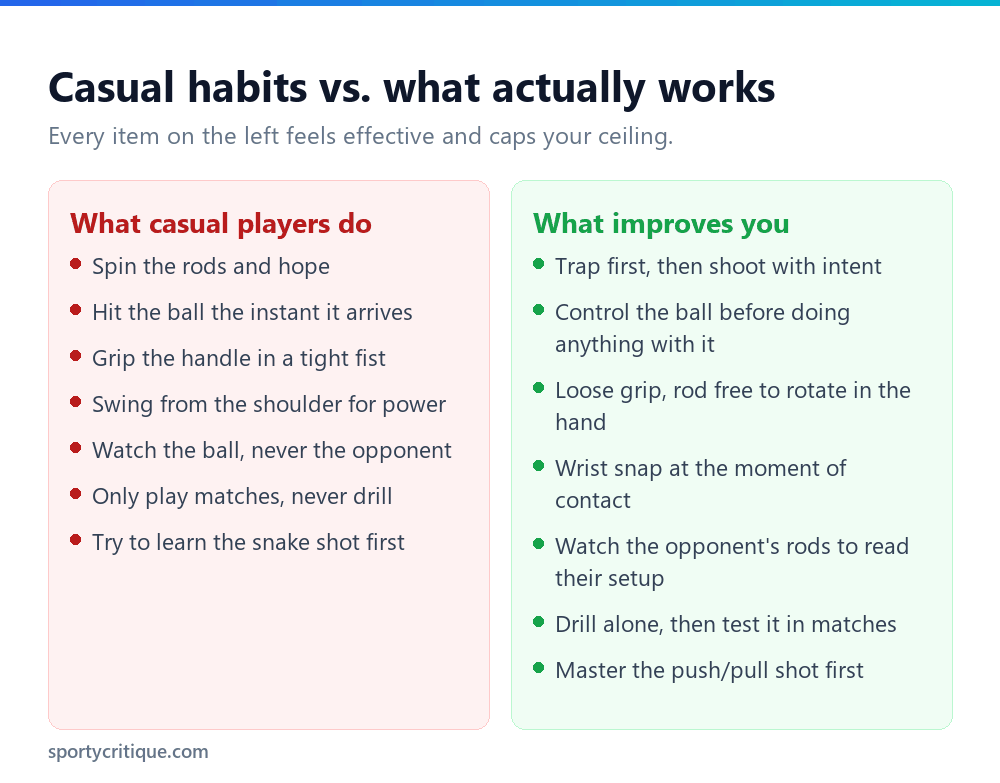
Every habit in that left-hand column has something in common: it works well enough at casual level to feel effective, which is exactly why it survives. Spinning scores goals against people who also spin. A tight grip feels controlled. Hitting the ball immediately feels fast.
They’re all ceilings, though. Spinning scores nothing against a defender who holds a line, because a spun ball goes in an unpredictable direction that’s as likely to miss as hit. A tight grip physically limits how fast you can rotate the rod. Hitting immediately means you never choose your target — you just redirect whatever arrived.
The hardest part of dropping them is that you will get worse first. A player who stops spinning loses to opponents they used to beat, for a couple of weeks. A player switching to a loose grip drops shots they used to make. This dip is where nearly everyone reverts, concludes the old way was better, and stays at the same level for a decade. Push through it — it’s short, and the other side of it is a genuinely different game.
A practice routine that fits real life
Three of these a week beats one long session, and the whole thing takes twenty minutes. If you’ve only got ten, do the trapping and the passing — those two carry the most weight.
📊 Note: Practising on a filthy table teaches you the wrong touch. If the ball skids, sticks, or the rods drag, you’re calibrating to a fault rather than to the game. A clean playfield and lubricated rods matter more for practice than for casual play, because you’re building fine motor habits against whatever the surface does.
Benchmarks: how to know you’re improving
“Get better” is unmeasurable, and unmeasurable goals quietly get abandoned. Counting gives you something to beat, and it turns a vague session into a test with a result.
Write the numbers down. The gap between a beginner and a club player looks unbridgeable in a match and looks completely bridgeable in this table — it’s thirty traps instead of five, and thirty traps is one session’s work repeated for a few weeks. Most people never find that out because they never count.
If you don’t own a table
This is most people, and it’s the reason most foosball advice goes unused. If your only access is a bar, an office break room, or a friend’s basement, the drills above still work — you just have to be deliberate about carving out the time.
The practical version: arrive ten minutes before anyone else and drill rather than knocking the ball around. In an office, the table is usually free mid-morning while everyone else is working. Ten minutes of trapping at 10am, three times a week, is a genuine training program — and it’s more focused practice than most casual players get in a year.
One warning: a shared table is often a badly maintained one, and technique built on a sticky, warped surface transfers poorly. If you can, spend twenty minutes cleaning it once. You’ll be the only person who ever has, and everyone including you will play better on it.
Reading your opponent
Once your hands work, the next gain is in your eyes. Most casual players watch the ball exclusively, which means they only react once a shot is already moving — and a foosball shot travels too fast to react to. Good defenders aren’t faster; they’re earlier.
What to watch instead: your opponent’s rods, particularly the lateral position of their attack figures and where their trapped ball sits. A player setting up a pull shot moves the ball to one side; a player setting up a push moves it to the other. Watch a regular opponent for a few games and you’ll notice they telegraph almost everything — a small wrist adjustment, a repeated setup position, a habit of always shooting the same way under pressure.
The corollary is that you telegraph too. Once you have two shots from the same setup, your job is to make the setup look identical for both. That’s the point at which technique becomes strategy, and it’s covered further in our defending guide.
Frequently asked questions
How long does it take to get good at foosball?
A few focused weeks will take you past almost every casual player, mostly because casual players never drill. Reaching genuinely competitive club standard takes a year or more of regular practice against better opponents. The gap between ‘beats everyone at the office’ and ‘competitive’ is much larger than it looks from the office side.
Can I practise foosball alone?
Yes, and it’s the most efficient way to improve. Trapping, lateral control, passing, and shot accuracy are all solo drills, and they’re precisely the skills that decide matches. The only things you genuinely need an opponent for are reading and reacting to a live defence.
Should I learn the snake shot?
Not early. The snake (or rollover) is powerful and deceptive, but it takes weeks to become reliable and it’s useless without a solid trap underneath it. Get the push/pull shot working from a trap first. Learning the snake before you can trap is the most common way people waste months.
Why do I keep losing to someone who just spins?
Because spinning generates unpredictable speed, and against an unset defence unpredictability scores. The answer isn’t to spin back — it’s to hold your defensive rods in a disciplined line so the random shots hit figures. A spinner beats a flailer but loses badly to a defender who simply doesn’t move much. Our defending guide covers it.
Does an expensive table make you better?
It makes practice more meaningful, because a solid table gives consistent feedback — the ball does the same thing every time, so you can actually learn a touch. On a warped, flexing table you’re learning that surface’s defects rather than the game. That said, a clean cheap table beats a filthy expensive one.
How do I stop my shots being blocked every time?
You’re probably shooting from a stationary ball at a stationary defence, which is a guessing game the defence usually wins. Add lateral movement before you shoot — move the trapped ball sideways so the defender has to commit, then shoot into the space they vacated. That single change turns a blocked shot into a scoring one more often than any increase in power.
- →How to play foosball — the real rules and fundamentals
- →How to defend in foosball — the half of the game nobody drills
- →Playing professionally — what competitive foosball involves
- →Cleaning your table — why a dirty table teaches bad touch