How to Choose a Foosball Table: An Honest Buying Guide


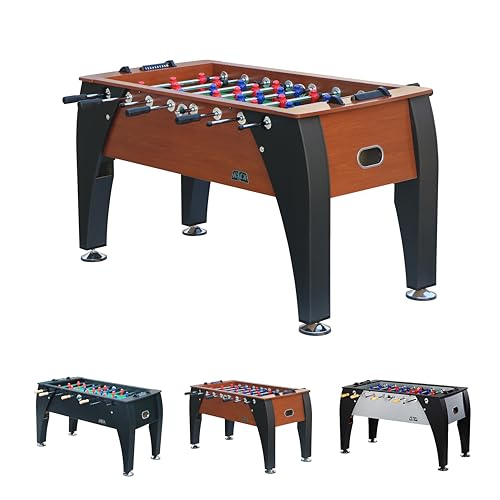
The single most useful shortcut when buying a foosball table is weight. You can’t inspect internal bracing or playfield density from a product photo, but shipping weight is always published and it correlates with everything that matters. Under about 70 lb is disposable; 100–150 lb is a solid family table; 200 lb+ is competition grade. Beyond that, insist on counterbalanced men, decent bearings, and levellers — and measure your room before you measure your budget.
Almost every foosball buying guide online is published by somebody who sells foosball tables. That doesn’t make them wrong, but it does shape what they emphasise — features that differentiate products, rather than the handful of things that actually determine whether you’ll still be playing on it in five years.
So here’s the version written by somebody with nothing to sell you, including the two pieces of advice a retailer will never lead with: weight tells you more than the spec sheet, and a good used table beats a new cheap one comfortably.
- →Weight is the best single proxy for build quality — and it’s always published.
- →Counterbalanced men are non-negotiable. Without them, figures flop down and block the ball.
- →Measure the room first: you need about 11 x 7 ft of clear floor for a full-size table.
- →Bearings decide how the table feels, and they’re cheap to upgrade later.
- →A used quality table beats a new budget one at the same price, almost every time.
- →Below roughly $150 new, you’re buying a toy that will wobble within a year.
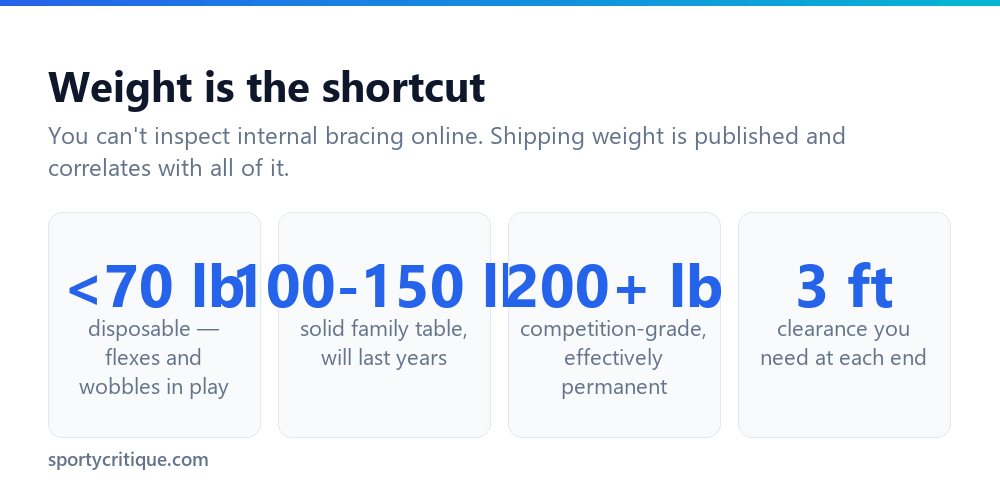
Table of Contents
Why weight is the shortcut
The things that make a foosball table good are mostly invisible in a listing: how thick the cabinet walls are, whether the side walls are braced along their length or held by a single tie rod, how dense the playfield substrate is, and whether the legs are solid or hollow.
You can’t assess any of that from photographs, and manufacturers describe all of it in the same enthusiastic language. But every one of those qualities adds mass — and shipping weight is published on essentially every product listing because it has to be. It’s the one honest number in the specification.
A 45 lb full-size table simply cannot have thick walls, a dense playfield, and solid legs. The physics won’t allow it. When two players lean into a shot, that table flexes, the rods bind slightly, and the whole thing walks across the floor. A 130 lb table of the same dimensions is a fundamentally different object.
Weight is the only number in a foosball listing that can’t be spun. Everything that makes a table good also makes it heavy.
⚠️ Watch out: The flip side: weight is also what makes delivery and assembly awkward. A 150 lb table arrives in a very heavy box, needs two people, and once assembled is not something you’ll move casually. Factor that into where it’s going to live — see our assembly guide.
The features that decide how it plays
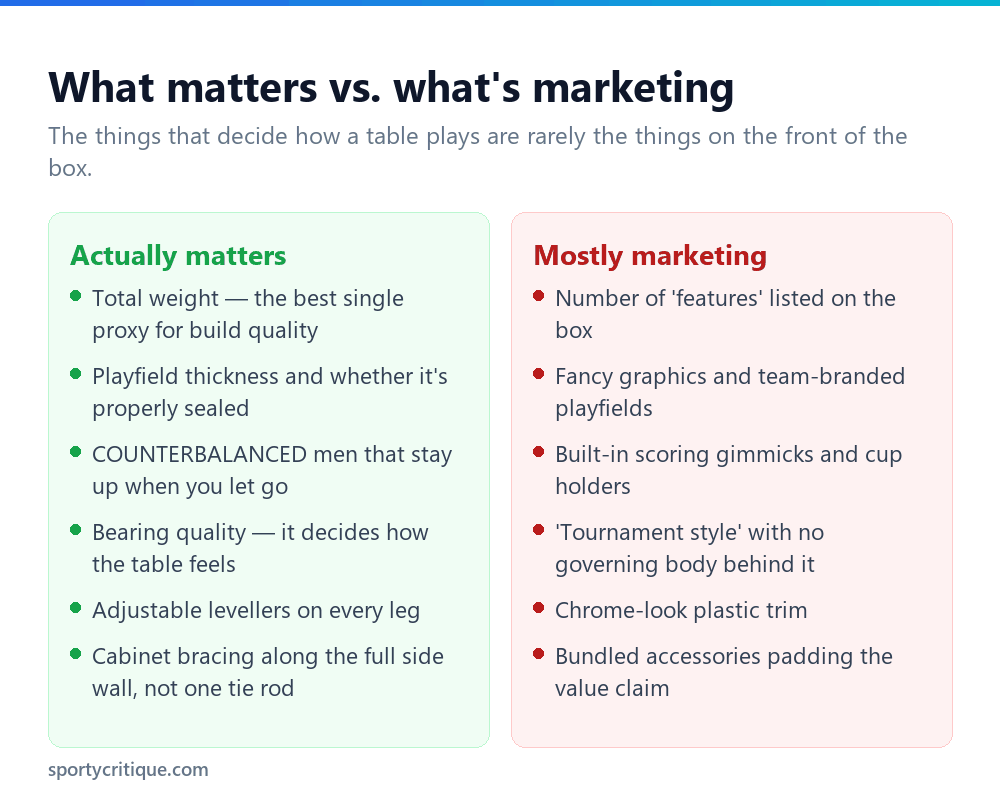
Counterbalanced men are the feature to check first, and the easiest to test in a shop. Lift a rod so the figure points upward and let go. On a counterbalanced table, the man stays up. On a cheap table, it swings down and sits over the playfield, blocking the ball and forcing you to hold every rod in position constantly. It’s the clearest single dividing line between a real table and a toy.
Bearings determine how the rods feel more than anything else. Good bearings let the rods glide with almost no resistance; poor ones drag from new. The reassuring part is that bearings are cheap and replaceable, so a table that’s structurally sound but sluggish can be transformed for very little — as our rod maintenance guide covers.
The playfield should be flat, sealed, and ideally laminated so the graphics don’t wear through. Run your hand across it and sight along it from one end — any visible dip or bow will affect ball roll permanently and is not fixable.
Levellers on all four legs are essential, not a bonus. Almost no floor is truly level, and without adjustable feet every loose ball drifts to one side for the life of the table. Check they have real adjustment range rather than a token half-inch.
The four decisions
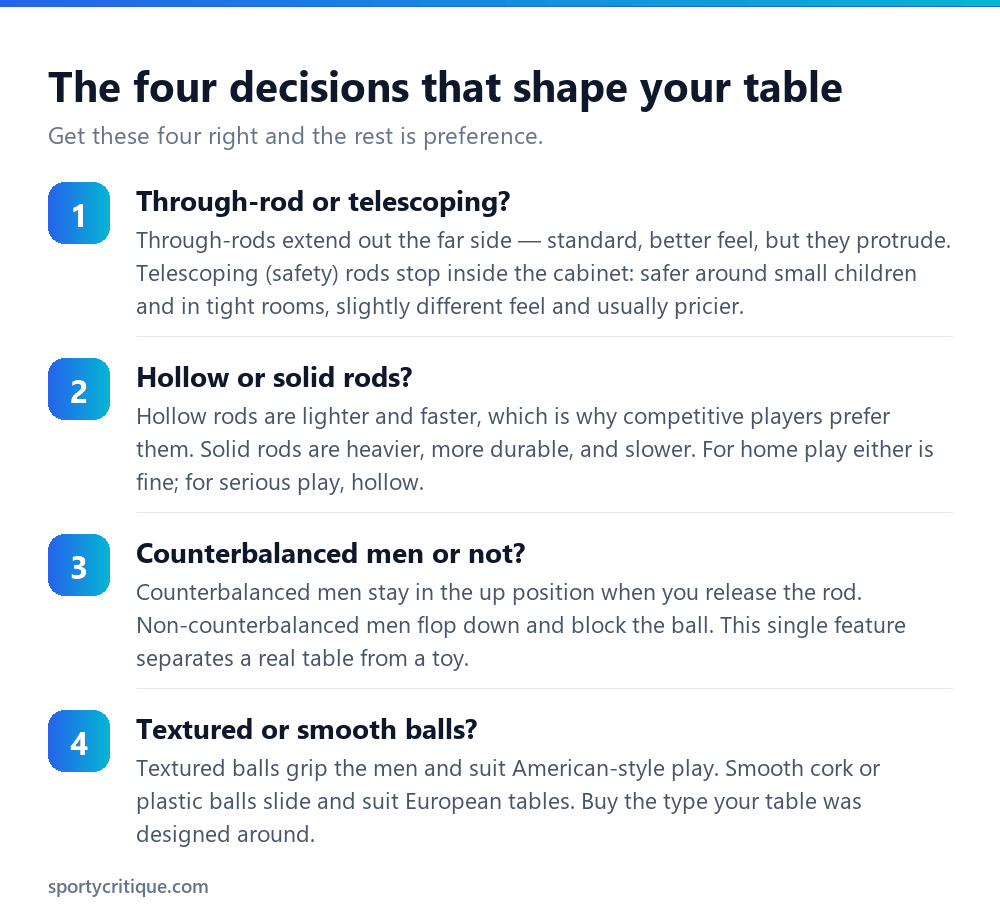
Through-rods versus telescoping is the one worth thinking about hardest, because it’s a genuine trade-off rather than a quality question.
Through-rods are standard: the rod passes fully through the table and extends out the far side as you push. They give the most direct feel and are what every competition table uses. The downside is real, though — a steel rod extending two feet out of a table at roughly toddler head height, in a room where people walk past.
Telescoping rods (also called safety rods) stop inside the cabinet, so nothing protrudes. They’re the sensible choice with small children around, or where the table sits in a walkway or a tight room. The trade-off is a slightly different, marginally less direct feel, and they typically cost more. For family play the safety benefit usually outweighs the feel difference; for a dedicated games room with adults, through-rods.
Ball type matters more than most buyers expect because it changes how the game plays, not just how it looks. Textured balls grip the men, which suits the pinning and trapping of American-style play. Smooth cork or plastic balls slide more and suit European tables. Buy what your table was designed for — our guide to playing foosball explains why brands differ so much.
Measure the room, not the table
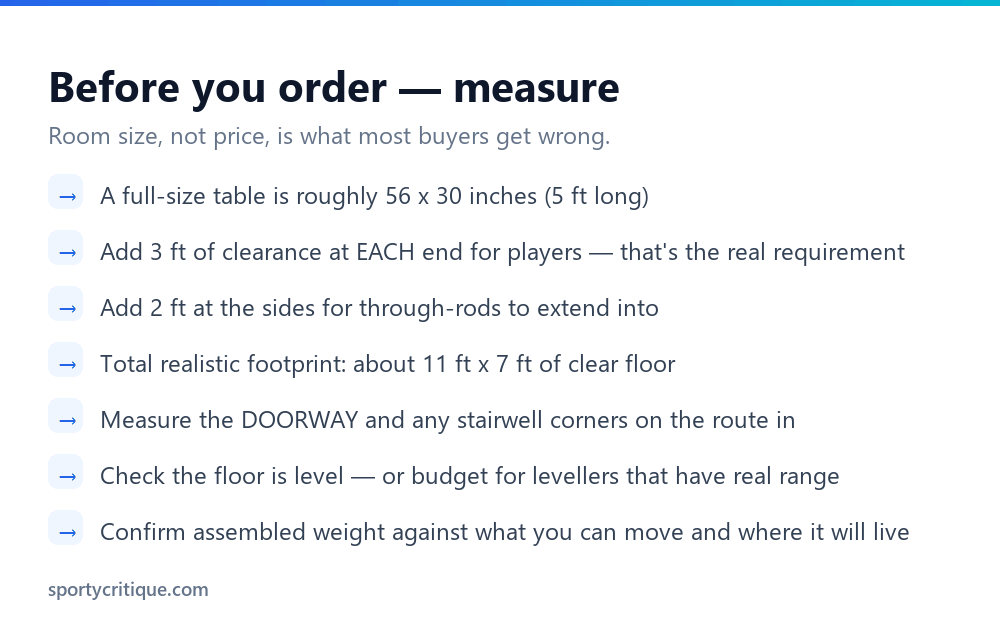
This is where most disappointing purchases come from. A full-size table is about five feet long and two and a half wide, which sounds modest — and then you need to actually stand at it.
Players need roughly three feet of clearance at each end to move, and with through-rods you need another couple of feet at the sides for the rods to extend into. That puts the realistic footprint at around eleven feet by seven of genuinely clear floor. A table crammed against a wall is playable in one direction only, which halves the game.
Then there’s getting it into the room. Foosball tables arrive flat-packed but the assembled cabinet doesn’t disassemble easily, so if you build it in the garage you may not get it through the door. Measure doorways, and pay particular attention to stairwell corners — the classic failure is a table that fits through every door individually but cannot turn the half-landing.
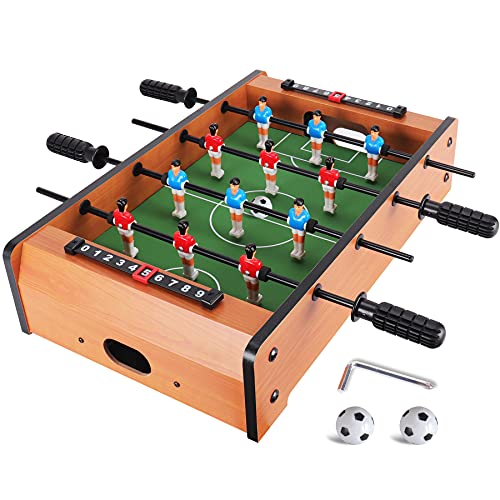
📊 Note: If the space genuinely isn’t there, a tabletop foosball unit is a legitimate compromise rather than a consolation prize — they’re short, sit on a dining table, and store away. They play a faster, cruder game because the pitch is compressed, but for occasional family play in a flat they make far more sense than an unusable full-size table.
Budget: what each tier actually gets you
The honest recommendation for most households is the $350–$700 band. Below it you’re buying something you’ll replace; above it you’re paying for a level of play most homes never reach. If your budget is under $150 and you can’t stretch, the used market is a far better use of the money than a new toy-grade table — which brings us to the advice retailers don’t give.
Buy used — seriously
A well-built foosball table is close to indestructible. The cabinet is wood, the rods are steel, and the parts that wear out — bearings, balls, handle grips — are inexpensive consumables that any owner can replace in an afternoon.
This means the second-hand market is unusually good value. A ten-year-old quality table that looks tired will typically need nothing more than a thorough clean, a set of bearings, fresh balls, and new grips — perhaps thirty or forty pounds of parts and an evening’s work — to play better than a new table costing several times more. Our guides to cleaning and repairing cover exactly that process.
What to check when viewing: sight along the playfield for warping (the one unfixable fault, usually from damp storage or a leak), check the rods are straight by rolling them, confirm the men are counterbalanced, and press down on the cabinet corners to feel for structural flex or rot. Cosmetic scuffs, sticky rods, worn grips, and missing balls are all irrelevant — those are the cheap parts.
💡 Pro tip: Pubs, offices, and student houses periodically offload tables, and heavy things nobody wants to move sell cheaply. The awkwardness of collection is precisely what makes the price low — budget for a van and a second pair of hands and it’s the best value in the sport.
When it arrives: check before you build
One practical warning that costs people real money. Foosball tables ship flat-packed in a single very heavy box, and damage in transit is common precisely because of that weight. Once you’ve assembled a table, returning it is difficult and sometimes impossible — retailers reasonably treat a built table as used.
So before you pick up a screwdriver, unpack everything and lay it out. Check the playfield for dents, scratches, and any sign of moisture exposure. Sight along each rod to confirm it’s straight. Count the bearings, men, screws, and balls against the parts list. Check the cabinet panels for cracked corners, which is where impact damage usually shows.
If anything is wrong, photograph it in the packaging and contact the retailer before assembling anything else. A missing bag of screws is a two-day inconvenience; a warped playfield you discover after four hours of assembly is an argument you will probably lose.
It’s also worth knowing that assembly genuinely takes longer than the box claims — budget two to three hours for a full-size table, with two people. Our assembly guide covers the order that avoids the common mistakes, particularly around not fully tightening anything until the whole cabinet is square.
Frequently asked questions
How much should I spend on a foosball table?
For a table that lasts, $350–$700 is the sweet spot for most households — solid cabinet, counterbalanced men, decent bearings. Under $150 new is toy-grade and will disappoint within a year. If your budget is tight, a used quality table beats a new cheap one comfortably.
What size room do I need for a foosball table?
About 11 x 7 feet of clear floor for a full-size table — the table itself is roughly 5 x 2.5 feet, plus three feet of player space at each end and room at the sides for through-rods. Measure the doorway and any stairwell corners too; getting the assembled table into the room is a common and expensive oversight.
Are telescoping rods better than through-rods?
Neither is better outright — it’s a trade-off. Through-rods give the most direct feel and are what competition tables use, but they extend out the side of the table at head height for small children. Telescoping rods stay inside the cabinet, making them safer and better in tight rooms, at the cost of a slightly less direct feel and a higher price.
What are counterbalanced men and do I need them?
Counterbalanced men stay in the up position when you release the rod, rather than flopping down over the playfield and blocking the ball. Yes, you need them — it’s the clearest dividing line between a genuine table and a toy, and it’s the first thing to check in a shop.
Is a heavier foosball table always better?
Not literally always, but weight is the most reliable proxy available to a buyer, because thick cabinet walls, dense playfields, solid legs, and proper bracing all add mass and none of them can be assessed from a photo. Use it as a first filter, then check counterbalanced men, bearings, and levellers.
Can I put a foosball table outdoors?
Only one built for it. Standard tables use particleboard or MDF playfields that swell and warp with moisture, and steel rods that rust — a season outside will destroy one. Purpose-built outdoor tables use weatherproof materials and cost considerably more, which is why a covered patio or garage is the usual compromise.
- →Assembling a foosball table — doing it without stripping the screws
- →Cleaning and maintenance — what keeps it playing well
- →Repairing a foosball table — bearings, wobbles, and worn parts
- →Best foosball tables for home — current options
- →How to play foosball — the real rules