How Volleyball Scholarships Actually Work: NCAA D1, D2 & D3 Explained

Volleyball scholarships work differently than most recruiting content assumes, and the rules changed in real ways for the 2025-26 season. Here’s how NCAA Division I, II, and III actually differ, what changed, and what to verify before treating any recruiting offer as a guaranteed scholarship.
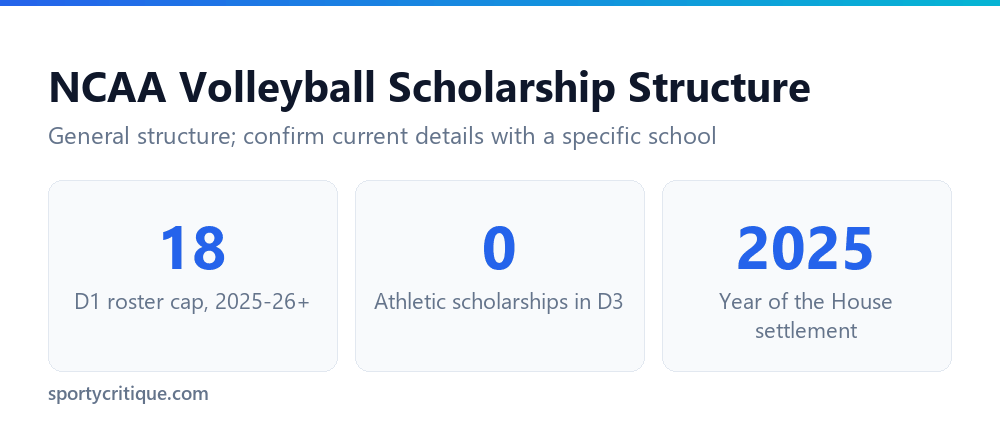
Volleyball scholarship rules changed significantly for the 2025-26 season under the House v. NCAA settlement, which replaced the NCAA’s old sport-by-sport scholarship limits with roster caps instead. Both NCAA Division I men’s and women’s volleyball are now equivalency sports with an 18-player roster limit, meaning coaches can split scholarship money across the roster rather than only offering full rides. Division II remains a smaller-scale equivalency sport, and Division III does not offer athletic scholarships at all. We are not naming specific schools or dollar figures here since those details vary by program and change from year to year; check a specific school’s athletics compliance office for current numbers.
College volleyball scholarship rules are more complicated than most recruiting content makes them sound, and they changed meaningfully for the 2025-26 season, which makes older articles on this topic outdated in a specific, factual way rather than just stylistically. This guide focuses on the mechanics that actually determine what a recruit can expect: how NCAA divisions differ, what an equivalency sport versus a headcount sport actually means, and how the recruiting process itself typically works. We deliberately avoid citing specific schools’ scholarship amounts or naming particular programs, since those figures are program-specific, change year to year, and are the kind of detail that’s easy to state confidently and get wrong.
- →Starting in 2025-26, NCAA D1 volleyball (both men’s and women’s) moved from the old headcount/equivalency split to a single 18-player roster cap with full flexibility on scholarship splits
- →D2 volleyball remains an equivalency sport, allowing partial scholarships split across more players than a headcount sport would allow
- →D3 schools do not offer athletic scholarships under any NCAA division rule
- →A ‘roster spot’ and a ‘scholarship’ are not the same thing; making a team does not guarantee any athletic money
- →Recruiting for volleyball runs heavily through club tournaments and recruiting camps, not just high school season film
Table of Contents
NCAA Division I, II, and III: the actual structural differences
The three NCAA divisions differ in more than just competition level. Division I schools generally have the largest athletic budgets and, since the 2025-26 season, operate under roster caps rather than the older per-sport scholarship-count limits. Division II schools offer athletic scholarships too, but typically with smaller overall budgets and scholarship pools than Division I programs. Division III schools do not offer athletic scholarships at all, full stop, though D3 athletes can still receive need-based financial aid or academic scholarships through the same channels available to any other student.
Equivalency vs. headcount, and what changed for volleyball
Before the 2025-26 season, NCAA sports were split into two scholarship models. A headcount sport, like football or basketball, could only offer full scholarships and had a hard cap on the number of players receiving any athletic money at all. An equivalency sport had a total scholarship budget that coaches could divide into partial awards across more players than the budget would cover as full rides. Women’s volleyball at the Division I level had historically been a headcount sport, meaning a fixed number of full scholarships and nothing partial, while men’s Division I volleyball had been an equivalency sport with a much smaller scholarship pool than women’s programs.
The House v. NCAA settlement, approved by a federal court in 2025 and implemented starting July 1, 2025, eliminated the old sport-by-sport scholarship-count system across all Division I sports and replaced it with roster limits instead. For volleyball specifically, both the men’s and women’s Division I game now use an 18-player roster cap, and every rostered player is scholarship-eligible, with coaches free to divide scholarship money however they choose within that roster rather than being bound to the old full-ride-only or fixed-pool structures.
📊 Note: This is a very recent and still-settling change. Individual conferences and schools are implementing it on their own timelines within the settlement’s framework, and roster and scholarship specifics can vary program to program during this transition. Confirm current numbers directly with a specific school’s compliance office or coaching staff rather than relying on any single article, including this one, for exact current-year figures.
Division II and Division III: what stayed the same
Division II volleyball remains an equivalency sport, meaning coaches divide a scholarship budget across the roster in partial amounts rather than offering only full rides, similar in structure to how men’s Division I volleyball worked before 2025-26, though with its own separate scholarship limits and rules. This didn’t change with the House settlement, which applied specifically to Division I.
Division III volleyball did not change either, because it was never part of the athletic scholarship system to begin with. D3 schools compete under a philosophy that explicitly excludes athletic scholarships, though D3 athletes are frequently eligible for the same need-based financial aid and academic scholarships available to any student at that school, which for some families ends up covering a comparable amount to a partial athletic scholarship elsewhere.
A roster spot is not automatically a scholarship
⚠️ Watch out: Making a college volleyball roster and receiving athletic scholarship money are two separate outcomes, even under the current, more flexible roster-cap system. A walk-on spot, meaning a roster spot without athletic scholarship money attached, remains common at every division, including Division I. Families evaluating a recruiting offer should ask directly and specifically what portion of tuition, room, and board a given offer actually covers, rather than assuming any offer to join the team includes scholarship money.
Walk-on realities vary a lot by program and division. At some schools, a walk-on who proves themselves in practice can earn scholarship money in a later year as roster spots and budget open up. At others, walk-on spots exist mainly to fill out practice squad depth with little realistic path to scholarship money. Asking a coach directly about that program’s specific track record with walk-ons, not just the general possibility, is a more useful question than the recruiting pitch alone will usually answer.
How volleyball recruiting actually happens
Club and travel volleyball, not high school season play alone, is where most serious college recruiting happens for the sport. College coaches attend club tournaments and showcase events specifically because they offer a concentrated look at many recruitable players across a weekend, compared to attending individual high school games scattered across a season. A strong high school season without club participation is a real disadvantage in most regions for players hoping to be seen by college coaches at scale.
Showcase events and camps hosted by specific colleges are a second common pathway, letting a recruit get direct, in-person evaluation time with a program’s own coaching staff rather than being seen only in a crowded club tournament setting. NCAA recruiting rules govern exactly when coaches can contact recruits directly, and those contact-period rules differ by division and change periodically, so checking the current NCAA recruiting calendar for your specific division and graduation year, rather than assuming last year’s rules still apply, is worth doing directly through NCAA.org.
- ✓Ask a coach directly what percentage of cost a specific offer covers, not just whether you ‘made the team’
- ✓Prioritize club and recruiting-camp participation if you’re serious about being recruited
- ✓Check NCAA.org directly for current recruiting-calendar and roster-cap rules for your graduation year
- ✓Consider D3 and NAIA programs seriously if D1/D2 scholarship money isn’t realistic for your situation
- ✕Assume a ‘roster offer’ automatically includes athletic scholarship money
- ✕Rely on club-season word of mouth for exact current scholarship rules, which changed recently
- ✕Skip academic and need-based aid research just because you’re being recruited athletically
- ✕Wait until senior year to start club or recruiting-camp participation if D1/D2 recruiting is the goal
💡 Pro tip: Contact a target school’s athletics compliance office directly, not just the coaching staff, if you want a precise, current answer on how scholarship money and the roster cap actually work at that specific program this year. Compliance offices deal with these rules as their actual job and give a more reliable answer than a general recruiting conversation.
NAIA and junior college: the paths outside the NCAA
The NAIA and NJCAA (junior college) systems run entirely separate scholarship and eligibility rules from the NCAA, and both offer real volleyball scholarship opportunities outside the divisions covered above. These paths are sometimes overlooked by recruits focused only on NCAA programs, but they can be a realistic and often more accessible route to athletic scholarship money, particularly for players who don’t receive strong Division I or II interest directly out of high school. Junior college in particular is also a common two-year stepping stone for players who later transfer into a four-year NCAA or NAIA program with a stronger recruiting profile than they had as a high school senior.
What to actually verify before committing
Before accepting any offer, get the specific scholarship percentage, the number of years it covers, and the conditions under which it could be reduced or not renewed, all in writing rather than as a verbal understanding from a recruiting conversation. NCAA athletic scholarships are typically renewed on a year-by-year basis rather than guaranteed for four years automatically, and the specific renewal conditions are set by each school individually within NCAA rules, not standardized across every program.
Bottom line
College volleyball scholarship rules meaningfully changed for the 2025-26 season, moving Division I to a flexible roster-cap model instead of the older headcount and equivalency split. Division II remains equivalency-based, and Division III still offers no athletic scholarships. None of that structure guarantees a specific recruit specific money. Verify actual numbers directly with a target school’s compliance office, and treat any recruiting-content claim of a fixed scholarship dollar amount, including ones on other sites, with real skepticism unless it’s sourced to that school’s own current published policy.
How many volleyball scholarships does a Division I team have?
This changed starting in the 2025-26 season. NCAA D1 volleyball now uses an 18-player roster cap with flexible scholarship distribution across that roster, rather than the older fixed full-ride or equivalency-pool models. Contact a specific school’s compliance office for that program’s current numbers.
Does Division III offer volleyball scholarships?
No. NCAA Division III schools do not award athletic scholarships in any sport, including volleyball, though D3 athletes remain eligible for need-based financial aid and academic scholarships through the same processes available to any other student.
Is club volleyball necessary to get recruited?
It’s not strictly required, but in most regions club and recruiting-camp participation is where the large majority of serious college recruiting happens, since it lets coaches evaluate many players efficiently at concentrated events. High school season play alone is a real disadvantage for visibility in most areas.
Are NCAA volleyball scholarships guaranteed for four years?
Generally no. Most athletic scholarships are renewed year to year rather than guaranteed for a full four-year term automatically, and the specific renewal terms are set by each school within NCAA rules. Get the renewal conditions in writing before committing.