Volleyball Serve Receive Platform Technique: Building a Stable Passing Angle

Good volleyball serve receive technique comes down to one idea coaches repeat for a reason: the platform aims the ball, the arms don’t swing at it. Get the angle right and a serve rebounds toward the target on its own. Get the angle wrong and no amount of arm speed fixes it.
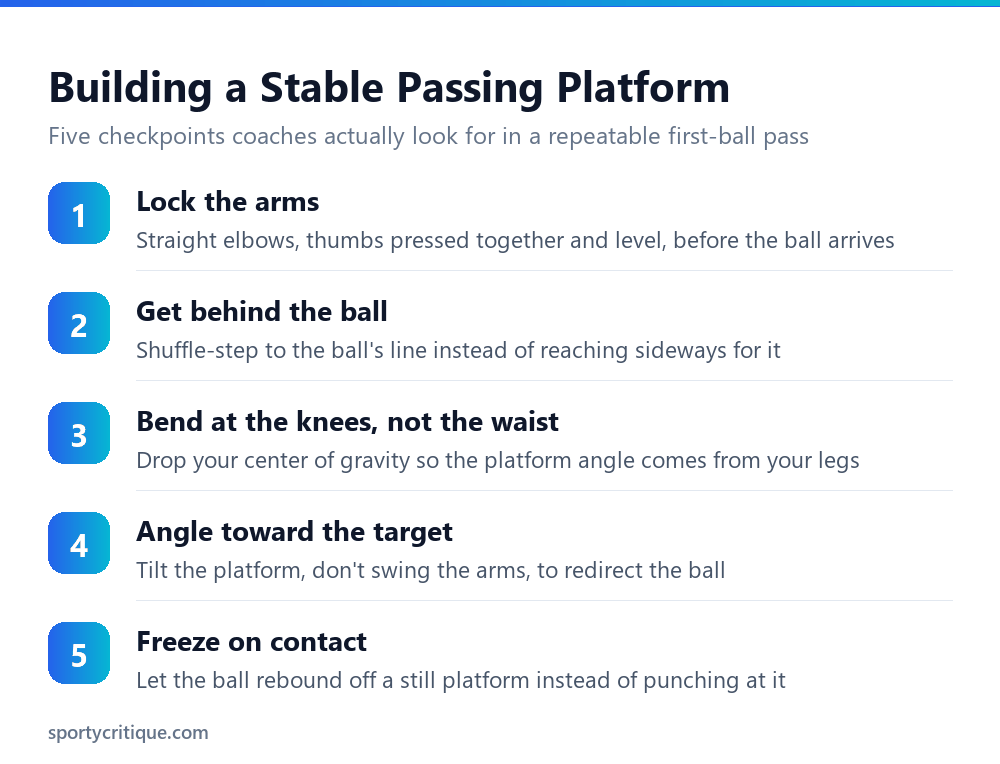
A stable passing platform starts with straight, locked arms and thumbs pressed level, formed early rather than at the last second. Direction comes from tilting that platform toward the target, not from swinging the arms, and footwork (shuffle steps, not crossovers) is what gets you behind the ball in time to set that angle before contact. Most inconsistent first-ball passing traces back to late platform formation, not bad arm mechanics.
- →The platform’s angle sends the ball to the target; swinging the arms adds speed you can’t control
- →Shuffle steps, not crossover steps, keep the shoulders square so the platform angle stays predictable
- →Form the platform early, while the ball is still in the air, not in the last half-second before contact
- →The ball should land between the wrist and elbow, never on the hands or forearms’ bony edge
- →Bend from the knees to lower your platform to the ball’s height, rather than reaching down with the arms
Table of Contents
What “Platform” Actually Means
The forearm platform is the flat surface created by pressing the arms together, straight at the elbow, with the thumbs side by side and level. It’s not a swinging motion and it’s not a bump in the sense of hitting the ball; it’s closer to holding up a tray and letting the ball rebound off the angle of that tray. The ball should contact the forearms between the wrist and elbow. Contact on the wrists or hands is unpredictable because that’s a smaller, harder surface that deflects the ball at inconsistent angles.
Coaches emphasize forming the platform early because a platform built in the last instant before contact is almost always tilted wrong. The serve is already traveling fast; there isn’t time to both react to its flight and build a clean platform in the same half-second. Locking the arms as soon as you read the serve’s general direction gives you time to adjust the angle with your body, which is a far more reliable adjustment than trying to correct with your arms at the last moment.
Direction Comes From the Angle, Not the Swing
This is the single most common correction volleyball coaches make at every level: stop swinging at the ball. A passer who swings the arms up and through the ball is trying to add power, but serve receive rarely needs added power, the serve already carries plenty of speed on its own. What it needs is direction, and direction comes entirely from where the platform is angled at the moment of contact.
Think of the platform as a flat board. Tilt that board toward the target and the ball rebounds toward the target, the same way a ball bounces off any flat surface at a predictable angle. Swing the board instead of tilting it, and you introduce a variable (arm speed, timing of the swing) that turns a repeatable physics problem into a guess. Elite passers barely move their arms at all on a clean pass; nearly all the visible movement is legs and platform angle.
⚠️ Watch out: If a passer’s forearms are sore or bruised after a match, that’s usually a sign they’re swinging at the ball with too much arm speed rather than absorbing it with a still platform. It’s a mechanics problem before it’s a conditioning problem.
Footwork: Shuffle Steps, Not Crossovers
Getting the platform angle right starts before the ball even arrives, with footwork that gets your body behind the ball’s line rather than reaching sideways for it. Shuffle steps (quick lateral steps that keep the shoulders and hips square to the net) are standard for exactly this reason: a crossover step rotates the shoulders mid-movement, which tilts the platform’s resting angle before you’ve even locked your arms.
The practical rule most coaches teach: if you can get there with two or three shuffle steps, shuffle. Only cross over when the serve is hit wide enough that a shuffle genuinely can’t cover the distance in time, and even then, square the shoulders back up before contact rather than passing while still rotated.
Reading the Serve Early
Passing angle decisions have to be made while the ball is still traveling, which means reading the serve’s trajectory in the first quarter-second matters more than reacting well late. Watch the server’s contact point and arm swing rather than waiting to track the ball itself; a floater served with a short, punching arm swing behaves differently in the air than a hard topspin serve, and recognizing which one is coming gives you a head start on where to move and how to angle the platform.
Floater serves in particular reward early reads because they move unpredictably late in flight. A passer who commits to a platform angle too early on a floater can get caught out by last-second movement, so the correction here is slightly different: track the floater longer than a topspin serve before locking the final platform angle, while still getting the footwork done early.
Passing to a Target, Not Just Over the Net
A technically clean platform still fails if it’s aimed at the wrong spot. The target on a first-ball pass is a specific zone in front of the setter, usually a few feet off the net and slightly to the right of center for a right-handed setter, not simply “anywhere on our side.” Passers who think of serve receive as “get it over” instead of “get it to the target” tend to produce technically fine platforms aimed at nothing in particular, which puts the setter in a scramble even when the pass technique itself looked correct.
This is why coaches drill serve receive with a visible target, whether that’s a teammate, a cone, or a taped zone on the floor, rather than just serving balls at players and calling it practice. The platform angle has to be aimed at something specific for the habit to transfer to a real match, where the setter’s position shifts play to play.
Where to Stand Before the Serve
Platform mechanics only matter if you’re in a position to use them. Serve receive formations are built to divide the court so that no single passer has to cover an unrealistic amount of ground, which is also why base positioning shifts depending on how many passers are in the rotation, commonly two, three, or four depending on level and system. Standing too deep forces you to move forward and up on short serves, which is a much harder platform angle to control than moving side to side.
A useful starting reference: most passers set up roughly in the back third of their zone, weight forward on the balls of the feet, knees already slightly bent before the serve is even contacted. Standing flat-footed and upright is the single most common reason a passer looks rushed on a serve that wasn’t actually hit that hard, since the body has to do two jobs (get low, then move) in the time it should only be doing one.
Adjusting the Platform for Float vs. Topspin Serves
A floater and a hard topspin serve arrive differently and reward slightly different platform habits. A floater has little to no rotation, which is exactly why it moves unpredictably late in flight; the correction is to track it longer before locking the platform angle, since committing early on a floater means guessing at a flight path that hasn’t finished moving yet.
A topspin serve is more predictable in its arc but arrives with more forward momentum, which means the platform angle usually needs to tilt back slightly more than instinct suggests to keep the pass from sailing long and over the target. Passers who only practice against one serve type tend to struggle the first time they face the other in a real match, which is a reasonable argument for making sure practice reps include both.
A Training Aid Worth Using
Because the most common flaw is excess arm movement, drills that physically limit swinging are effective for retraining the habit faster than verbal correction alone. The Tandem Sport Pass Rite passing trainer straps around the wrists and ankles with adjustable resistance bands specifically to limit upward arm swing during passing reps, which forces the angle-not-swing habit through repetition rather than just being told about it in practice.
💡 Pro tip: Use a platform-restriction trainer for short, focused reps (10-15 minutes) rather than a full practice session. The goal is retraining the feel of a still platform, not fatiguing the arms, and the correction sticks faster in short, high-attention blocks.
Common Mistakes That Break the Angle
- ✓Locking the platform before the ball crosses the net, not in the last half-second
- ✓Bending at the knees to lower the platform to the ball’s height
- ✓Keeping the shoulders square through shuffle-step footwork
- ✓Letting the ball rebound off a still platform instead of punching at it
- ✕Reaching down with just the arms instead of bending the knees
- ✕Crossing over on serves a shuffle step could have reached in time
- ✕Swinging the arms upward through contact to add power that serve receive doesn’t need
- ✕Contacting the ball on the wrists or hands instead of the flat forearm surface
Common Myths About Platform Passing
Putting It Together in a Drill
A simple progression: start with a partner tossing serves from close range so you can focus purely on platform angle without worrying about footwork or read time. Once the angle feels consistent, add distance and real serve speed, then add lateral movement so footwork enters the equation. Resist the urge to skip straight to full-speed serve receive drills; the angle habit has to be automatic before adding speed and movement, or the old swinging habit reappears under pressure.
What does “platform” mean in volleyball serve receive?
The platform is the flat surface formed by pressing the forearms together with straight, locked elbows and level thumbs. The ball should contact the platform between the wrist and elbow, and the platform’s angle, not arm swing, determines where the pass goes.
Should I swing my arms to pass the ball harder?
No. Serve receive rarely needs added power since the serve already carries speed. Swinging the arms adds an unpredictable variable to what should be a simple rebound off a still, angled platform, which is why most inconsistent passing traces back to excess arm movement.
Why do coaches emphasize shuffle steps over crossover steps in serve receive?
Crossover steps rotate the shoulders mid-movement, which tilts the platform’s resting angle before the arms even lock. Shuffle steps keep the shoulders and hips square to the net, which keeps the platform angle predictable and easier to aim.
How early should I form my passing platform before the ball arrives?
As soon as you’ve read the serve’s general direction and type, well before contact. A platform built in the final half-second before the ball arrives is almost always tilted wrong because there isn’t time to both react to the serve and build a clean angle simultaneously.
As an Amazon Associate, we earn from qualifying purchases through links on this page.