Volleyball Net Violations: Touching the Net and Reaching Over

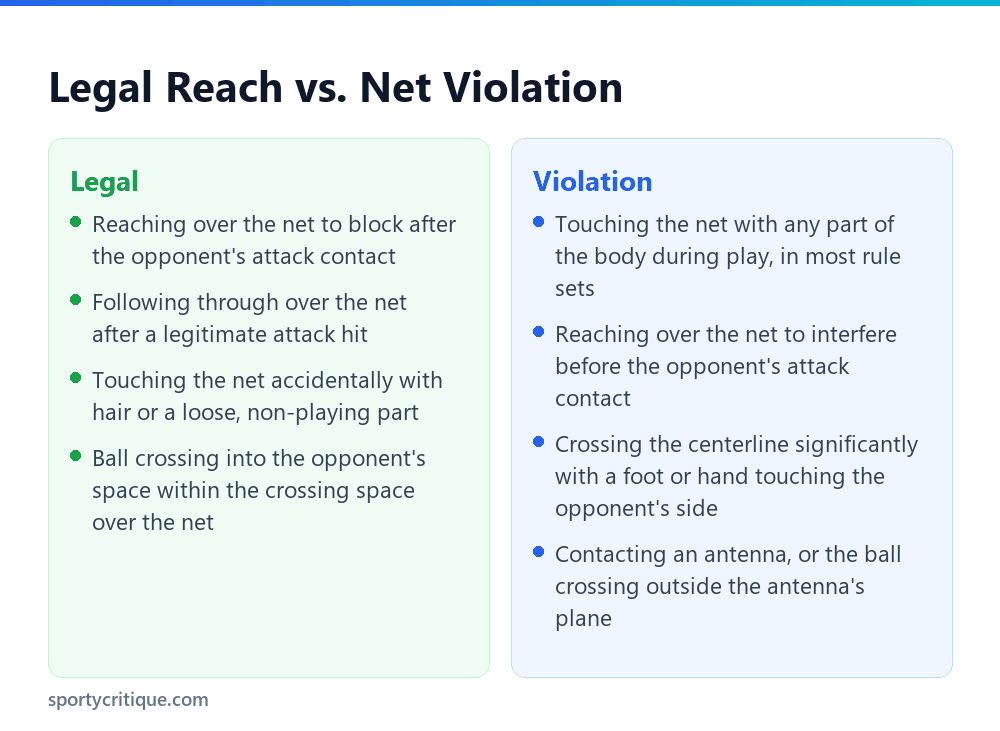
Volleyball net violation rules center on two main faults: touching the net with any part of the body during active play, which is a fault under most rule sets regardless of whether it affected the play, and reaching over the net to interfere with the ball before the opponent has completed their attack hit. Reaching over the net is legal specifically when following through after a legitimate attack or when blocking after the opponent has already made attacking contact, timing that trips up many newer players.
Net-related violations are among the most commonly misunderstood rules in volleyball, since the net separates the two teams’ spaces but doesn’t create an absolute barrier that a player can never legally cross or contact under any circumstances. The specific timing and context around net contact and reaching over the net make all the difference between a legal play and a penalized fault.
- →Touching the net during active play is a fault under most rule sets, regardless of intent
- →Reaching over the net is illegal before the opponent’s attack, legal as a follow-through or block after
- →The antenna marks the legal boundary a ball must pass within when crossing the net
- →Incidental contact from hair or a non-playing element generally isn’t penalized the same as body contact
- →Centerline crossing rules are separate from net-touch rules, though both involve the net area
Table of Contents
Touching the Net
Under most competitive rule sets, any player contact with the net during an active play, attempting to play the ball, is a fault, regardless of whether that contact actually affected the rally’s outcome in any meaningful way. This strict standard exists to prevent players from using the net as a stabilizing aid or gaining any advantage from contact with it.
⚠️ Watch out: A common misunderstanding is that net contact only counts as a fault if it visibly disrupts the play or gives a clear advantage. Under most standard rules, any contact during an attempt to play the ball is penalized regardless of impact, which surprises many newer players and spectators who assume intent or effect matters more than it actually does.
Contact with the net outside of an active play attempt, after a rally has clearly ended or before a serve, generally isn’t penalized the same way, since the fault specifically concerns net contact that occurs while a player is in the act of playing the ball during a live rally.
Reaching Over the Net
A blocker may legally reach over the net into the opponent’s space specifically after the opponent has made contact with the ball to attack it, since the block is responding to a completed attacking action rather than interfering with the attack before it happens. Reaching over before that attacking contact occurs, attempting to block or interfere with the ball while it’s still on the opponent’s side before they’ve hit it, is a fault.
An attacking player following through with their arm and hand after hitting the ball, ending up reaching over the net as a natural continuation of the attacking motion, is generally legal under most rule sets, since this follow-through happens as a result of a legitimate attack already completed, not as separate interference with the opponent’s play.
💡 Pro tip: The key distinguishing question for reaching over the net is timing relative to the opponent’s attack contact: before that contact, reaching over is illegal interference; after it, both blocking reach and attacking follow-through become legal under standard rules.
The Antenna and Legal Crossing Space
The antennas, thin rods attached to the net at the sidelines, mark the outer boundary of the legal space a ball must pass through when crossing from one side of the court to the other. A ball that crosses the net outside the antennas, even if it would otherwise land in bounds, is ruled out of play.
Contact with the antenna itself by the ball is also a fault, treated similarly to the ball touching the net incorrectly or crossing outside the legal space. This rule keeps the ball’s path over the net confined to the actual playing width of the court, preventing a wide, out-of-bounds trajectory from being ruled a legal crossing just because it eventually lands in bounds.
The Centerline Rule: A Separate but Related Fault
The centerline, extending beneath the net between the two courts, has its own separate rule: a player fully crossing the centerline into the opponent’s court with a foot or hand touching down on the other side is typically a fault, though most rule sets allow some incidental crossing as long as part of the foot or hand remains on or above the centerline itself.
📊 Note: This rule exists separately from the net-touching and reaching-over rules already discussed, though all three involve the net area and get confused with each other by newer players who haven’t yet learned to distinguish the three distinct fault types clearly.
Common Net Violation Confusions
- ✓Avoid touching the net at all during an active attempt to play the ball
- ✓Wait until the opponent’s attack contact before reaching over to block
- ✓Keep the ball’s crossing path within the antennas, not outside them
- ✓Distinguish net-touch, reaching-over, and centerline faults as three separate rules
- ✕Assuming net contact only counts as a fault if it visibly affects the play
- ✕Reaching over the net to interfere before the opponent has attacked the ball
- ✕Confusing antenna contact rules with the general net-touching fault
- ✕Treating centerline crossing and net touching as the same rule
How Referees Signal Net Faults
A referee signaling a net fault typically uses a specific hand gesture, often a hand brushing against the fingers of the other hand, distinct from the signals used for other common faults like a double hit or a lift. Recognizing this specific signal helps players and spectators quickly identify what kind of fault has just been called without needing a verbal explanation.
Because net faults can be subtle, a slight touch that’s hard to see from a distance, officials positioned close to the net specifically watch for this contact throughout a match, which is one of the specific responsibilities that makes net-area officiating a demanding, attention-intensive part of the second referee’s role covered in more detail in other rules content on this site.
Rule Variations by Level of Play
Some youth or recreational leagues relax certain net-touching enforcement, particularly for incidental, non-play-affecting contact, compared to the strict standard used in most competitive and international play. Checking a specific league’s exact rule interpretation avoids confusion for a player or coach transitioning between different levels of organized volleyball.
Beach volleyball’s two-player format and different net dynamics also introduce some rule variations around net contact and reaching over compared to the indoor six-player game, though the core principles, no net contact during active play and no interference before an opponent’s attack, remain broadly consistent between the two formats.
Net Faults During a Serve
A serve that contacts the net and still crosses over into the opponent’s court within the legal antenna boundaries is playable in most modern rule sets, a change from older rules that treated any net contact on a serve as an automatic fault. This is a specific, commonly misunderstood exception to the general strict standard around net contact discussed throughout this guide.
A served ball that touches the net and then fails to cross over, or crosses outside the legal antenna space, is still a fault, just for a different underlying reason, failing to complete a legal serve, rather than the net contact itself being the specific violation. This distinction matters for understanding exactly why a given serve was or wasn’t ruled a fault.
Additional Blocking Rules Near the Net
A back-row player is generally prohibited from blocking at the net, a separate rule from the net-touching and reaching-over rules already covered, specifically limiting blocking participation to front-row players in most standard rule sets. This rule exists to maintain the front-row and back-row positional structure central to volleyball’s broader rotation system.
Multiple players blocking together, a common tactic against a strong attacker, must still each individually avoid net contact and premature reaching over, since a fault by any one blocker in a multi-player block is penalized the same as a fault by a single blocker acting alone. Coordinating a clean, simultaneous block without any individual net contact takes real practiced timing among the blocking players.
Video Review for Net Faults at Higher Levels
At levels with access to video review or challenge systems, net faults are among the calls that can be reviewed, given how subtle and hard to see in real time some net contact actually is, even for an official positioned close to the net with a clear sightline.
Lower levels of play without review technology rely entirely on the officiating crew’s real-time judgment for these calls, which is part of why close, contested net-touch situations sometimes generate more disagreement and frustration at recreational or youth levels than at professional levels where review technology can settle a genuinely ambiguous call.
Coaching Players to Avoid Net Faults
Coaches commonly drill blockers specifically on timing their jump and reach to the moment of an opponent’s attack contact, rather than jumping early out of anticipation, since premature jumping is a leading cause of both reaching-over faults and net contact from an overextended, off-balance blocking motion.
Practicing blocking footwork and timing repeatedly against a live or simulated attacker, rather than only in isolated, non-live blocking drills, builds the specific timing sense needed to avoid these faults consistently under actual match pressure and pace, which differs meaningfully from a slower, more controlled practice repetition.
Frequently Asked Questions
Is touching the net always a fault?
Under most standard rules, yes, if the contact happens during an active attempt to play the ball, regardless of whether it visibly affected the play. Contact outside of active play attempts generally isn’t penalized the same way.
When is it legal to reach over the net?
After the opponent has made contact with the ball to attack it, whether as a blocker responding to that attack or as an attacker’s natural follow-through after their own hit.
What happens if the ball hits the antenna?
It’s ruled a fault, similar to the ball touching the net incorrectly or crossing outside the legal space the antennas mark on each sideline.
Is crossing the centerline always a fault?
Not always. Most rule sets allow some incidental crossing as long as part of the foot or hand remains on or above the centerline; a foot or hand fully crossing and touching down on the opponent’s side is typically the actual fault.
Do youth leagues enforce net-touching the same way as competitive leagues?
Not always. Some youth or recreational leagues relax enforcement for incidental, non-play-affecting contact compared to strict competitive and international standards.
Are net violation rules different in beach volleyball?
Some specific variations exist given the two-player format and different net dynamics, but the core principles around net contact and reaching over remain broadly consistent with indoor rules.
Understanding the specific timing and context behind net-touching, reaching over, and centerline rules clears up much of the confusion that makes these calls seem inconsistent or unfair to newer players and spectators. Once the underlying logic is clear, these three related but distinct rules become straightforward to follow during any match.
None of these rules exist arbitrarily; each one addresses a specific fairness or safety concern around the shared space at the net, and seeing them that way makes the whole rule set feel far less like an arbitrary list to memorize and more like a coherent system worth actually understanding.
As an Amazon Associate, we earn from qualifying purchases through links on this page.