Volleyball Timeout Rules: When Teams and Coaches Can Call Them

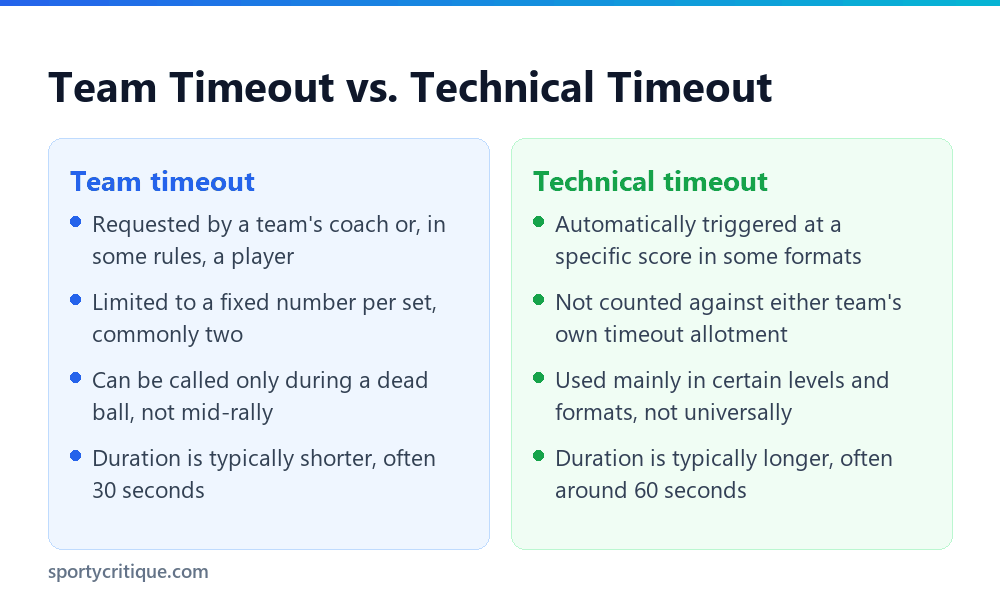
Volleyball timeout rules typically grant each team two timeouts per set, requested by the head coach and callable only during a dead ball, not mid-rally, each lasting around 30 seconds. Some formats and levels also use technical timeouts, automatically triggered at a specific score milestone and separate from a team’s own regular timeout allotment, typically running longer at around 60 seconds. Understanding the difference between these two timeout types clears up confusion about why a stoppage sometimes happens without either team formally requesting it.
Timeout rules vary somewhat between different levels and formats of organized volleyball, making it worth understanding both the general standard most competitions follow and the specific variations a player, coach, or fan might encounter moving between different leagues, tournaments, or broadcast formats.
- →Most formats grant each team two regular timeouts per set, typically around 30 seconds each
- →Timeouts can only be called during a dead ball, never in the middle of an active rally
- →Technical timeouts, where used, trigger automatically and don’t count against a team’s own allotment
- →The head coach typically requests timeouts, though specific rules on who can call one vary
- →Timeout availability and duration can differ between levels, from youth leagues to professional play
Table of Contents
Standard Team Timeouts
Most standard volleyball rule sets grant each team two timeouts per set, requested typically by the head coach rather than a player directly, though some specific leagues or levels allow a team captain to request a timeout as well, depending on that competition’s exact rules.
⚠️ Watch out: A timeout can only be requested during a dead ball, when the rally has already ended and the ball isn’t actively in play, not during a live rally itself. A team cannot interrupt an active point to call a timeout regardless of how the rally is unfolding.
Standard team timeout duration is commonly around 30 seconds, though this specific length can vary somewhat between different leagues and levels of competition, making it worth checking a specific league’s exact rules rather than assuming a universal duration applies everywhere.
Technical Timeouts
Some competitive formats, historically more common in certain international and collegiate settings, include automatic technical timeouts triggered when a set reaches a specific score milestone, commonly when the leading team reaches a certain point total within a set.
This automatic timeout doesn’t count against either team’s own regular timeout allotment, existing as a separate mechanism entirely, often used historically to accommodate broadcast advertising breaks or simply to give players a standardized rest point during a longer, more physically demanding set.
💡 Pro tip: Checking whether a specific league or tournament actually uses technical timeouts before a match avoids confusion when a stoppage happens automatically at a specific score without either coach actively requesting it during that particular moment.
Who Can Actually Call a Timeout
In most standard rule sets, only the head coach has formal authority to request a timeout from officials, a restriction that keeps this specific decision centralized rather than allowing individual players to interrupt play independently based on their own in-the-moment judgment during a match.
Some levels and formats specifically extend this authority to a team captain as well, particularly relevant in settings without a dedicated head coach present courtside, though this variation isn’t universal and depends on the specific competition’s own rule set.
Common Timeout Rule Confusions
- ✓Confirm a specific league’s exact timeout count and duration before a match
- ✓Request timeouts only during a dead ball, never attempting to interrupt a live rally
- ✓Check whether technical timeouts apply in a specific competition before assuming they do
- ✓Know who specifically holds timeout-calling authority under a given league’s rules
- ✕Assuming every league uses an identical number and duration of timeouts
- ✕Attempting to call a timeout in the middle of an active, ongoing rally
- ✕Confusing an automatic technical timeout with a team’s own regular timeout request
- ✕Assuming any player can call a timeout when that authority is typically restricted to the coach
Strategic Timing of Timeout Requests
Coaches commonly use a timeout specifically to stop an opponent’s momentum during a scoring run, a well-established tactic that gives a struggling team a brief reset and a chance to adjust strategy before the opponent extends their run further into the set.
Timing a timeout too early in a match, before a real momentum shift has actually developed, wastes a limited resource that might prove more valuable later in a close, tightly contested set where every available strategic tool matters more as the stakes of each individual point increase.
What Actually Happens During a Timeout
During a timeout, players typically gather at their team’s bench area to receive coaching instruction, hydrate, and briefly rest, while substitutions, if a coach chooses to make one, are also commonly processed during this same stoppage rather than requiring an entirely separate break in play.
Officials and the scoring table use this same window to confirm the current score and any pending administrative matters, making the timeout a multi-purpose stoppage that serves both teams’ strategic needs and the match’s broader administrative and officiating requirements simultaneously.
How Timeout Rules Vary by Level
Youth and recreational leagues sometimes modify standard timeout rules, occasionally allowing additional timeouts or adjusting duration specifically to accommodate developmental or educational priorities that differ from the competitive efficiency emphasis of higher-level, more serious competitive play.
Professional and top-level international volleyball, by contrast, typically enforces timeout rules more strictly and consistently, reflecting both broadcast scheduling needs and the higher competitive stakes where precise, consistent rule enforcement matters more than the flexibility some lower-level leagues intentionally build into their own rule structures.
Injury Timeouts: A Separate Category
An injury timeout, called when a player needs medical attention during play, operates under a separate set of rules from a team’s regular strategic timeouts, typically not counting against either team’s own timeout allotment since its purpose is player safety rather than tactical advantage.
Officials generally have discretion over how an injury timeout is handled, including how long play pauses and whether an injured player must be substituted if they can’t continue within a reasonable window, a judgment call that balances player welfare against the practical need to keep a match moving forward at a reasonable pace.
Timeouts vs. Breaks Between Sets
A break between sets is a separate, standardized stoppage distinct from any timeout a team requests during active play, typically lasting a fixed, predetermined duration set by tournament or league rules rather than something either team calls or has any control over triggering.
This distinction matters because unused timeouts from a completed set don’t carry over into the next set; each new set begins with a team’s full timeout allotment restored, regardless of how many timeouts, if any, that team used during the previous set of the same match.
Broadcast and Media Timeouts
Televised matches, particularly at professional and major international levels, sometimes include additional media or broadcast timeouts specifically inserted to accommodate commercial breaks, a category distinct from both team timeouts and the technical timeouts discussed earlier in this guide.
These broadcast-driven stoppages aren’t a universal feature of volleyball rules generally, applying specifically to televised events with commercial sponsorship needs rather than the sport’s core rulebook, which is why a spectator watching an untelevised local match won’t encounter this particular category of stoppage at all.
What Coaches Actually Do During a Timeout
Effective timeout coaching typically focuses on one or two specific, actionable adjustments rather than an overwhelming list of feedback points, since players have limited time to process and apply instruction before returning to play, and cramming in too much information tends to produce worse execution than a focused, prioritized message.
Some coaches also use timeouts specifically to address a team’s emotional or mental state during a difficult stretch of a set, recognizing that a brief pause to reset composure sometimes matters more than any specific tactical adjustment, particularly for younger or less experienced teams still developing the mental resilience higher-level competitive play demands.
Can Players Ever Request a Timeout Themselves?
In most standard rule sets, individual players cannot request a timeout directly; this authority rests specifically with the head coach or, in some formats, the team captain, reflecting a deliberate rule design that centralizes this strategic decision rather than leaving it open to any player’s individual judgment mid-match.
A player who believes a timeout would help their team’s situation typically needs to communicate this to the coach or captain, who then makes the actual formal request to officials, rather than attempting to signal or request a stoppage directly themselves during play.
Frequently Asked Questions
How many timeouts does each team get per set?
Most standard rule sets grant two timeouts per team per set, though this can vary somewhat between different leagues and levels, so checking a specific competition’s exact rules is worth doing.
Can a timeout be called during an active rally?
No. Timeouts can only be requested during a dead ball, after a rally has already ended, never in the middle of ongoing, live play.
What’s the difference between a team timeout and a technical timeout?
A team timeout is requested by a coach and counts against that team’s limited allotment; a technical timeout, where used, triggers automatically at a specific score and doesn’t count against either team’s own timeouts.
Who can request a timeout during a match?
Typically the head coach, though some levels and formats also allow a team captain to request one, depending on that specific competition’s rules.
Do all leagues use technical timeouts?
No. They’re more common in certain international and collegiate formats historically, and not universal across every level and league of organized volleyball.
What actually happens during a timeout on the court?
Players gather at their bench for coaching, hydration, and brief rest, and substitutions are commonly processed during this same stoppage window.
None of these categories, team timeouts, technical timeouts, injury stoppages, set breaks, and broadcast timeouts, need to feel confusing once they’re understood as distinct tools serving different purposes rather than variations of one single, universal concept applied inconsistently across different matches.
A spectator or new player who keeps this basic categorization in mind can watch almost any match, at almost any level, and accurately identify why a given stoppage is actually happening rather than assuming every pause in play means the same thing regardless of its actual underlying cause.
Understanding both the standard team timeout system and the separate technical timeout mechanism, where a specific league actually uses it, clears up confusion about why stoppages happen and gives a clearer picture of the strategic decisions coaches make when choosing exactly when to use this limited, valuable resource.
For a spectator new to the sport, recognizing this chain of communication, player to captain or coach, then coach to official, explains why a timeout sometimes appears to happen with a brief delay after an obvious tactical need becomes apparent on the court, rather than instantaneously the moment that need arises.
This same principle extends to substitution requests in many rule sets, reinforcing a broader pattern in volleyball’s officiating structure where most formal, game-stopping requests flow through a single designated team representative rather than being open to any player acting independently in the moment.
That clarity turns what can feel like a confusing patchwork of stoppages into a straightforward, logical system, one that any player, coach, or fan can pick up quickly once the underlying categories are made clear right from the very start of watching or playing the sport at any level of competition, from a first pickup game to a nationally televised match.
As an Amazon Associate, we earn from qualifying purchases through links on this page.