5 Badminton Grip Mistakes Costing You Points

The most common badminton grip mistakes are squeezing the handle too tight, never switching between forehand and backhand grips, choking up too far on the handle, playing with worn-out grip tape, and using the wrong grip size. All five are easy to fix once you know what to look for. Squeezing too tight is the most common mistake of all, and it kills your wrist speed on every single shot.
Table of Contents
The 5 mistakes, ranked by how common they are
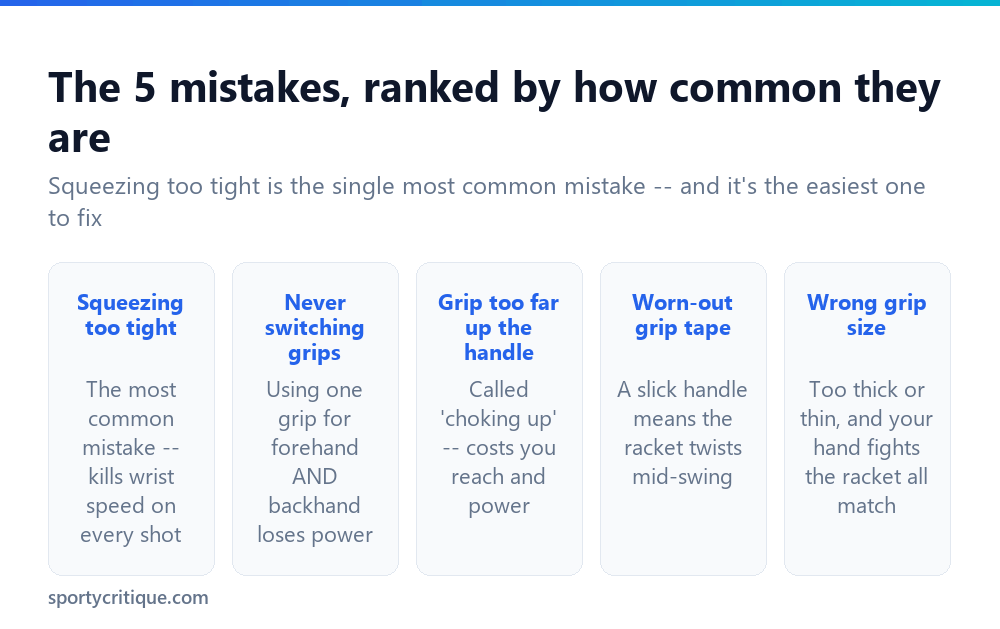
Squeezing too tight. This is the most common mistake at every level, even among club players who’ve played for years. A tight grip kills the wrist speed that generates real power.
Never switching grips. Using one grip for both forehand and backhand shots feels simpler. It also means you’re losing power on whichever shot doesn’t match that grip.
Grip too far up the handle. Called “choking up.” It feels more controlled, but it costs you reach and power on every shot.
Worn-out grip tape. A slick, smooth handle means the racket can twist in your hand mid-swing. Most players don’t notice how bad theirs has gotten.
Wrong grip size. Too thick and your fingers can’t move freely. Too thin and you’re fighting the racket the entire match.
A death grip on the handle is the number one mistake at every skill level. It’s also the easiest one to fix — you can feel the difference in your very next swing.
Checking your own grip
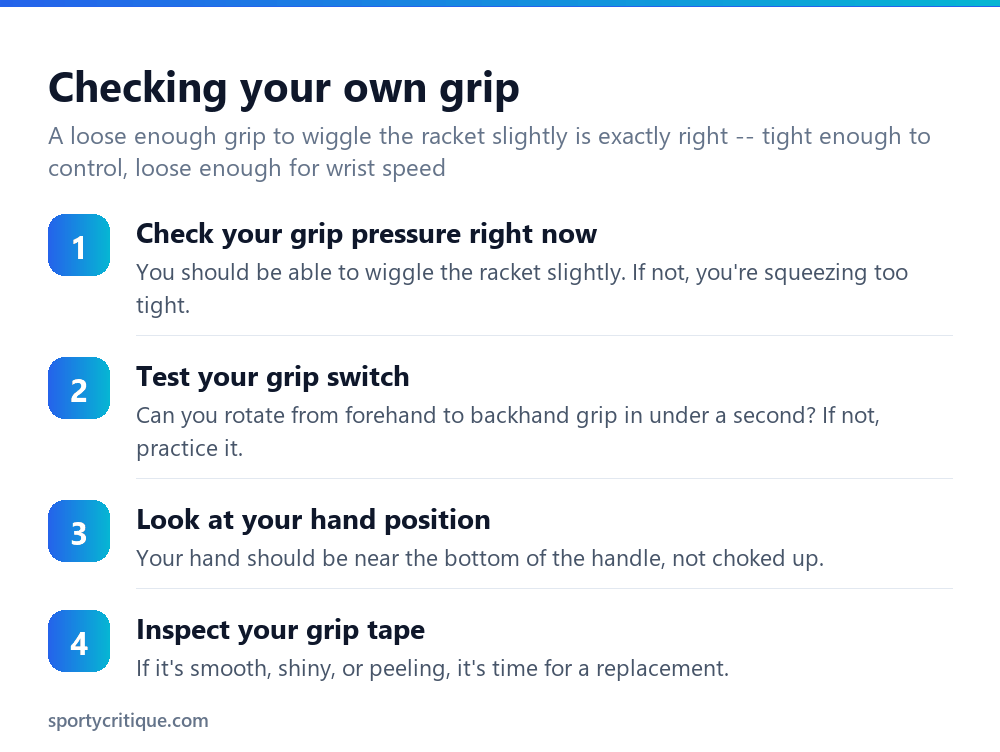
Check your grip pressure right now. Pick up your racket. You should be able to wiggle it slightly in your hand. If you can’t move it at all, you’re squeezing too tight.
Test your grip switch. Can you rotate from forehand grip to backhand grip in under a second, without looking at your hand? If not, that’s worth practicing.
Look at your hand position. Your hand should sit near the bottom of the handle. If it’s noticeably higher up, you’re choking up without realizing it.
Inspect your grip tape. If it looks smooth, shiny, or is starting to peel, it’s already past the point where it should’ve been replaced.
Why a tight grip actually costs you power
This feels backwards. More grip strength should mean more power, right? It doesn’t work that way in badminton.
Power comes from wrist speed, not arm strength. A tight grip locks your wrist in place. That kills the fast wrist snap that generates real racket head speed. Relaxing your grip, even slightly, almost always makes your shots faster, not weaker.
The easiest fix: replace worn grip tape
If your grip tape is smooth or peeling, replacing it solves more problems than people expect. A fresh Yonex Overgrip ($10, 4.7 stars, 794 reviews) gives your hand something to actually hold onto. It also makes it much easier to hold the correct grip pressure, since you’re not fighting a slick handle anymore.
As an Amazon Associate, we earn from qualifying purchases through links on this page.
Checking your grip before every match
Make this part of your pre-match routine. It takes 30 seconds and catches problems before they cost you points.
Pick up your racket. Wiggle it. Switch grips a few times. Look at the tape. If anything feels off, fix it in the warm-up, not in the middle of your first game.
How grip size affects your game
Most rackets come in a standard grip size. That size doesn’t fit every hand. If your fingers wrap all the way around with room to spare, the grip is too thin for you.
Adding one or two layers of overgrip tape builds it up to the right thickness. If the opposite is true, and your hand feels cramped, a thinner factory grip or a smaller racket handle size is worth trying instead.
Why sweaty hands make grip mistakes worse
Sweat changes everything about grip. A grip that felt fine in a cool gym can turn slippery ten minutes into a match.
This is exactly why worn grip tape is such a common, hidden problem. Fresh tape absorbs sweat and keeps its texture. Old tape stops absorbing and just gets slick, right when you need grip the most.
If your hands sweat heavily, consider a towel grip instead of a synthetic one. Towel grips absorb far more moisture. Some players also keep a small towel courtside just to wipe the handle between points during long matches.
How to practice a proper grip without a court
You don’t need a badminton court to fix your grip. Most of this work happens at home, racket in hand, no shuttle required.
Sit in front of the TV and practice switching grips. Forehand, then backhand, then back again. Do this for five minutes a day. It feels silly at first. It also works much faster than trying to fix your grip mid-rally, when you’re already thinking hard about footwork and shot selection at the same time.
Another simple drill: hold the racket loosely and bounce a shuttle on the strings, over and over, without dropping it. This teaches your hand exactly how loose a grip can be while still keeping full control.
Should beginners buy an expensive grip?
No, not at first. A basic overgrip does the same job as an expensive one for learning the fundamentals.
Focus your budget on getting the technique right first. Grip pressure, the switch between forehand and backhand, hand position on the handle. Once those habits are solid, then it’s worth trying different grip textures to find your personal preference.
A $10 overgrip, replaced regularly, beats an expensive one you never change. Consistency matters more than price here, the same way it does with most gear decisions when you’re still building the fundamentals. Save the upgrade money for later, once your technique actually needs it and you know exactly what you’re looking for in a grip, not before you’ve actually put in the real practice time on court.
Grip mistakes that show up only in matches
Some grip problems never show up in practice. They only appear under real match pressure.
Nerves make people squeeze harder, without even noticing. If your grip feels fine in practice but you’re losing power in matches, this is very likely the cause. Pay attention to your grip pressure specifically during close, tense points.
A simple fix: build a habit of relaxing your grip between every single point. Consciously loosen your fingers while walking back to serve or receive. This resets your hand before the tension has a chance to build up over a long match.
Quick fixes for each mistake
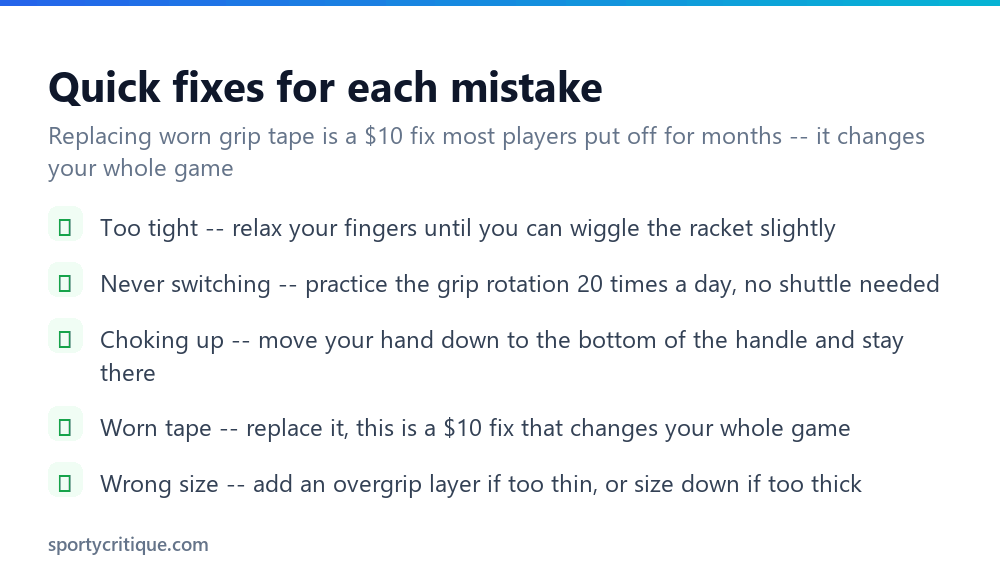
Too tight. Relax your fingers until you can wiggle the racket slightly. It’ll feel strange at first. Stick with it for a week.
Never switching. Practice the grip rotation 20 times a day. You don’t even need a shuttle for this. Just the racket in hand, switching back and forth.
Choking up. Move your hand down to the bottom of the handle and keep it there. It’ll feel less controlled for a few sessions. That feeling goes away.
Worn tape. Replace it. This is a $10 fix that genuinely changes how your whole game feels.
Wrong size. Add an overgrip layer if it’s too thin. Try a smaller handle if it’s too thick.
- ✓Keep your grip loose enough to wiggle the racket slightly
- ✓Practice switching between forehand and backhand grips daily
- ✓Keep your hand at the bottom of the handle, not choked up
- ✓Replace grip tape as soon as it looks smooth or shiny
- ✓Match your grip size to your actual hand size
- ✕Squeezing the handle as tight as possible for ‘more power’
- ✕Using the same grip for both forehand and backhand shots
- ✕Choking up on the handle for a false sense of control
- ✕Playing months with worn-out, slick grip tape
- ✕Ignoring a grip that’s clearly too thick or thin for your hand
Frequently asked questions
What are the most common badminton grip mistakes?
Squeezing too tight, never switching between forehand and backhand grips, choking up on the handle, worn-out grip tape, and the wrong grip size.
Why does gripping too tight hurt my badminton shots?
Power comes from wrist speed, not arm strength. A tight grip locks your wrist and kills the fast snap that generates real power.
How do I know if my badminton grip is too tight?
You should be able to wiggle the racket slightly in a relaxed grip. If you can’t move it at all, you’re squeezing too hard.
What is choking up on a badminton racket?
Holding the racket too far up the handle instead of near the bottom. It feels more controlled but costs you reach and power.
How often should I replace badminton grip tape?
As soon as it looks smooth, shiny, or starts peeling. A slick handle lets the racket twist in your hand mid-swing.
Do I need different grips for forehand and backhand?
Yes. Using one grip for both loses power on whichever shot doesn’t match it. Practicing the switch is worth the time.
- →Put your fixed grip to work on backhand: how to hit a badminton backhand
- →Build the legs to back it up: badminton leg workout
- →Get your footwork right too: badminton footwork basics