Badminton Footwork Basics: The Steps That Actually Matter

Six-Corner Badminton Footwork Cadence & Recovery Matrix
| Court Corner / Zone | Primary Footwork Pattern | Step Count from Base | Lead Foot Plant Angle | Ground Reaction Force | Center Recovery Dynamic |
|---|---|---|---|---|---|
| Forehand Front Net | Chassé slide into deep forward lunge | 2 steps (chassé + lunge) | Heel-to-toe 45° outward toe flare | 2.5× body weight on front heel | Explosive push-back off front heel into base |
| Backhand Front Net | Cross-behind step into reverse lunge | 2 steps (crossover + lunge) | 30° outward bevel to protect patella | 2.2× body weight on dominant leg | Non-racket arm counterbalance extension |
| Forehand Midcourt Defense | Lateral hop / Side-skip | 1 explosive lateral push step | Parallel to baseline | 2.8× body weight lateral brake | Immediate split-step upon opponent contact |
| Backhand Midcourt Defense | Pivot chassé to backhand bevel | 1 to 2 lateral slide steps | 45° rearward pivot | High lateral braking force | Core rotation recoil to center court |
| Forehand Rear Court (Smash) | Scissor kick / China jump step | 3 steps (pivot + chassé + jump) | Landing on non-dominant foot behind line | 3.5× body weight vertical dissipation | Forward momentum drive into midcourt |
| Backhand Rear Court (Clear) | Reverse pivot to cross-step | 3 steps (pivot + cross + drop-step) | Back turned 180° to net, heel plant | Controlled deceleration force | 180° shoulder spin unwinding back to court |
Badminton footwork basics are not complicated, but they are specific: a ready position, a split step, a chasse or lunge, and a recovery step, run in that order on nearly every point. Here is what each one actually looks like, why players skip the split step specifically, and the drills that build the pattern faster than rallying alone.
🏸 Badminton Hub: Explore all 34 racket reviews, stroke mechanics, and drills in our Complete Badminton Resource Hub.
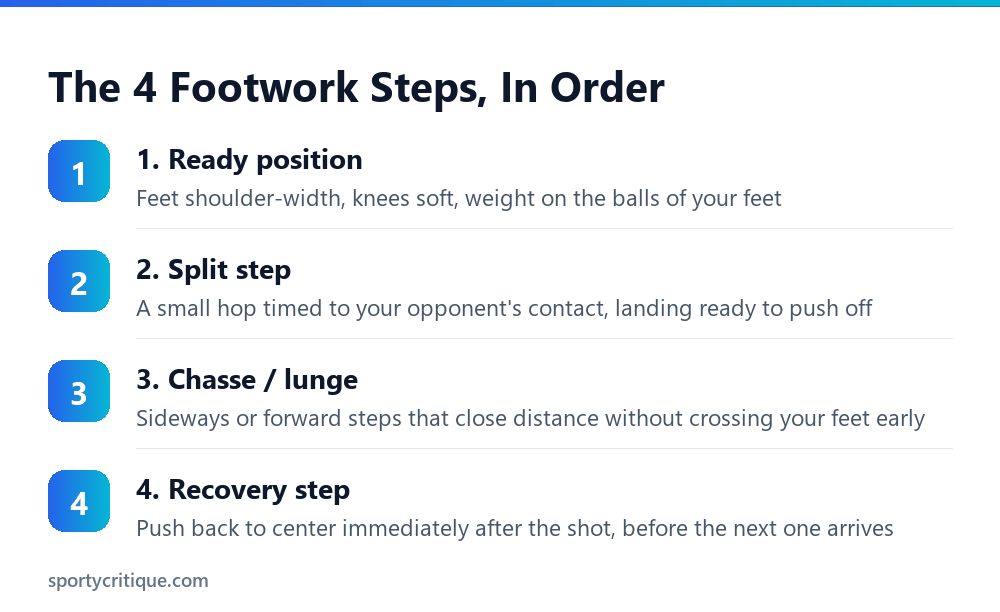
Badminton footwork basics come down to four repeatable pieces: a ready position with your weight forward, a split step timed to your opponent’s contact, a chasse or lunge step to close the distance to the shuttle, and a recovery step back to center before the next shot arrives. Most players who feel like they are always “a step late” are missing the split step specifically, not lacking raw speed. Drilling the steps in isolation, then stringing them together with a shadow-footwork or star drill, builds the pattern faster than just playing more points.
Badminton footwork basics get less attention than the swing itself, but the swing rarely matters if you arrive at the shuttle a half-step late or off balance. Good footwork is what turns a rushed, arm-only shot into one hit with your feet set and your weight moving through it. None of this requires unusual athleticism; it requires learning a small set of specific steps and drilling them until they happen without thinking.
- →Everything starts from a ready position with weight on the balls of your feet, not flat-footed or leaning back
- →The split step, a small hop timed to your opponent’s racket contact, is the single most common footwork gap among self-taught players
- →Chasse steps (sideways shuffle) and lunges (forward reach) cover different distances; using the wrong one for the shot wastes time, not effort
- →Recovery back to center after every shot matters as much as getting to the shuttle in the first place
- →The star drill and shadow footwork build the pattern faster than rallying alone, because you can repeat one movement without waiting on a shuttle
Table of Contents
Ready position: where every step starts
Stand with feet roughly shoulder-width apart, knees slightly bent, and weight resting on the balls of your feet rather than your heels. Your racket should be up around chest height, not down at your side. This sounds obvious written out, but under match pressure it is the first thing that slips: players drift onto flat feet between points, and flat feet cannot push off quickly in any direction. If you notice your calves are not at least a little fatigued after a match, you were probably standing too flat-footed to move well.
The split step: the piece most self-taught players skip
The split step is a small, quiet hop timed to the moment your opponent’s racket makes contact with the shuttle. You land from that hop with your feet already spread and your weight balanced, ready to push off toward wherever the shot goes. Skip it, and you are starting your first step from a static, flat-footed stance, which is measurably slower even if your top speed is fine once you get moving.
The timing is the hard part to self-coach. Landing too early means you are flat-footed again by the time the shot actually arrives; landing too late means you have not absorbed the hop before you need to move. Watch your opponent’s racket, not the shuttle, and try to land the instant the strings make contact. It takes real repetition to get the timing consistent, and it will feel unnatural for longer than most other parts of this guide before it clicks.
⚠️ Watch out: A split step that turns into an actual jump, both feet leaving the ground for a visible hang time, is too big and too slow. Keep it small and quiet; you are resetting your balance, not gaining height.
Chasse steps and lunges: covering the court without crossing your feet
A chasse step is a sideways shuffle where your trailing foot closes toward your lead foot without the two ever crossing. It is the standard way to cover mid-court shots to either side without turning your hips away from the net. Crossing your feet on a sideways shot is slower and puts you off balance for the next movement, even though it can feel like a bigger, more committed step in the moment.
For shots closer to the net or deeper into a corner, a lunge, a longer forward or angled step ending with your front knee bent over your front foot, covers more ground in one movement than a series of small shuffles would. The trade-off is recovery time: a deep lunge takes longer to push back out of than a shuffle does, so save it for shots that genuinely need the extra reach rather than using it as a default.
Recovery: the step everyone forgets to count
Getting to the shuttle is half the job. The other half is getting back toward the center of the court before your opponent’s return arrives, and it is the step that gets skipped most often once players are tired. A shot hit from a great position but followed by a slow recovery just moves the “late” problem to the next shuttle instead of solving it. Build the recovery step into every drill from the start, not as an afterthought once the main movement feels comfortable.
Drills that actually build the pattern
Rallying alone teaches footwork slowly, because you are waiting on a shuttle between reps. Isolated footwork drills let you repeat the movement pattern dozens of times in a few minutes, which is where the steps actually become automatic.
💡 Pro tip: Two to three footwork-focused sessions a week is enough to see real improvement within a few weeks. More than that without adequate recovery tends to degrade form rather than sharpen it, especially for the split-step timing, which needs a fresh, alert nervous system to actually improve.
Footwear matters more than most players account for
Badminton’s stop-start, multidirectional footwork pattern is hard on a running shoe’s cushioning and outsole grip, both of which are built for a straight-ahead motion rather than the constant lateral shuffling and lunging described above. A dedicated indoor court shoe, built with a gum rubber outsole for grip on a court surface, like the ASICS Gel-Rocket 10 Indoor Court Shoes, holds up to that movement pattern noticeably better than general athletic shoes do. Amazon’s listing did not return a live price for this specific model when we checked, so confirm the current price and your size’s availability on the page before buying.
📊 Note: If your shoes are sliding slightly on a chasse step or catching unexpectedly on a lunge, that is very often a footwear grip problem, not a footwork problem. It is worth ruling out before assuming your technique is the issue.
Common footwork mistakes
- ✓Keep weight on the balls of your feet in the ready position
- ✓Time the split step to your opponent’s racket contact, not the shuttle’s flight
- ✓Use a chasse step for mid-court coverage, a lunge for reach
- ✓Recover toward center after every single shot, tired or not
- ✕Stand flat-footed or leaning back between shots
- ✕Turn the split step into a visible jump with real hang time
- ✕Cross your feet on a sideways shuffle step
- ✕Treat recovery as optional once you are fatigued late in a match
Singles footwork vs doubles footwork
Singles and doubles ask for different footwork priorities, and treating them as the same skill is a common reason footwork that looks fine in one format falls apart in the other. Singles covers the full width and depth of the court alone, so lunges and deeper chasse sequences to the back corners come up constantly, and recovery to center has to cover a longer distance each time.
Doubles is a narrower court split between two players, so the individual steps are usually shorter, but the split step has to fire faster and more often because the pace of the rally is higher and a partner is depending on you to cover your half without hesitation. Front-court doubles play leans more on quick, small adjustment steps than the longer lunges singles requires, and rotating positions with a partner adds a communication layer footwork alone does not solve. Players who only train one format tend to carry its habits into the other, which shows up as over-lunging in doubles or under-committing to deep corners in singles.
Warming up before you drill footwork
Footwork drills, especially the star drill and agility ladder work above, load the ankles, calves, and hip flexors hard and fast from a standing start. Going into them cold raises the odds of a rolled ankle or a strained calf, both common badminton injuries tied directly to the same multidirectional movement that makes the footwork itself effective. A short dynamic warm-up, high knees, lateral leg swings, ankle circles, and a few slow reps of the actual chasse and lunge steps at half speed, gets the joints ready without burning energy you need for the drill itself.
Static stretching, holding a stretch for 20 or 30 seconds, is better saved for after the session rather than before it. Stretching cold muscles right before explosive lateral movement has been linked to a short-term drop in power output, which is the opposite of what you want heading into a footwork-focused session.
How long it actually takes to feel different
Most players notice the split step timing starting to feel automatic somewhere around three to four weeks of consistent, focused practice, not a single session. The chasse and lunge steps usually come faster since they are more mechanical and less about reaction timing, but the split step is a timing skill layered on top of a physical one, and timing skills take repetition under slightly varied conditions to lock in. Shadow footwork with a partner calling directions at random, rather than a fixed pattern you can memorize, speeds that process up.
What is the single most important badminton footwork basic?
The split step. It is the one piece most self-taught players skip entirely, and it is the difference between starting your movement from a balanced, ready stance versus a flat-footed one.
How often should I practice badminton footwork?
Two to three focused sessions a week is enough to build real improvement within a few weeks. Footwork, especially split-step timing, benefits from a fresh, alert state more than high volume.
Do I need special shoes for badminton footwork?
Not to learn the steps, but a dedicated indoor court shoe with proper lateral grip makes the chasse and lunge steps noticeably more stable than a general running shoe once you are moving at real speed.
What is the difference between a chasse step and a lunge?
A chasse is a sideways shuffle where your feet never cross, used for mid-court coverage. A lunge is a longer forward or angled step ending with a bent front knee, used when a shot needs more reach than a shuffle covers, at the cost of a slower recovery.
Can footwork drills be practiced without a partner?
Yes. Shadow footwork, the star drill, and agility ladder work all build the pattern solo. A partner helps mainly with randomizing the direction calls so you are reacting rather than memorizing a sequence.
As an Amazon Associate, we earn from qualifying purchases through links on this page.