Best Lacrosse Helmets: NOCSAE-Certified Picks by Price

Finding the best lacrosse helmets for your budget starts with a standard, not a brand: every helmet on this page passed the current NOCSAE ND200 certification test, but that certification is a floor, not a guarantee. Picking the right one still comes down to fit, position, and being honest about what a helmet can and cannot protect against.
The Cascade CPV-R and Warrior Burn are the most consistently available NOCSAE-certified helmets in the $150-$180 range, and both cover a field player’s needs without paying for pro-level features you will not use as a developing player. Step up to the Cascade XRS line if you want the extra peripheral vision and liner technology used at the college level, and check the STX Stallion 100 for a lower-cost youth option, though we could not confirm a live price for it at publish time. Whatever you buy, the certification label matters more than the brand name; an uncertified or expired helmet is not legal for sanctioned play regardless of how new it looks.
A lacrosse helmet is the one piece of gear on this list where getting the decision wrong has consequences beyond a bad purchase. Every helmet sold for competitive play in the United States has to meet the NOCSAE ND200 standard, and that certification, not the price tag, is the first thing to verify before anything else on this page matters.
- →NOCSAE ND200 (2025 edition) certification is mandatory for high school and college play; check for the label, do not assume it based on brand
- →Certified helmets reduce the risk and severity of some head impacts; they do not eliminate concussion risk, and no manufacturer can honestly claim otherwise
- →Fit matters as much as the model: a certified helmet worn loose performs worse than a well-fitted one from the same line
- →Cascade recommends replacing a competitive player’s helmet every 5 years, or immediately after any hard impact, cracked shell, or compressed liner
- →Youth and adult sizing are not interchangeable; measure head circumference and check the specific model’s chart rather than guessing from age alone
Table of Contents
What NOCSAE certification actually covers
NOCSAE, the National Operating Committee on Standards for Athletic Equipment, sets the test standard that lacrosse helmets have to pass before they can be sold for sanctioned high school or college play. The current standard is NOCSAE ND200, updated in 2025, and a certified helmet carries a label reading “MEETS NOCSAE STANDARD,” verified either directly by the manufacturer or by the Safety Equipment Institute. If that label is missing, damaged beyond reading, or the helmet has been reconditioned by a shop not authorized to recertify it, USA Lacrosse and most state athletic associations will not allow it on the field.
It is worth being direct about what this certification does and does not promise. NOCSAE testing measures how much a helmet reduces the force transmitted to the head during a defined set of impact tests. A helmet that passes is meaningfully safer than playing without one, and better liner technology can reduce impact severity further within that certified range. None of that adds up to concussion prevention. Concussions happen from rotational forces and impact mechanics that no helmet fully neutralizes, and any product description that implies otherwise is overstating what the equipment can do. Treat helmet quality as risk reduction, pair it with proper tackling and checking technique, and do not let a good helmet change how a suspected head injury gets handled afterward.
⚠️ Watch out: A secondhand or hand-me-down helmet is only as good as its certification history. If you cannot confirm the manufacture date and impact history, or the shell shows any cracking, the safer call is a new certified helmet, not a bargain on one with an unknown past.
Sizing a lacrosse helmet correctly
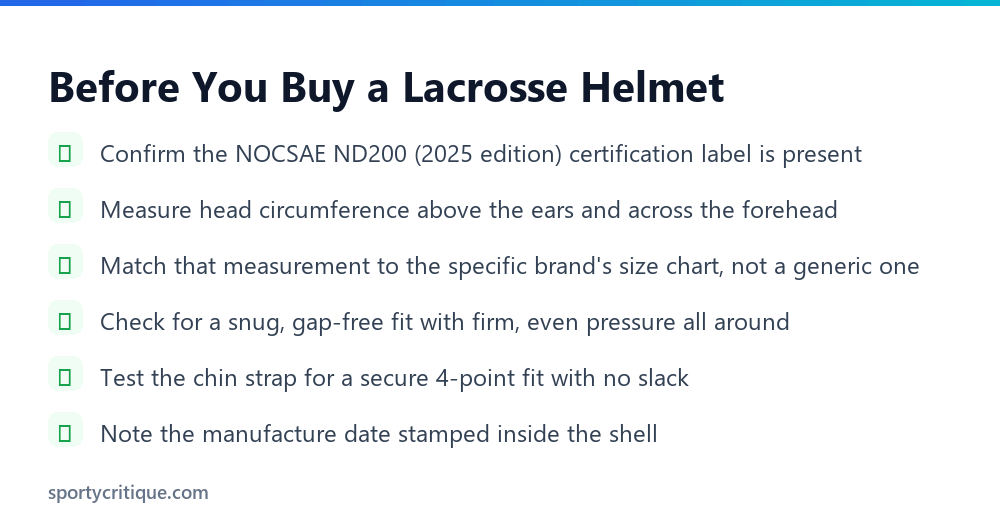
Get the size wrong and even a well-built, fully certified helmet will not protect the way it is designed to. Measure head circumference with a flexible tape, wrapped above the ears and across the mid-forehead, and match that number against the specific model’s size chart rather than a size chart from a different brand or a different helmet line from the same brand. Charts are not standardized across manufacturers.
A correctly sized helmet sits snug all the way around with no gaps between the internal padding and the head, and the padding should apply firm, even pressure rather than pinching in one spot and gapping in another. The chin strap should hold the helmet in a stable 4-point position; if you can shift the helmet more than an inch by pushing on the front or back with the strap fastened, it is either the wrong size or not adjusted correctly.
Our picks by price tier
These are real, currently listed helmets checked against live Amazon pricing and availability at the time this guide was written. Prices and stock change, so treat the numbers below as a starting point and confirm the current listing before buying.
Entry tier: STX Stallion 100
The STX Stallion 100 Youth Helmet is a straightforward, NOCSAE-certified starting point built with an ABS shell and EVA foam padding. It does not have the adjustable fit dials or the vision technology of the pricier picks below, and Amazon’s product feed did not return a live price for this specific listing when we checked, so confirm the current price on the page before buying rather than trusting a number here. For a first-year player who might outgrow the helmet within a season or two anyway, that trade-off is usually fine.
Value tier: Warrior Burn
The Warrior Lacrosse Burn Helmet sits at $159.99 and was showing only one unit left in stock at our last check, so availability on this specific listing may shift quickly. It uses Warrior’s energy-absorbing liner and a reinforced jaw area, and it is a common choice for high school players who want a certified helmet without paying for the adjustable BOA-style fit systems that show up higher in the lineup. The trade-off is a fixed-pad fit rather than a dial adjustment, so sizing correctly at purchase matters more than it does with the adjustable models.
Mid tier: Cascade CPV-R
The Cascade CPV-R Lacrosse Helmet was listed at $174.99 and in stock at last check. Cascade’s CPV-R line carries the brand’s Seven Technology impact liner and a customizable shell and mask combination, which is the main reason it costs more than the Warrior Burn without stepping up to XRS-level pricing. It is a reasonable middle ground for a player who has outgrown a beginner helmet and plans to keep playing for more than one season.
Premium tier: Cascade XRS
The Cascade XRS Youth Lacrosse Helmet was listed at $359.99 at last check. The XRS line is Cascade’s flagship design, built around the R.A.T. rotational liner and a wider peripheral vision cutout that the company markets as improving field awareness. It is the helmet most often seen at the college level, and the price reflects that positioning. For a recreational or first-time competitive player, this tier is more helmet than most people need; it makes more sense for a committed player training seriously enough that the vision and liner differences are worth the extra cost.
Field player helmets vs goalie helmets
Everything above covers field player helmets. Goalies face shots at closer range and higher frequency to the head and face, and NOCSAE tests goalie helmets to a separate standard with additional throat and facial coverage requirements. Do not put a field player in a goalie’s old helmet or the reverse; the certification, padding density, and cage coverage are built for different impact patterns, and a goalie wearing field gear is under-protected for the position even if the helmet is otherwise a good brand and size.
When to replace a lacrosse helmet
Cascade, one of the largest manufacturers in the sport, recommends replacing a competitive player’s helmet roughly every 5 years even without a specific incident, since foam liners lose some of their impact-absorbing properties over time and with repeated compression. That guidance is from the manufacturer, not an independent lab figure, so treat it as a reasonable ceiling rather than a hard deadline. Replace it sooner, immediately, if the shell shows a visible crack, the liner has an obvious flat or compressed spot, or the helmet has taken a hard direct hit regardless of how old it is. A helmet that looks fine on the outside can still have compromised padding after a serious impact, and there is no reliable way to inspect that damage yourself.
💡 Pro tip: Write the purchase date inside the helmet with a permanent marker, on the foam where it will not rub off. It is a five-second habit that makes the 5-year replacement window something you can actually track instead of guessing at years later.
Youth vs adult sizing, and why age alone is not enough
Youth and adult lacrosse helmets are built on different shell geometries, not just scaled-down versions of the same mold, so a small adult helmet is not automatically a safe substitute for a large youth one or the other way around. Head circumference, not age or grade, is the number that should drive the decision. A ten-year-old with a larger head than average may already need to size up out of the youth line, and a smaller-framed teenager might still be in a youth model longer than expected. Measure before every purchase rather than assuming the previous season’s size still fits; kids’ head growth does not follow a predictable yearly jump.
- ✓Verify the NOCSAE ND200 label before comparing anything else
- ✓Measure head circumference fresh for every purchase, not from memory
- ✓Replace the helmet immediately after a hard direct impact
- ✓Buy from the model’s own size chart, not a generic one
- ✕Assume a higher price automatically means better concussion protection
- ✕Buy a secondhand helmet with an unknown impact history
- ✕Put a field player in a goalie helmet or the reverse
- ✕Keep a helmet past 5 years of competitive use without inspecting it closely
Caring for the helmet between games
Wipe the interior padding down after practice and let it air dry fully before the helmet goes back in a bag; trapped sweat breaks down foam faster and creates the kind of odor that does not come back out. Avoid direct sunlight or a hot car trunk for long stretches, since UV exposure and heat can degrade the shell’s plastic over time in ways that are not always visible until the helmet is already compromised. Most manufacturers recommend hand-cleaning the shell with mild soap and water rather than anything abrasive, since a scratched or thinned shell surface can change how it performs in an impact.
Is the extra money for a premium helmet actually worth it
The honest answer depends on how much lacrosse the player in question is actually playing, not on how competitive the parents feel about it. A recreational or first-season player spending two hours a week on a field gets the same NOCSAE-level protection from a $160 certified helmet as they would from a $360 one; the difference between those two price points shows up in liner comfort over a long practice, peripheral vision on the field, and how the helmet holds up to repeated use over multiple seasons, not in a meaningfully lower concussion risk at the moment of impact.
Where the premium tier earns its price is with players training several days a week, wearing the helmet for hours at a time, and relying on it across multiple seasons of competitive play. The wider vision cutouts on helmets like the Cascade XRS line matter more when a player is reading the field constantly rather than playing casually, and a more durable liner holds its shape better across a long season of daily wear. If that describes the player, the extra cost is going toward real, usable differences. If it does not, that money is better spent on a well-fitted mid-tier helmet and a good pair of gloves.
Common mistakes buyers make with lacrosse helmets
The most frequent mistake is buying by age or grade level instead of measuring head circumference directly, which leads to a helmet that is technically the right category but the wrong fit for the specific kid wearing it. A close second is assuming a helmet advertised as “tournament grade” or “pro style” carries some additional safety certification beyond NOCSAE; those are marketing terms, not test standards, and they do not replace checking for the actual certification label.
A third common mistake is skipping the break-in period and judging comfort after a single practice. Foam liners soften slightly and mold closer to the head shape over the first few sessions of normal wear, so a helmet that feels a little tight or a little loose in one spot during the first practice is often not the fit problem it seems to be after week one. Give a new helmet two or three full sessions before deciding it is the wrong size, and only then look at exchanging it.
📊 Note: If a helmet still feels uneven or loose in one specific spot after a proper break-in period, that is a fit issue worth acting on, not something to push through. A helmet that shifts under contact is not doing its job regardless of certification.
Do all lacrosse helmets need NOCSAE certification?
Yes, for sanctioned high school and college play. Youth recreational leagues vary by state and organization, but buying a certified helmet regardless of league rules is the safer default, and most youth leagues require it anyway.
Does a more expensive helmet mean a lower concussion risk?
Not directly. A certified helmet reduces the force transmitted in a defined impact test, and better liner technology in pricier lines can improve on that within the certified range. No helmet, regardless of price, eliminates concussion risk, since rotational forces and impact angle matter as much as the padding.
How often should a lacrosse helmet be replaced?
Cascade recommends roughly every 5 years for a competitive player, or immediately after a hard direct impact, a cracked shell, or a visibly compressed liner, whichever comes first.
Can a goalie wear a field player’s helmet?
No. Goalie helmets are tested and built to a separate NOCSAE standard with additional throat and facial coverage for the closer-range shots goalies face. Field and goalie helmets are not interchangeable.
How do I know if a lacrosse helmet fits correctly?
It should sit snug all around with no gaps between the padding and your head, apply even pressure rather than pinching anywhere, and stay stable with the chin strap fastened. If you can shift it more than about an inch by pushing on it, it is the wrong size or not adjusted correctly.
As an Amazon Associate, we earn from qualifying purchases through links on this page.