Best Lacrosse Cleats for Turf and Grass


The best lacrosse cleats depend on the surface a player trains and plays on most. For a program split between turf and grass, a low-cut shoe with a detachable stud plate like the New Balance FreezeLX V5 gives the most flexibility. For turf-only fields, a dedicated turf outsole with short, dense studs like the Under Armour Blur Pro Turf reduces joint strain on the harder surface. For natural grass, a mid-cut shoe with an aggressive molded pattern like the Nike Huarache 9 Elite Mid digs in for better traction and cutting.
Cleat choice in lacrosse gets less attention than stick or head selection, but the wrong stud pattern for the surface a player actually plays on affects traction, injury risk, and comfort far more directly than most equipment decisions. Turf and grass are different surfaces mechanically, and a cleat built for one doesn’t automatically perform well, or safely, on the other.
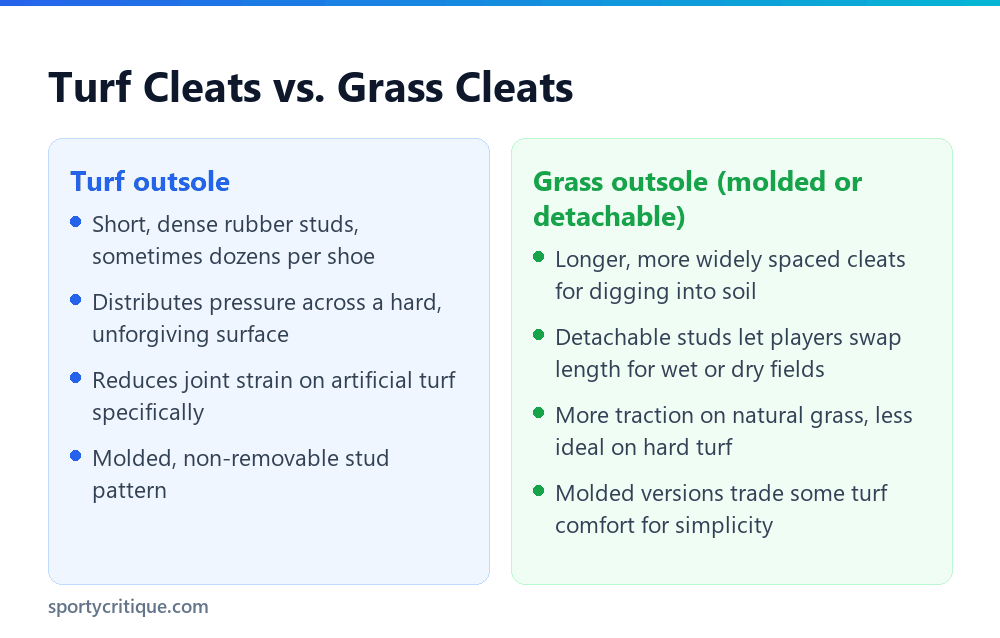
- →Turf cleats use short, dense rubber studs; grass cleats use longer, more widely spaced studs
- →Playing turf-specific fields on grass cleats increases joint strain from excessive traction
- →A detachable stud plate offers the most flexibility for programs that split time between surfaces
- →Mid-cut cleats add ankle support at a small weight and mobility cost versus low-cut models
- →Fit and break-in matter as much as stud pattern; a poorly fitted cleat undermines any outsole choice
Table of Contents
Why Turf and Grass Need Different Outsoles
Artificial turf is a harder, more consistent surface than natural grass, and a cleat built for soil, with longer studs meant to dig in and release, grips turf too aggressively. That excess grip doesn’t let the foot rotate and release naturally during quick cuts and stops, which concentrates stress on the knee and ankle instead of allowing the small, natural slide a turf outsole is designed to permit.
⚠️ Watch out: Wearing long-stud grass cleats on turf regularly is a specific, documented risk factor for lower-body injury, not just a comfort or performance tradeoff. Programs that play primarily on turf fields should prioritize a turf-specific or turf-compatible outsole rather than defaulting to a traditional molded cleat.
Natural grass, by contrast, is softer and less consistent, varying with weather, mowing height, and field condition from one game to the next. Longer studs that can dig past a thin, wet top layer into firmer soil underneath actually improve traction on grass in a way that short turf studs can’t replicate, since turf studs are built to grip a hard, flat surface rather than penetrate soil.
5 Real Options, Compared
📊 Note: The FreezeLX V5’s detachable stud plate is the single most useful feature in this comparison for any player who doesn’t know in advance whether a given practice or game will be on turf or grass, since it removes the guesswork of committing to one surface type at purchase time.
Detachable Studs: Worth the Extra Cost?
A detachable stud plate adds cost and a small amount of setup time compared to a fully molded outsole, but it solves a real, recurring problem for players who train on one surface and compete on another, or whose schedule mixes both throughout a season. Swapping a shorter turf stud for a longer grass stud takes a few minutes with the right tool and avoids owning two separate pairs of cleats entirely.
For a player who only ever sees one surface type, turf-only or grass-only for an entire season, a molded outsole built specifically for that surface is simpler, usually lighter, and often cheaper than a detachable system that’s solving a problem that player doesn’t actually have.
Low-Cut vs. Mid-Cut
- ✓Choose low-cut for maximum speed, agility, and reduced weight
- ✓Choose mid-cut for added ankle support, especially for players with prior ankle injuries
- ✓Match stud pattern to primary playing surface, not just cut height
- ✓Break in new cleats during practice before wearing them in a game
- ✕Assuming mid-cut automatically prevents ankle injuries on its own
- ✕Buying based on cut height alone while ignoring stud pattern entirely
- ✕Wearing brand-new, unbroken-in cleats for the first time in a game
- ✕Using long-stud grass cleats as a default on turf-heavy schedules
💡 Pro tip: Mid-cut cleats add real ankle support, but they aren’t a substitute for proper ankle strengthening and mobility work. A player who has had repeated ankle sprains benefits more from addressing the underlying stability issue than from relying on footwear alone to compensate.
Fit and Break-In Matter More Than Brand
A cleat that fits poorly, too tight across the toe box, too loose in the heel, undermines even the best stud pattern and outsole design. Lacrosse cleats generally run true to size but vary meaningfully between brands, so checking a specific brand’s sizing chart or trying a pair in person before committing to an online purchase avoids a common and frustrating mismatch.
New cleats, even a correctly sized pair, benefit from a few practice sessions of break-in before facing full game intensity. Stiff new material around the ankle and heel can cause blistering or discomfort that fades once the shoe has flexed and molded to the player’s foot through normal use.
Socks and Insoles: The Overlooked Half of the Fit
A well-fitted cleat paired with the wrong sock thickness can still produce blisters or a sloppy, unstable fit. Compression-style athletic socks that don’t bunch inside the shoe reduce friction points, and players moving between a thicker winter sock and a thinner summer sock sometimes need a half-size adjustment to compensate.
Aftermarket insoles can also extend the useful life of an otherwise well-fitting cleat whose factory cushioning has broken down before the outsole itself shows real wear. This is a cheaper fix than replacing an entire pair of cleats and is worth trying before assuming a shoe has fully reached the end of its useful life.
Choosing Cleats for Youth Players
Youth players’ feet grow quickly enough that buying a premium, detachable-stud cleat rarely makes financial sense compared to an adult player at a stable shoe size. A simpler, less expensive molded cleat, replaced more frequently as the foot grows, is usually the more practical choice for younger age groups still going through regular growth spurts.
Fit still matters as much for youth players as adults, and a cleat bought with room to grow, expecting a child to grow into it over a season, tends to produce a loose, unstable fit that increases both blister risk and the chance of a rolled ankle from a shoe that doesn’t hold the foot securely during quick direction changes.
When to Replace Lacrosse Cleats
Visible wear on the stud pattern itself, rounded-off edges that no longer bite into the surface, is the clearest sign a pair needs replacing regardless of how the upper material looks. Worn studs reduce traction gradually enough that many players don’t notice the decline until they compare old cleats side by side with a new pair.
A season or two of regular use is a reasonable general timeline for a molded cleat under consistent play, though heavier use, a player who trains daily rather than a few times a week, shortens that window. Checking stud wear at the start of each new season, rather than waiting for an obvious failure mid-game, catches the decline before it affects performance or safety.
Cleaning and Storing Cleats Between Uses
Knocking loose mud and debris out of the stud pattern after every practice or game, rather than letting it dry and harden between the studs, keeps the outsole performing as designed and prevents the buildup from adding unnecessary weight to the shoe. A stiff brush and a quick rinse handle most of this; a full submerged wash isn’t necessary and can damage the upper material or adhesives over time on some models.
Letting cleats air dry fully between uses, rather than storing them damp in a closed bag immediately after a game, reduces odor buildup and helps the materials hold their shape longer. Removing the insole separately to dry, if the shoe allows it, speeds this process up considerably compared to leaving everything sealed together.
Thinking About Cost Per Season, Not Just Sticker Price
A cheaper cleat that needs replacing every half-season because the stud pattern wears down quickly can end up costing more over a full year than a pricier pair that holds up for two full seasons of regular use. Factoring expected lifespan into the purchase decision, not just the upfront price tag, gives a more accurate picture of which option is actually the better value for a specific player’s usage level.
This calculation matters most for players training multiple times a week on turf, where wear accumulates faster than for a player playing a lighter, once-a-week grass schedule. A parent or player budgeting for a season of equipment benefits from thinking in these terms rather than simply picking whichever pair costs the least at checkout.
Frequently Asked Questions
Can I use football cleats for lacrosse?
Some players do, since stud patterns overlap significantly between the sports, but lacrosse-specific cleats are built with the sport’s cutting and running patterns in mind. Football cleats work in a pinch but aren’t a purpose-built substitute long-term.
Are detachable studs worth it for a single-surface team?
Generally no. A team that plays exclusively on one surface type gets little practical benefit from the flexibility a detachable system offers, and a molded outsole built for that surface is usually simpler and cheaper.
How do I know if my cleats are turf-safe?
Check the outsole for short, dense rubber studs rather than long, widely spaced cleats. Many manufacturers also label turf-specific models directly, or list turf compatibility in the product description.
Do lacrosse cleats run true to size?
Generally yes, but sizing varies by brand. Checking a specific brand’s size chart, or trying a pair in person, avoids the most common sizing mismatches before an online purchase.
How often should youth players get new cleats?
More often than adults, mainly due to foot growth rather than wear. Checking fit at the start of each season, rather than assuming last year’s pair still fits, catches growth-related sizing issues early.
Is mid-cut always better for ankle support?
It adds support, but it’s not a complete substitute for ankle strength and mobility work. Players with a history of ankle injuries benefit from addressing the underlying stability issue directly, not just relying on footwear.
Matching stud pattern to the surface a player actually competes on most, then getting fit and break-in right, matters more than chasing the priciest option on the shelf. Once those fundamentals are covered, the remaining choice between the picks above comes down to budget and how much flexibility a detachable system is actually worth to a specific player’s schedule.
As an Amazon Associate, we earn from qualifying purchases through links on this page.