How to Run a Wall Ball Routine for Stick Skills

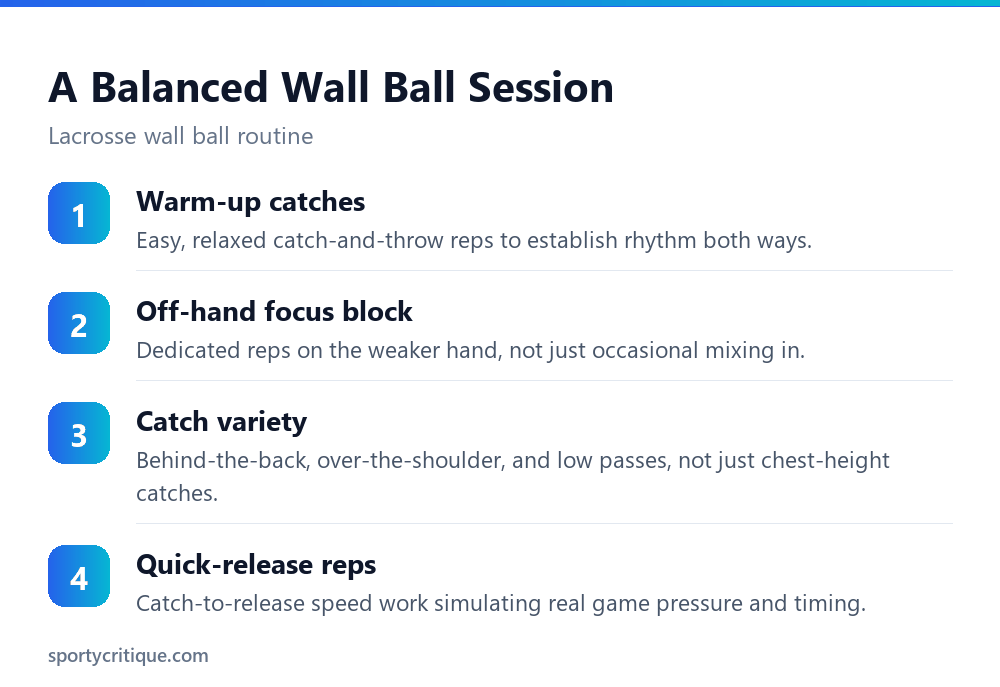
An effective lacrosse wall ball routine balances four elements: a relaxed warm-up establishing catch-and-throw rhythm on both sides, a dedicated block specifically targeting the off-hand rather than just occasionally mixing it in, catch variety including behind-the-back, over-the-shoulder, and low passes rather than only repeating chest-height catches, and quick-release reps that simulate the catch-to-release speed actual game pressure demands. Simply throwing against a wall for a set amount of time without this structure wastes much of wall ball’s real training potential.
Wall ball is one of the most universally recommended lacrosse training tools, but its actual value depends entirely on how deliberately a player structures their time against the wall. Two players spending the same 20 minutes can walk away with very different skill development depending on whether that time followed a real routine or just repeated the same comfortable catch and throw indefinitely.
- →Off-hand work needs a dedicated block, not just occasional mixing into a dominant-hand session
- →Catch variety, not just repeated chest-height catches, builds more complete stick skills
- →Quick-release reps specifically train the catch-to-release speed real games actually demand
- →A structured routine produces meaningfully more development than unstructured wall time
- →Session length matters less than the quality and variety of reps within that time
Table of Contents
Starting With a Relaxed Warm-Up
Beginning with easy, relaxed catch-and-throw repetitions on both the dominant and off hand establishes basic rhythm and lets a player’s hands and eyes adjust to the wall’s specific rebound speed and angle before moving into more demanding, technical work later in the session.
This warm-up phase also serves as a useful diagnostic moment, since a player paying attention during these easier reps can notice early signs of fatigue, distraction, or a specific technical issue that’s worth addressing before ramping up intensity for the rest of the session.
Dedicating Real Time to the Off-Hand
Most players naturally gravitate toward their dominant hand during unstructured wall ball, getting the vast majority of total reps on their stronger side unless a routine specifically carves out dedicated off-hand time rather than leaving it to occasional, incidental mixing.
⚠️ Watch out: A wall ball routine that only occasionally throws in a few off-hand reps within an otherwise dominant-hand-focused session doesn’t build meaningful off-hand competency. A genuinely effective routine needs a real, dedicated block, not just a token gesture toward the weaker side.
💡 Pro tip: Structuring a session with roughly equal time split between dominant and off-hand work, rather than a heavily lopsided ratio favoring the stronger side, closes the skill gap between hands far faster than an imbalanced routine ever will.
Building In Catch Variety
Repeating only comfortable, chest-height catches throughout an entire session builds competency in exactly one specific catching scenario while leaving a player unprepared for the wider range of catch angles and heights that actually occur during real game play.
Deliberately practicing low passes, high passes requiring a reach, and behind-the-back or over-the-shoulder catches specifically, even though these feel awkward and less successful initially, builds the more complete stick skill set that separates a well-rounded player from one whose skills only hold up in the specific, narrow conditions they’ve actually practiced.
Quick-Release Reps
Dedicating a portion of a session specifically to catching and releasing as fast as possible, rather than catching, settling, and then throwing in two distinct motions, trains the catch-to-release speed that actual game pressure from a closing defender genuinely demands in live play.
This quick-release work connects directly to skills covered in more detail elsewhere on this site, including the specific catch-and-shoot technique used for a quick-stick shot, since both skills depend on the same underlying principle of merging the catch and the next action into one continuous, fluid motion rather than two separate steps.
Common Wall Ball Mistakes
- ✓Dedicate real, equal time to off-hand work, not just occasional mixing
- ✓Practice varied catch types, not only comfortable chest-height catches
- ✓Include quick-release reps that simulate actual game pressure and timing
- ✓Structure sessions with clear phases rather than unstructured, repetitive throwing
- ✕Spending the vast majority of reps on the dominant hand out of comfort and habit
- ✕Repeating only easy, comfortable catches while avoiding more awkward, useful variations
- ✕Treating every catch as a separate action from the following throw
- ✕Measuring session quality purely by total time spent rather than rep variety and focus
Varying Distance and Angle
Adjusting throwing distance from the wall periodically within a session changes the ball’s rebound speed and reaction time available, building adaptability that a fixed, unchanging distance throughout an entire session doesn’t develop nearly as effectively.
Throwing at different angles to the wall, rather than always squarely facing it, also introduces rebound variation closer to the unpredictable angles a player actually encounters catching passes from teammates positioned at different spots on an actual field during live play.
Equipment Considerations for Wall Ball
Using a slightly worn or backup stick specifically for wall ball, rather than a primary game stick, protects the main stick from the repetitive wear this kind of intensive practice puts on pocket tension and stringing over hundreds or thousands of repetitions.
Checking that the specific wall surface used is appropriate and, where required, permitted for this kind of use avoids property damage or conflict, particularly for players practicing against a home garage door, a school wall, or another surface not specifically built or designated for ball-against-wall training.
Progressing a Wall Ball Routine Over Time
A beginner’s wall ball routine should emphasize basic catch-and-throw consistency on both hands before adding the more advanced elements, quick release, unusual catch angles, and distance variation, covered throughout this guide, since attempting advanced variations before basic consistency is solid tends to reinforce sloppy fundamentals rather than build on a solid base.
As a player’s basic consistency improves, gradually layering in the more demanding elements one at a time, rather than attempting every advanced variation simultaneously from the start, builds a progressively more complete and battle-tested skill set over a full season or multiple seasons of consistent practice.
Solo Wall Ball vs. Partner Passing
Wall ball’s main advantage over partner passing is repetition volume without needing another player available, letting a motivated player rack up significantly more total reps in a given amount of time than waiting on a partner’s return throw would ever allow.
Partner passing still offers something wall ball can’t fully replicate, reading a human thrower’s release and body language rather than a fixed, predictable wall rebound, which is why the two practice methods work best as complements rather than one fully replacing the other in a complete training plan.
Specific Drill Sequences Worth Trying
A simple progression drill, five reps standing still, five reps shuffling laterally while catching and throwing, then five reps approaching and retreating from the wall, builds footwork and stick skill together rather than isolating pure stationary catching in a way that doesn’t reflect how players actually move during real games.
A “bad pass” drill, deliberately throwing off-target passes to oneself that require an awkward stretch, a low scoop, or a reach to catch, specifically trains recovery from the kind of imperfect pass a teammate might realistically deliver during a fast-paced, less-than-ideal game situation.
💡 Pro tip: Counting successful catches out of a set number of attempts, rather than practicing for pure time without any measurable target, gives a player a concrete number to track and improve over successive sessions, adding a simple, motivating progress metric to the routine.
Maintaining Mental Focus During High-Repetition Work
Wall ball’s repetitive nature makes it easy for attention to drift after the first several minutes, and a player going through the motions without genuine focus gets meaningfully less actual skill development from their reps than one staying mentally engaged with each individual catch and throw.
Breaking a longer session into shorter, clearly defined blocks with a brief pause between each, rather than one continuous, undifferentiated stretch of throwing, helps maintain this mental engagement better than pushing through an extended session without any structural breaks to reset focus.
Wall Ball for Younger Players
Younger players benefit enormously from wall ball specifically because it provides high-repetition practice without requiring a coach, parent, or teammate’s constant availability, letting a motivated young player accumulate meaningful extra reps independently between organized team practices.
Keeping early sessions shorter and more focused on basic catch-and-throw consistency, rather than immediately introducing the more advanced variations covered throughout this guide, matches a younger player’s developmental stage and attention span better than an adult-level routine applied without adjustment.
Tracking Improvement Over a Season
Periodically testing specific benchmarks, consecutive off-hand catches without a drop, or quick-release reps completed within a set time window, gives a concrete way to measure actual progress rather than relying purely on a subjective sense that skills are improving over a season of regular practice.
Revisiting these same benchmark tests every few weeks throughout a season provides clear, objective feedback on whether a specific routine is actually producing results, information that’s far more useful for adjusting training focus than continuing an unchanged routine purely out of habit without ever checking whether it’s still the right emphasis for that player’s current needs.
Frequently Asked Questions
How long should a wall ball session be?
Session length matters less than structure and rep quality. A well-structured 15 to 20 minute session covering off-hand work, catch variety, and quick release often produces more real development than an unstructured hour.
Why is off-hand wall ball work so important?
Most players naturally favor their dominant hand during unstructured practice, and only a dedicated, equal-time off-hand block actually closes the skill gap between hands over time.
Should I only practice comfortable, chest-height catches?
No. Practicing varied catch heights and angles, including awkward ones, builds more complete stick skills that transfer better to the unpredictable catches actual games demand.
What are quick-release reps and why do they matter?
Catching and releasing in one fluid motion rather than two separate steps, training the catch-to-release speed that real defensive pressure in games actually requires.
Should beginners use advanced wall ball variations right away?
No. Building basic catch-and-throw consistency on both hands first, then gradually layering in more advanced elements, produces better long-term results than attempting everything at once.
Does the surface I practice against matter?
Yes, both for appropriateness and permission. Confirming a wall surface is suitable and, where needed, allowed for this use avoids property damage or conflict.
A coach who assigns wall ball as homework between practices does the team a real favor by handing over a specific, structured routine rather than a vague instruction to “go throw against a wall,” since the structure itself is what actually determines whether that independent practice time translates into real, measurable improvement.
Wall ball’s reputation as one of lacrosse’s most valuable training tools is well earned, but only when a player brings real structure and intention to the time spent against the wall, rather than treating it as a mindless activity that improves skills through sheer repetition alone.
None of these tracking or drill-sequencing ideas require special equipment beyond a stick, a ball, and a suitable wall, which is part of why wall ball remains one of the most accessible and cost-effective training tools available to a lacrosse player at any level, from a first-year beginner to an experienced competitive athlete.
Whatever level a player is at, the same underlying principle holds true: intentional, varied, and consistently tracked practice against a wall builds real stick skills far faster than any amount of unstructured, casual time spent simply going through the same comfortable, familiar motion over and over again, session after session.
As an Amazon Associate, we earn from qualifying purchases through links on this page.