Best Badminton Strings for Tension and Repulsion: Gauge Diameter Physics, Vectran Core Durability, and Acoustic Feedback

While badminton players spend significant time analyzing racket frame carbon grades and balance points, the string bed represents the sole mechanical component that makes physical contact with the shuttlecock. The physical characteristics of this interface—including gauge diameter, core tensile strength, tension holding capability, and surface friction braiding—dictate whether your smash leaves the racket face at three hundred kilometers per hour or floats softly into your opponent’s mid-court kill zone.
Selecting the ideal string setup requires balancing repulsion speed against structural longevity. High-tension thin-gauge strings deliver surgical directional control and explosive auditory feedback but can break prematurely on off-center mishits, while thick-gauge strings offer durable tension retention at the expense of crisp water-cutting speed. This technical equipment breakdown examines the engineering principles governing badminton strings: gauge physics, Vectran composite braiding, tension decay dynamics, and restringing protocols.
Table of Contents
Physics of String Diameter: Thin Gauges vs Heavy Gauges
String gauge is measured in fractions of a millimeter and dictates the fundamental tradeoff between repulsion and durability:
Thin Gauge Strings (0.61mm to 0.65mm): Exemplified by Yonex Aerosonic (0.61mm), Exbolt 63 (0.63mm), and BG66 Ultimax (0.65mm). Thin strings slice cleanly through oncoming air turbulence, minimizing frame hoop drag during rapid overhead swings. Upon shuttlecock contact, the narrow cross-section indents deeply into the natural feather cork, generating instantaneous trampoline repulsion and high exit velocity. The acoustic report produced by a 0.63mm string bed at twenty-eight pounds is a piercing metallic crack that intimidates opponents. The critical compromise is structural lifespan: thin strings subjected to aggressive slicing or off-center mishits near the top frame grommets frequently break within fifteen to twenty playing hours.
Medium Gauge Strings (0.66mm to 0.68mm): The competitive tournament standard, exemplified by Yonex BG80 (0.68mm) and Victor VBS-66 (0.66mm). Striking an optimal balance between blistering repulsion speed and robust structural integrity, medium gauges provide enough mass to withstand high-tension string beds up to thirty pounds while maintaining crisp shuttlecock control.
Thick Gauge Strings (0.69mm to 0.70mm): Exemplified by the legendary Yonex BG65 (0.70mm). Composed of dense multi-filament nylon wraps, thick strings are built for maximum tension holding durability. They resist friction fraying and survive hundreds of training hours, making them the standard choice for club training and junior programs, though they sacrifice crisp acoustic bite and explosive touch.
Top Badminton Performance Strings: Technical Comparison Matrix
| String Model | Gauge Diameter | Core Construction & Coating | Repulsion vs Durability Rating | Target Player Profile |
|---|---|---|---|---|
| Yonex BG80 Power | 0.68 mm | High-polymer nylon with Vectran fiber wrap | Hard feeling, maximum smash power | Aggressive backcourt smashers |
| Yonex Exbolt 63 | 0.63 mm | Forged Fiber molecular braided outer | Explosive repulsion, crisp hitting acoustic | Speed players, technical doubles drivers |
| Yonex BG66 Ultimax | 0.65 mm | High-intensity multifilament nylon core | Medium feeling, maximum shuttle repulsion | Elite singles technicians, touch players |
| Victor VBS-66 Nano | 0.66 mm | High-strength nylon with nano-resin bonding | Crisp snap, tight directional control | Competitive tournament all-arounders |
| Li-Ning No. 1 | 0.65 mm | Heat-resistant high-modulus nylon core | High repulsion with metallic acoustics | Fast-paced attacking doubles specialists |
Top Badminton Performance Strings: Detailed Equipment Analysis
1. Yonex BG80 Power: The definitive benchmark for attacking backcourt power specialists. Yonex integrates high-modulus Vectran fibers braided tightly around a dense multifilament nylon core. With an 0.68mm diameter and a distinctively hard hitting feel, the BG80 Power retains high tension exceptionally well, transferring maximum body torque directly into the shuttlecock for punishing baseline smashes.
2. Yonex Exbolt 63: A breakthrough in material science engineered with proprietary Forged Fiber technology. Traditional thin strings suffer from low shear resistance; Yonex restructured the molecular intermolecular bonds within the outer braid, increasing durability by twenty-four percent compared to conventional 0.63mm strings while delivering razor-sharp repulsion speed and lightning-fast flat drive recovery.
3. Yonex BG66 Ultimax: Favored by international singles champions for its buttery touch, elastic repulsion, and surgical shuttlecock feedback. At 0.65mm, the BG66 Ultimax flexes easily upon impact, providing effortless baseline clears and crisp half-smash placement. Requires careful restringing to prevent premature shearing at the grommets.
4. Victor VBS-66 Nano: Designed with high-strength nylon filaments bound by specialized nano-resin matrices. The VBS-66 Nano delivers a firm, crisp sensation on impact with reduced string bed deflection, giving competitive all-arounders accurate directional trajectory control on delicate tumbling net drops and cross-court slices.
5. Li-Ning No. 1: The premier choice among fast attacking doubles players who demand blistering shuttlecock departure velocity. Utilizing heat-resistant high-modulus nylon, the 0.65mm No. 1 string produces an explosive acoustic crack on overhead smashes while providing substantial repulsion on abbreviated stick smashes.
Hybrid Stringing Mechanics: Combining Friction Mains with Slick Crosses
Modern badminton has embraced hybrid string configurations to optimize conflicting mechanical requirements:
The Mechanics of Hybrid Setups (Yonex Aerobite Concept): The vertical main strings absorb roughly eighty percent of impact force and dictate directional slice spin. In a hybrid setup, the mains utilize a thicker, rough-textured string (such as a 0.67mm polyurethane-coated braid) that grips the shuttlecock cork for devastating cut smashes and spinning net tumbling shots. Conversely, the horizontal crosses utilize an ultra-thin, slippery 0.61mm string that allows the mains to slide freely and snap back explosively into alignment.
Tension Differentiation in Hybrids: When stringing hybrid setups, stringers routinely pull the cross strings two pounds tighter than the mains to account for crossbed friction and preserve the frame’s structural oval profile.
Core Material Engineering: Vectran vs Forged Fibers
Synthetic string cores utilize advanced polymeric chemistry to maximize tensile strength and elastic recovery:
Vectran Liquid-Crystal Polymer Braiding: Vectran is an aromatic polyester spun from liquid-crystal polymers. It exhibits zero moisture absorption, extreme tensile strength (over five times that of standard steel by weight), and exceptional resistance to permanent plastic elongation. In strings like Yonex BG80, Vectran fibers wrapped around the core create a rigid, highly stable matrix that prevents string stretching under twenty-eight-plus pounds of tension.
Forged Fiber Molecular Realignment: In the Exbolt series, Yonex introduced Forged Fiber technology. By removing internal voids and realigning molecular chains during the extrusion process, the outer braid resists friction sawing—the primary mechanism by which cross strings cut into main strings during heavy topspin slices.
Tension Physics: Sweet Spot Size vs Repulsion Board Dynamics
Understanding string tension dynamics allows players to optimize their equipment for their physiological capability:
Lower Tensions (20 to 24 lbs): The Trampoline Spring: At lower tensions, the string bed deflects significantly when struck by the shuttlecock, creating an extended dwell time. This mechanical trampoline effect acts as an energy amplifier for club players with slower arm speeds, allowing effortless full-court clears. However, lower tensions cause the shuttlecock to bounce unpredictably off the strings, reducing directional placement precision.
High Tensions (27 to 31 lbs): The Board-Like Contact Plane: Advanced tournament players pull tensions between twenty-seven and thirty-one pounds. At these extreme loads, the string bed acts like an immovable board. Dwell time is compressed to microseconds, resulting in immediate shuttlecock release and surgical shot control. However, high tensions shrink the functional sweet spot to the exact geometric center of the frame. Any off-center contact transmits severe shock vibrations up the carbon shaft into the player’s elbow, risking acute lateral epicondylitis (tennis elbow).
String Notching and Friction Sawing Mechanics
Strings break through microscopic friction wear rather than direct tensile snapping:
How Notching Develops: When striking the shuttlecock off-center or slicing across the bird, the vertical main strings deflect laterally across the stationary horizontal cross strings. Under thirty pounds of compressive tension, this repetitive sliding action saws microscopic grooves (notches) into the main strings. Once a notch cuts fifty percent into the multifilament core, the next hard smash snaps the string instantly.
Diagnosing Impending Breakage: Inspect your string bed between games. If you observe deep notches where strings intersect, or visible fraying of the outer braided coating, the string bed is on the verge of failure and should be restrung before your next tournament match.
Environmental Factors: Temperature and Relative Humidity Dynamics
Badminton strings are sensitive to atmospheric conditions:
Winter Brittleness: In cold winter gymnasiums, nylon polymers contract and lose their plastic elasticity, becoming brittle like glass. High-tension rackets stored in cold vehicles will snap strings on the first hard smash of warmup. Always allow cold rackets to acclimate to indoor gym temperatures for fifteen minutes before hitting.
Tropical Humidity Softening: In high-humidity environments, nylon strings absorb trace airborne moisture, softening the polymer chains and accelerating tension drop. Competitive players traveling to tropical tournaments frequently string one to two pounds higher than their home baseline to compensate for moisture-induced tension relaxation.
Acoustic Feedback and Striking Frequency
Acoustic report is an authentic indicator of striking efficiency:
The High-Frequency Crack: When a high-tension, thin-gauge string bed contacts a feather shuttlecock cleanly in the sweet spot, it vibrates at frequencies exceeding one thousand hertz. This sharp acoustic pop confirms that mechanical energy was transferred efficiently into the shuttlecock cork rather than lost to frame vibration. Players subconsciously use this acoustic feedback to calibrate their swing timing and contact point.
Tension Decay Curves and Restringing Timelines
All synthetic badminton strings lose tension over time, regardless of whether the racket is played with:
Initial 48-Hour Tension Drop: Immediately after coming off the stringing machine, synthetic nylon undergoes rapid viscoelastic relaxation. The string bed loses approximately one to two pounds of tension within the first twenty-four to forty-eight hours. Professional tournament stringers account for this drop by pre-stretching strings on electronic tensioning machines.
The Rule of Restringing Frequency: A widely accepted competitive formula states that an active player should restring their racket as many times per year as the number of days they play per week. For example, a player training three days per week should restring their rackets at least three to four times per year to prevent playing with dead, tension-compromised strings that increase injury risk.
Stringing Methodologies: 2-Knot vs 4-Knot Patterns
How strings are installed on the racket hoop influences both frame health and tension uniformity:
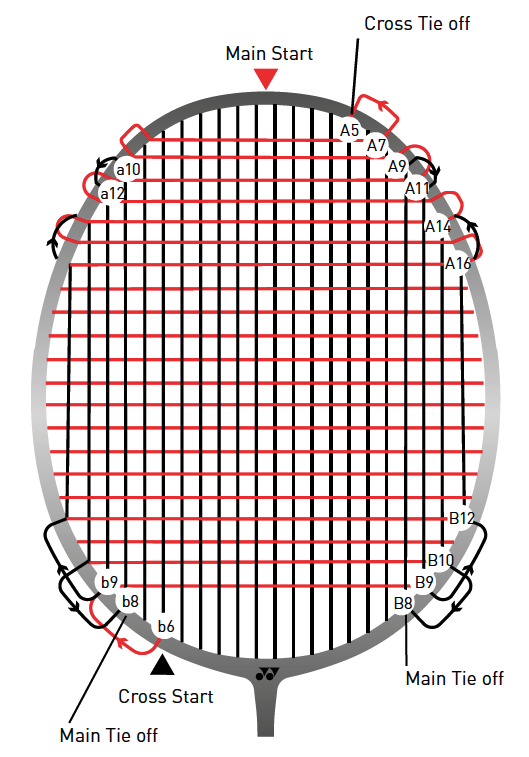
2-Knot Stringing Systems: Utilizes a single continuous piece of string to thread both vertical mains and horizontal crosses. While fast for commercial shops, tension cannot be adjusted independently between mains and crosses, often causing distortion in the frame hoop geometry.
4-Knot Professional Systems (Yonex Official Standard): Uses two separate string pieces: one dedicated to vertical mains, and one for horizontal crosses. This enables the stringer to pull the crosses two pounds tighter than the mains, compensating for structural hoop compression and preserving the frame’s true isometric shape under tournament tensions.
Diagnostic Tools: Electronic Tension Meters and Frequency Apps
Verifying actual string tension without destroying the string bed requires acoustic diagnostics:
Acoustic Resonance Frequency Analysis: Modern players and stringers utilize smartphone acoustic frequency apps (such as Stringster). By tapping the center of the string bed near the microphone, the app measures the fundamental vibrational frequency in hertz. Because vibration frequency correlates directly with tension and string mass per unit length, this provides a non-invasive, objective measurement of tension loss over weeks of play.
Mechanical Tension Gauges: Electronic diagnostic tools (such as the ERT 300) apply an oscillatory mechanical load to the string bed to calculate dynamic stiffness. Tracking dynamic stiffness helps tournament players determine the exact moment a string bed has dropped below competitive threshold.
Grommet Care and Frame Friction Mitigation
Grommets are the essential plastic buffers separating high-tension strings from razor-sharp carbon graphite frame edges:
Split Grommet Dangers: High string tensions exert enormous localized shear stress against the grommet barrel. A split, cracked, or deformed grommet allows the string to rub directly against raw high-modulus graphite, slicing through the outer braid during a hard smash. Always instruct your stringer to inspect and replace damaged grommets during every restringing session.
Thermal Protection for Strung Rackets: Never leave freshly strung rackets in vehicle trunks or exposed to direct sunlight. Extreme heat softens synthetic nylon strings while expanding graphite frames, causing sudden string bed relaxation and warped hoops.