Badminton Deceptive Shots: How to Disguise a Drop from a Clear


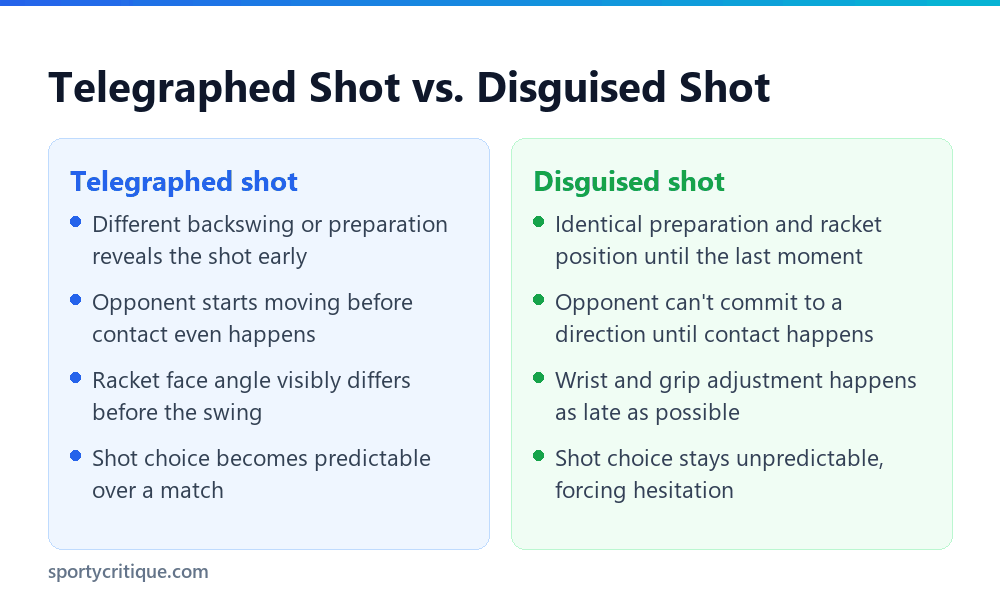
Badminton deception shots work by keeping identical preparation, footwork, backswing, and racket position for both shots right up until the final moment, then using late wrist and grip adjustment to determine the actual shot at the last possible instant. An opponent who can’t read any difference in setup between the two shots has to guess or wait, and waiting costs them the reaction time needed to cover either shot effectively.
Deception in badminton isn’t about tricking an opponent with an unusual or flashy motion; it’s about removing every visual cue that would normally reveal a shot choice early, forcing the opponent into a genuine guessing game they weren’t in before. This distinction matters because players sometimes think ‘good deception’ means adding something extra, when it actually means removing the differences that give the shot away.
- →Effective deception removes visual cues rather than adding flashy or unusual movement
- →Identical footwork and backswing for both shots is the foundation of any disguised shot
- →Wrist and grip adjustment should happen as late as possible, ideally right at contact
- →An opponent forced to wait for contact loses meaningful reaction time either way
- →Overusing deception on shots that don’t need it can slow down a player’s own game unnecessarily
Table of Contents
Building Identical Preparation for Both Shots
The foundation of disguising a drop from a clear is approaching both shots with the exact same footwork, body positioning, and racket backswing, so that everything an opponent could visually read in the setup phase looks identical regardless of which shot is actually coming. Any difference in this preparation phase, a slightly different racket angle, a different approach speed, gives the game away before the actual shot even happens.
⚠️ Watch out: A common mistake is disguising the early preparation well but then rushing or changing tempo specifically for the drop shot’s softer touch, which reintroduces a readable cue at exactly the moment the deception needs to hold together most. The whole point collapses if tempo changes give away the shot even after the setup looked identical.
Late Wrist and Grip Adjustment
The actual difference between a clear and a drop shot needs to happen as late as possible in the swing, ideally right at the moment of contact rather than earlier in the racket’s path toward the shuttle. This requires a level of wrist and grip control that takes deliberate practice to develop, since most players naturally commit to their shot decision earlier in the swing than truly optimal disguise actually requires.
A firm wrist through most of the swing, with a subtle, late adjustment in grip pressure or wrist angle right before contact, differentiates a full-power clear from a soft, controlled drop without needing any visible change earlier in the motion. This is a genuinely fine-motor skill that separates advanced players from intermediate ones far more than raw power or speed does.
💡 Pro tip: Practicing both shots from the exact same setup repeatedly, having a partner or coach call out which shot to hit only at the last possible moment before the swing begins, builds the reflexive late-decision habit better than practicing each shot in isolation.
Reading Whether Deception Is Actually Working
The clearest sign that deception is working is an opponent who hesitates or starts moving late, committing to cover one shot only after contact has already happened rather than anticipating it beforehand. A player whose opponent consistently moves early and accurately toward the actual shot, regardless of how disguised the preparation felt, likely has a readable tell somewhere in their setup that needs identifying and fixing.
Video review, watching recorded match footage specifically for the moment right before contact, often reveals tells that are invisible to the player themselves in real time, since these differences can be extremely subtle, a fractionally different racket angle or a barely faster approach for one shot versus the other. A coach or training partner reviewing footage specifically for this purpose catches issues that self-assessment alone frequently misses.
Common Deception Mistakes
- ✓Keep footwork and backswing completely identical for both shots
- ✓Delay the wrist and grip adjustment until as close to contact as possible
- ✓Practice with a partner calling the shot late to build reflexive disguise
- ✓Review match footage specifically for tells right before contact
- ✕Changing tempo or rushing specifically for the softer drop shot
- ✕Committing to the shot decision too early in the swing
- ✕Practicing each shot in isolation without building the late-decision habit
- ✕Assuming deception is automatically working without checking opponent reaction
When Deception Actually Matters
Deception pays off most clearly in situations where an opponent has to commit to covering one specific area of the court, like defending against an attacking clear versus a tight net drop from a similar overhead position. In situations where the opponent has plenty of time to react regardless of disguise, a routine, less time-pressured rally shot, the payoff from disguising the shot is smaller relative to the extra mental and physical effort it takes to execute well.
Overusing deliberate deception on every single shot, rather than reserving it for moments where it creates genuine tactical advantage, can actually slow down a player’s own game and introduce unnecessary hesitation into shots that didn’t need disguising in the first place. Experienced players learn to apply deception selectively rather than as a blanket habit across every shot.
Footwork’s Role in Maintaining Disguise
Footwork that arrives at the shuttle with proper balance and enough time to spare supports effective deception far better than a rushed approach that leaves a player scrambling and off-balance at the moment of contact. A player forced to rush their approach often loses the fine wrist and grip control that late-shot deception depends on, reverting to whatever motion gets the racket to the shuttle fastest rather than maintaining a controlled, disguised swing.
This is part of why deception tends to develop later in a player’s overall skill progression, after footwork and basic shot mechanics are already solid enough that a player has genuine spare capacity, both physical and mental, to focus on late-shot disguise rather than simply getting to the shuttle in time.
Deception in Doubles vs. Singles
In doubles, where reaction time margins are tighter and the court is more crowded with players, even small deception gains translate into disproportionately large tactical advantages, since partners covering different court zones have less room for error if they commit to the wrong coverage. Deception in doubles often focuses on quick, close-to-net exchanges where a split second of hesitation from an opponent creates a clear opening.
In singles, with a longer, narrower court and generally more time between shots, deception still matters but often plays out over slightly longer setups, disguising an overhead clear from a drop with the extra half-second a singles rally typically allows compared to the faster pace common in doubles net exchanges.
Beyond Drop vs. Clear: Other Deceptive Shot Pairs
The same disguise principles apply to several other shot pairs beyond drop versus clear, including a smash disguised as a drop from the same overhead position, or a tight net shot disguised as a net lift near the front of the court. Each pairing relies on the same underlying approach: identical setup and preparation, with the actual differentiation happening as late as possible.
Players developing deception skills often find that mastering one shot pair transfers some, but not all, of that skill to other pairs, since each combination has its own specific timing and wrist mechanics that need separate, deliberate practice rather than assuming general “deception skill” automatically covers every possible shot combination a player might want to disguise.
The Mental Side of Deception
Beyond the physical mechanics, effective deception requires a level of composure and confidence that lets a player commit fully to the disguised setup without hesitation, since any visible uncertainty in a player’s own movement can itself become a readable tell, separate from the specific technical elements already discussed. A player who looks tentative approaching a shot sometimes gives away information through that tentativeness alone.
This mental composure develops alongside the physical skill through repeated practice and match experience, and it’s part of why deception often becomes more effective for a player over seasons of continued play rather than something that clicks immediately after a single focused practice session. Patience with the gradual timeline of this skill’s development matters as much as the specific drills used to build it.
Getting Useful Feedback From a Coach
A coach positioned specifically to watch for early tells, rather than just assessing shot outcome and power, provides feedback a player often can’t generate through self-assessment alone, since a player executing their own shot has no external vantage point on how it actually looks to an opponent standing across the court.
Asking a coach or training partner specifically to comment on deception quality, not just overall shot execution, during a practice session focuses their attention on the particular detail that matters most for this skill. General feedback about shot power or placement, while useful for other aspects of a player’s game, doesn’t necessarily surface the subtle tells that undermine deception specifically.
Frequently Asked Questions
Why does my opponent always seem to read my drop shot early?
A readable tell somewhere in your preparation, footwork, backswing tempo, or racket angle, is most likely giving away the shot before contact. Reviewing match footage specifically for the moment right before contact often identifies the issue.
Is deception more about the swing or the setup?
Both need to be identical for effective deception, but the setup and preparation phase matters most, since any difference there gives the shot away before the swing’s late wrist adjustment even has a chance to matter.
Should beginners focus on learning deception early?
Generally no. Most coaches recommend building solid footwork and basic shot mechanics first, since deception depends on having spare capacity to focus on late-shot disguise rather than just reaching the shuttle in time.
Does deception matter more in singles or doubles?
It matters in both, but doubles rewards even small deception gains disproportionately due to tighter reaction time margins and a more crowded court.
How do I practice disguising shots effectively?
Have a partner or coach call out which shot to hit only at the last possible moment before your swing begins, which builds the reflexive late-decision habit better than practicing each shot in isolation.
Can too much deception actually hurt my game?
Yes, if overused on shots that don’t need it. Applying deliberate deception to every single shot can slow down your own game and introduce unnecessary hesitation where it isn’t needed.
Treat every disguised shot as feedback, not just a scored point or a lost rally. A shot an opponent read easily is information about exactly where the tell lives, and fixing that one specific detail compounds over a season into a noticeably harder-to-read game overall, one rally at a time.
Mastering the disguise between a drop and a clear takes patient, deliberate practice focused specifically on removing tells rather than adding tricks. Players who commit to this kind of fine, late-decision practice consistently find their opponents hesitating a fraction longer, which is often all the advantage a well-placed shot actually needs.
None of this requires special athleticism or a naturally deceptive personality off the court. It’s a learnable technical skill, built the same way any other stroke mechanic is built: through focused repetition, honest feedback, and patience with a gradual improvement curve that rewards consistent, deliberate practice more than any single breakthrough session ever will.
As an Amazon Associate, we earn from qualifying purchases through links on this page.