Best Volleyball Nets for Backyard Play: Portable Systems Compared

Picking the right volleyball nets for backyard play comes down to three real specs: net length that fits your yard, height adjustability for mixed-age play, and a tensioning system that holds up under hard hits. Here’s how the real options compare, and which fits which yard.
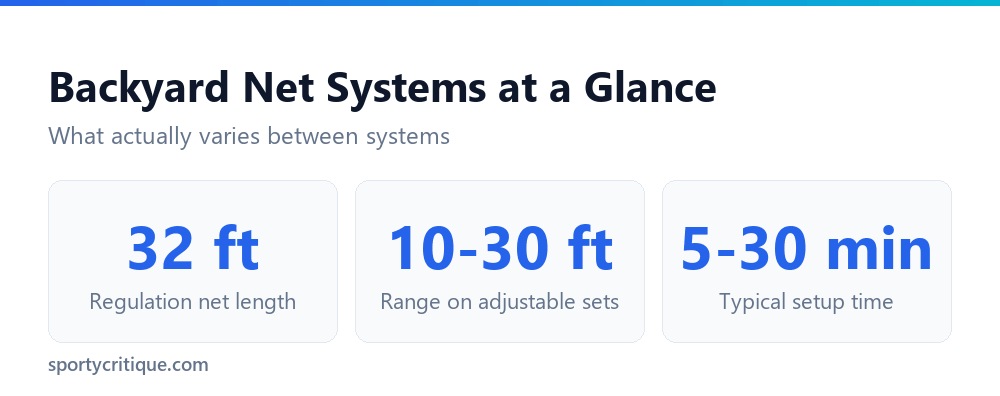
A good backyard volleyball net system needs three things: a net length that actually fits your yard, poles that go up and adjust height without tools, and a tensioning method, usually a rope-and-stake system or a metal winch, that keeps the net from sagging mid-game. A 32-foot regulation-width net suits most standard backyards, while an adjustable-length set like a 10-to-30-foot system is the better pick for a smaller or irregularly shaped yard where a full regulation net won’t fit.
Backyard volleyball net systems mostly compete on the same handful of specs: total net length, how the poles adjust for height, how fast setup actually is, and how well the tensioning system resists sagging after repeated hard hits. Price differences in this category usually track durability and pole material more than they track any single standout feature, so it’s worth being clear about which of those specs matters most for your specific yard and how often you’ll be setting the net up and taking it back down.
- →Net length is the first spec to check: 32 ft is regulation width, adjustable sets (10-30 ft) fit smaller yards
- →Height adjustability matters if the same net is used for both women’s and men’s regulation height, or casual family play
- →A winch tensioning system holds tighter over time than a rope-and-stake setup, but adds cost
- →Aluminum poles resist rust better than steel for a net stored outdoors between uses
- →Setup speed varies a lot between systems: some take a real 5-10 minutes, others closer to 30
Table of Contents
Net length: regulation-width vs. adjustable
A regulation volleyball net is 32 feet long. That’s the standard for most full-size backyard sets and it’s the right choice if your yard has the space and you want something close to real court dimensions. An adjustable-length system, often built to shrink down to 10 feet, trades some of that regulation feel for flexibility, letting you fit a usable net into a narrower side yard or set up a shorter, more casual version for younger kids or a smaller group.
Height adjustability: why it matters more than it sounds
Regulation net height differs between men’s and women’s play, roughly 8 feet for men and 7 feet 4 inches for women, and family backyard games often mix skill levels and ages that don’t match either standard. A system with multiple pre-set height notches, rather than one fixed height, lets the same net work for a competitive adult game one day and a lower, more approachable setup for kids the next, without needing separate equipment.
Our picks for backyard volleyball nets
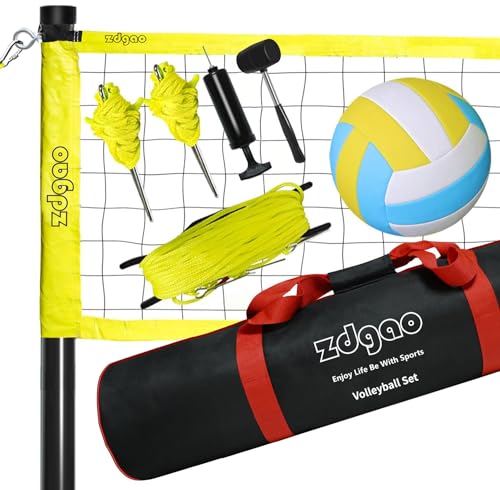
The Patiassy Outdoor Portable Volleyball Net System (about $70 at last check, in stock) is a full regulation-width set that includes the volleyball, pump, and a carrying bag, which matters if you don’t already own a ball and don’t want a second purchase. Its steel poles adjust across three preset heights, covering men’s, co-ed, and women’s regulation settings without extra hardware.
The SPOYNAL 32 FT Portable Volleyball Net Set (about $60 at last check, in stock) is a similar full-length 32-foot set built around sand and grass courts specifically, with a slightly lower price point than the Patiassy set. It’s a reasonable choice if you mainly play on a beach or sandy area and want poles designed to plant securely in looser ground.
The EastPoint Adjustable Volleyball Net Set, 10 to 30 ft (about $59 at last check, in stock) is the pick for a smaller or irregularly shaped yard, since its net adjusts from 10 to 30 feet rather than being fixed at regulation width. That flexibility is the entire reason to choose it over a fixed 32-foot set, and it comes at a similar price to the fixed-length options above.
The Park & Sun Sports Spectrum PRO Volleyball Net System (about $230 at last check, only one left in stock at the time we checked) sits well above the other three on price, and that gap buys heavier-duty aluminum poles with a push-button locking system built for players who set the net up and take it down often and want it to hold up over several seasons rather than one. It’s a reasonable step up if you’re outfitting a permanent-feeling backyard court rather than an occasional casual setup.
Setup speed and what slows it down
Setup time across this category ranges from a genuine 5 to 10 minutes on the simpler rope-and-stake systems to closer to 20 or 30 minutes on heavier-duty sets with more hardware and a winch mechanism to thread and tension correctly the first time. If you’re setting the net up fresh for every use rather than leaving it up for a season, that difference adds up fast, and it’s worth weighing against the tighter, longer-lasting tension a winch system provides.
Ground conditions affect setup more than most buyers expect going in. Soft grass or sand takes stakes easily but can let poles lean under net tension if they’re not planted deep enough. A hard-packed dirt or gravel surface holds pole bases more rigidly but makes driving stakes in significantly harder, sometimes requiring a mallet that isn’t included with the set.
- ✓Measure your actual yard space before choosing between a 32 ft fixed net and an adjustable set
- ✓Check for multiple height presets if the net needs to work for both adults and kids
- ✓Consider a winch tensioning system if you’ll leave the net up for a full season
- ✓Plant poles deep enough on soft ground, even if it takes a few extra minutes
- ✕Buy a full 32 ft regulation net for a yard that can’t actually fit it stretched taut
- ✕Assume every listing’s stated setup time reflects a first-time, from-the-box assembly
- ✕Skip checking pole material if the net will live outside between uses
- ✕Overtighten a rope-and-stake system so hard that it strains the net’s edge tape
💡 Pro tip: Before buying, measure the actual open, level space in your yard rather than eyeballing it. A 32-foot net needs meaningfully more clearance than the net length alone, since you also need room on both sides for players to move and land safely without hitting a fence or a tree.
⚠️ Watch out: A rope-and-stake tensioning system will loosen gradually over a session, especially with hard spiking. Check tension every 20 to 30 minutes of active play rather than assuming it holds all afternoon, since a sagging net changes the game noticeably and can also let the poles lean if the tension imbalance gets bad enough.
Aluminum vs. steel poles for outdoor storage
If the net system lives outside between uses rather than getting broken down and stored indoors, pole material matters more than most buyers initially weigh it. Aluminum poles resist rust and general weather wear noticeably better than steel over multiple seasons left outdoors, though they typically cost more and can flex slightly more under heavy tension than a comparable steel pole. Steel holds up fine if you’re diligent about storing it indoors or under cover between uses, but it’s the weaker choice for a set that’s genuinely left outside year-round.
Storage and off-season care
Most portable systems pack down into a single carrying bag, but taking a few extra minutes to dry the net fully before storing it prevents mildew, especially if it was used near a beach or in humid conditions. Coil poles rather than folding them at sharp angles where possible, since repeated sharp folding at the same joint is a common way telescoping poles develop a stuck section over a few seasons of storage and reuse.
Ball, pump, and boundary lines: what’s actually included
Some backyard net sets include a matching volleyball and pump, others sell the net system alone and assume you already own a ball. That’s a meaningful price difference to check before comparing listings side by side, since a set that looks cheaper on its own can end up costing about the same once you add a decent ball and pump separately. Boundary lines, rope or tape marking the court edges, are a smaller add-on but genuinely useful for settling close calls during casual games rather than arguing about where the line was.
Carrying bags vary more than expected too. A well-padded bag with separate compartments for poles and net protects the poles from scratching each other in transport and storage, while a basic single-pocket bag works fine if the set mostly stays in one place and rarely travels. If you plan to bring the net to the beach or a park regularly rather than leaving it in one backyard, a sturdier carrying bag is worth checking for specifically.
Surface considerations: grass, sand, and hard ground
The same net system performs differently depending on what it’s anchored into. Grass and soil generally hold stakes well as long as they go in deep and at a slight angle away from the net, which resists the constant inward pull of net tension. Sand needs either much longer stakes or, on some systems, a sand-anchor kit sold separately, since standard-length stakes can work loose in loose sand faster than on packed soil.
A hard surface like a patio, driveway, or packed court changes the equation entirely, since stakes don’t work at all. Systems built with weighted base plates or a design that supports sandbag or water-bag ballast instead of stakes are the only realistic option on those surfaces, so check a listing’s base design specifically if your intended setup location doesn’t have soil or sand to stake into.
Bottom line
Match net length to your actual yard first, regulation 32 feet for real open space, adjustable 10 to 30 feet for a tighter or irregular yard, then weigh setup speed against tensioning quality based on how often you’ll be putting the net up and taking it down. A winch system and aluminum poles cost more but hold up better for a net that lives outside or gets used constantly through the season.
What size volleyball net do I need for my backyard?
A full regulation net is 32 feet long, which needs real open space on both sides for play. For a smaller or irregularly shaped yard, an adjustable set that shrinks down from around 30 feet to 10 feet fits more situations without needing a second, shorter net.
How long does it take to set up a backyard volleyball net?
Simpler rope-and-stake systems typically take 5 to 10 minutes once you’re familiar with them. Heavier-duty sets with a winch tensioning mechanism can take 20 to 30 minutes, especially the first time, since threading and tensioning the winch correctly takes more steps than a basic rope setup.
Do I need a winch system, or is rope-and-stake tensioning good enough?
Rope-and-stake tensioning works fine for casual, occasional use, but it loosens faster under repeated hard spikes and needs more frequent retightening during play. A winch system holds tension longer and suits players who use the net often or leave it set up for a full season.
Are aluminum poles worth the extra cost over steel?
If the net system stays outside between uses rather than getting stored indoors, yes. Aluminum resists rust and weather wear meaningfully better over multiple seasons. If you’ll store it indoors or under cover consistently, steel poles hold up fine and cost less.
As an Amazon Associate, we earn from qualifying purchases through links on this page.