Best Basketball Shoes for Ankle Support: What Actually Prevents Rolls


For ankle support specifically, prioritize a stiff heel counter and a wide base over collar height. The Under Armour Lockdown 7 was the only one of the three shoes checked here with a confirmed live price at $70.00 and in-stock status. The Nike Giannis Immortality 4 and Nike LeBron XXII Crown Jewel both build in specific containment features aimed at lockdown, but neither returned live pricing at the time we checked.
🏀 Basketball Hub: Explore all 28 sneaker reviews, shooting tutorials, and court guides in our Complete Basketball Resource Hub.
A high-top collar is the feature most players point to first when shopping for the best basketball shoes for ankle support, and it is also the feature with the weakest evidence behind it. Studies comparing ankle sprain rates between high-top and low-top basketball shoes have generally failed to find a meaningful difference. What actually correlates with fewer rolled ankles is torsional rigidity through the midfoot, a wide lateral base, and a stiff heel counter that keeps the heel from sliding sideways inside the shoe. This guide picks shoes based on those features, not collar height alone.
That does not mean collar height is irrelevant. A snug high-top can add a small amount of proprioceptive feedback, a sense of where your ankle is in space, which some players find genuinely helps them catch a roll before it becomes a sprain. But it is a secondary effect layered on top of the structural features below, not a substitute for them. A loose high-top with a soft heel counter offers less real support than a well-fitted low-top with a rigid one.
- →Collar height correlates weakly with ankle sprain rates in the actual research; base width and heel-counter stiffness correlate more.
- →Only the Under Armour Lockdown 7 had a confirmed live price ($70.00) of the three shoes checked here.
- →A snug high-top can add useful proprioceptive feedback, but it’s a secondary effect, not the main mechanism.
- →Torsional rigidity (how much the midsole twists) is one of the most overlooked ankle-support specs.
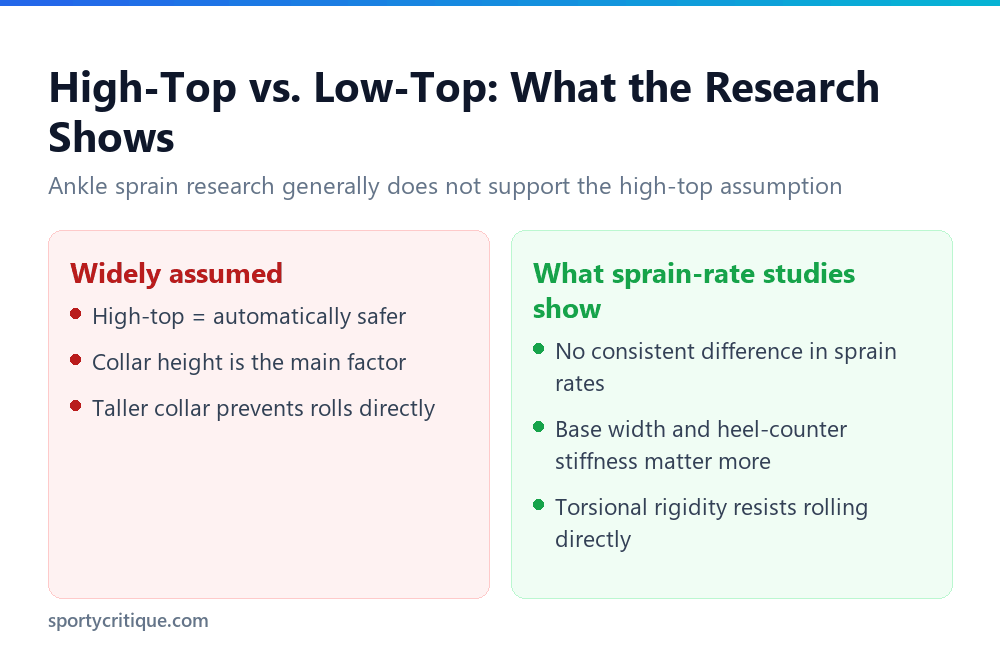
Table of Contents
What the ankle-sprain research actually shows
The research on high-tops versus low-tops is worth stating plainly rather than gesturing at. Several studies tracking ankle sprain rates in basketball players wearing high-top versus low-top shoes have not found a statistically meaningful difference in sprain frequency between the two categories. That surprises most players, since a taller collar feels more supportive. The likely explanation is that an ankle sprain happens fast enough, and with enough force, that a shoe collar’s passive restriction does relatively little to stop the motion once it starts. What does correlate better with reduced ankle rolling is the shoe’s base width and torsional stiffness, which resist the foot rolling in the first place rather than trying to catch it after it has started.
The four features that actually matter
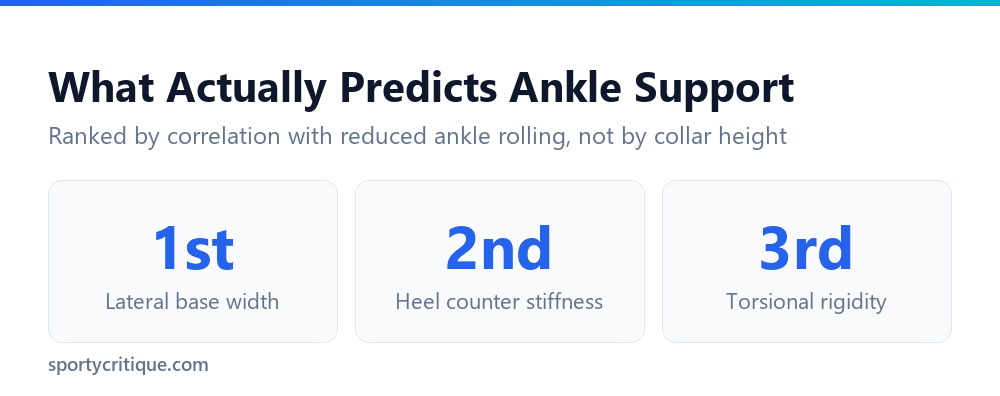
Four features do the actual work, in roughly descending order of impact. A wide lateral base gives your foot a bigger platform to land on before the ankle has to compensate for an off-center landing. A stiff heel counter, the rigid cup around the heel, keeps the heel centered instead of sliding sideways inside the shoe during a hard cut. Torsional rigidity through the midsole (how much the shoe twists when you try to wring it like a towel) resists your foot rolling independently of your lower leg. Outsole traction prevents the kind of unexpected slip that causes an awkward landing in the first place, which is a different failure mode than a rolled ankle but often gets lumped in with it.
Lacing technique: the free upgrade
Lacing technique changes how much lockdown a shoe actually delivers, independent of the shoe itself, and it is free. A standard straight lace pattern leaves some lateral play through the midfoot on most basketball shoes. A lace-lock (running the lace through the top eyelet from the inside before tying off) tightens that last inch of midfoot hold noticeably, and it is the single cheapest upgrade available to any of the three shoes on this list. Players who feel like a shoe’s ankle support is inconsistent often have not tried tightening the midfoot lacing specifically, as opposed to just pulling the laces tighter overall, which mostly affects the forefoot instead.
Bracing and taping alongside shoe choice
An ankle brace or taping is a separate layer worth considering alongside shoe choice, not instead of it, especially for a player recovering from a previous sprain. A brace or tape job restricts the specific inversion motion (the foot rolling outward) that causes most basketball ankle sprains, doing more of that specific job than any shoe collar can. None of the three shoes in this guide are a substitute for a brace if you have a history of ankle injuries; think of shoe choice as the baseline and a brace as the additional layer for players who need it.
The verified picks
We ran each ASIN through Amazon’s product API directly. Only the Under Armour Lockdown 7 came back with a confirmed live price and in-stock status; the Giannis Immortality 4 showed as unavailable, and the LeBron XXII Crown Jewel returned no price or availability fields at all. That is disclosed under each pick rather than smoothed into a guessed number.
Under Armour Lockdown 7
The Lockdown 7 is built around a straightforward, budget-accessible take on ankle stability: a breathable mesh upper with leather and film overlays for structure, and a solid rubber outsole with a herringbone traction pattern. It does not have a headline containment feature the way the Nike models below do, but the overlay structure through the midfoot does the actual job of resisting lateral roll, which is what matters more than branding around it.
See current listing for the Under Armour Lockdown 7 (Verified in stock at $70.00 at the time we checked.)
Nike Giannis Immortality 4
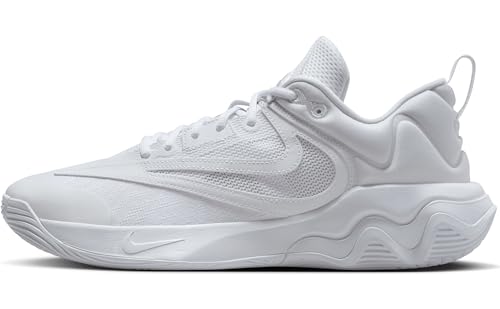
The Immortality 4 carries over Nike’s internal containment system from the signature Freak line into a lower-priced model, along with a sleeker heel shape padded specifically to control the heel during sudden stops. The traction pattern is also upgraded from the previous Immortality generation. As a lower-tier signature shoe, it is priced below the flagship Freak model while keeping most of the stability engineering.
See current listing for the Nike Giannis Immortality 4 (This ASIN showed as currently unavailable on Amazon when we checked it. Confirm current availability before assuming it is back in stock.)
Nike LeBron XXII Crown Jewel
Built for power players and bigs, the LeBron XXII combines an Air Max heel unit with a Zoom Air forefoot unit for plush impact absorption, wrapped in a higher, more structured collar than the other two shoes here. It runs heavier as a result, which is a fair tradeoff for players who want maximum containment and less so for a guard who prioritizes quickness over lockdown.
See current listing for the Nike LeBron XXII Crown Jewel (Amazon did not return live price or stock data for this ASIN when we checked it. Confirm current price and availability on the listing before ordering.)
How to choose between these three
Prioritize fit over collar height when shopping for ankle support specifically. A shoe that fits snugly through the midfoot and heel, regardless of whether it is a high-top or low-top, does more for stability than a loose high-top will. If two shoes are otherwise comparable, take the one with the wider platform and the stiffer heel counter, both of which you can usually feel by hand before buying, over the one with the taller collar. The LeBron XXII’s added weight from its higher, more structured build is a real tradeoff worth weighing against how much you actually value that extra containment during play. Between the three shoes checked here, the Lockdown 7 is the easiest recommendation simply because it is the one with confirmed live stock and pricing; the other two are worth pursuing on their engineering, but you will need to check the listing yourself before assuming either is currently purchasable.
- ✓Try a lace-lock through the top eyelet for extra midfoot hold before buying a new shoe
- ✓Prioritize a wide base and stiff heel counter over collar height alone
- ✓Check the shoe’s torsional rigidity by hand (twist it like a towel) before buying if possible
- ✓Break in a new pair gradually rather than playing full-intensity games in them immediately
- ✓Replace shoes once the outsole traction degrades, even if the upper still looks fine
- ✕Rely on a taller collar alone and skip checking heel counter and base width entirely
- ✕Assume a high-top automatically outperforms a low-top for ankle support
- ✕Buy based on collar height alone without checking heel counter stiffness
- ✕Ignore weight tradeoffs; a heavier, more structured shoe is not free performance
- ✕Play through a rolled ankle assuming the shoe alone will prevent re-injury
💡 Pro tip: Twist a shoe like a wet towel before buying if you can handle it in person. Less twist through the midsole generally means more torsional rigidity, which resists ankle roll directly.
FAQ
Do high-top basketball shoes actually prevent ankle sprains better than low-tops?
The research is mixed at best. Several studies comparing sprain rates between high-top and low-top basketball shoes have not found a statistically meaningful difference. Base width, heel counter stiffness, and torsional rigidity appear to matter more than collar height.
What is the single most important feature for ankle support in a basketball shoe?
A wide lateral base is generally considered the most impactful single feature, since it gives the foot more surface area before the ankle has to compensate for an off-center landing. Heel counter stiffness is a close second.
Can a basketball shoe alone prevent ankle injuries?
No. Shoes can reduce risk factors related to fit and structural support, but ankle sprains also depend on landing mechanics, prior injury history, and court conditions. A shoe is one factor among several, not a guarantee.
Should I size down for a tighter, more supportive fit?
Sizing down to force a tighter fit usually causes more problems (cramped toes, blisters) than it solves. A properly sized shoe with a well-fitted heel counter and lacing adjusted for lockdown provides more real support than an undersized shoe.
Does a lace-lock technique really make a measurable difference?
It changes how much the heel and midfoot can shift inside the shoe during a hard cut, which is exactly the motion that precedes many ankle rolls. It will not turn a poorly fitted shoe into a well-fitted one, but on a shoe that already fits reasonably well, it removes slack that a standard lacing pattern leaves in place.
If I’ve had a previous ankle sprain, should I buy differently?
Consider pairing shoe choice with a brace or taping rather than relying on the shoe alone. A history of ankle sprains raises the risk of a repeat injury regardless of footwear, and a brace restricts the specific inversion motion that causes most basketball ankle sprains more directly than any shoe collar can.
As an Amazon Associate, we earn from qualifying purchases through links on this page.