How to Have the Best Basketball Practice: Proven Tips & Drills



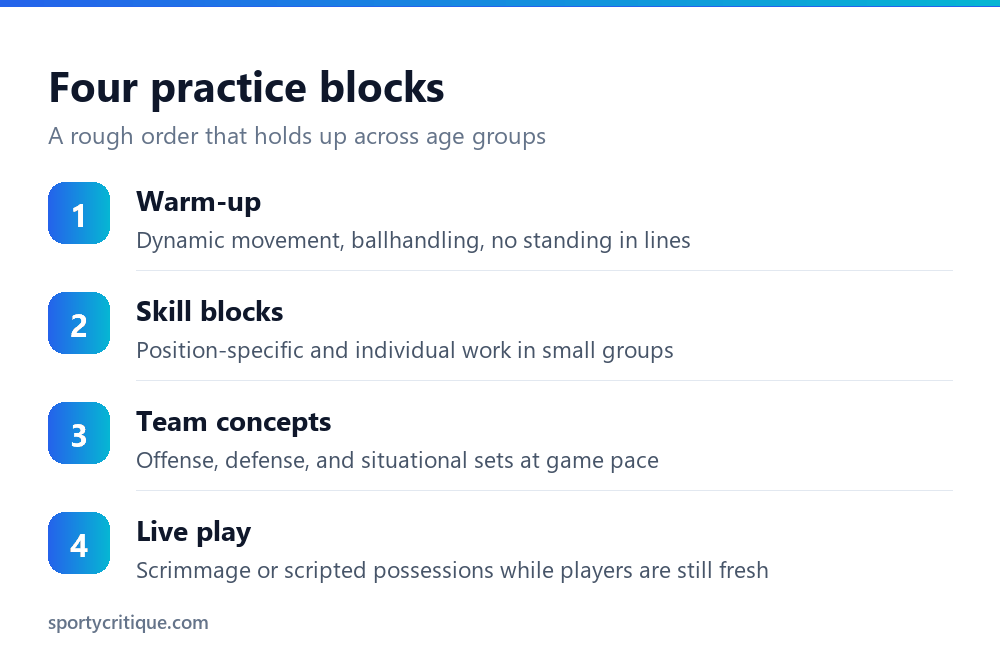
A well-run basketball practice moves through four blocks in roughly this order: a 10-15 minute warm-up that includes the ball from the first minute, 20-30 minutes of skill work in small groups, 25-35 minutes of team offense and defense at game speed, and 15-25 minutes of live scrimmage or scripted situations while players still have legs left. The split shifts with age and level, but the order rarely should: skills before concepts, concepts before live play.
Most practices that feel unproductive aren’t short on effort, they’re short on sequencing. A gym full of players running the same three-man weave for the fortieth time isn’t building anything new, and a scrimmage bolted onto the front of practice before anyone has touched a ball in a purposeful drill wastes the sharpest part of everyone’s attention span. The fix isn’t more drills. It’s ordering the ones you already run so each block sets up the next one.
- →Warm-ups that include ball-handling from minute one save practice time versus separating conditioning from skill work
- →Skill blocks belong before team-concept drills, not after, since tired legs and thin attention spans make new information stick worse
- →Live scrimmage works best in the back third of practice, not the front, once concepts have actually been rehearsed
- →A 90-minute practice and a 2-hour practice need different block lengths, not different blocks
- →The single most common structural mistake is running 5-on-5 for the majority of practice time, which gives most players fewer than 10 real touches
Table of Contents
The four blocks, in order, and why the order matters
Warm-up comes first because a cold gym and cold hands lead to worse shooting mechanics and a higher chance of a rolled ankle on the first hard cut. It doesn’t need to be separate from skill work, though. Dynamic stretching mixed with two-ball dribbling series, layup lines that progress into finishing moves, or a passing shuttle that raises heart rate while touching the ball does double duty: bodies warm up and hands get reacquainted with the ball at the same time.
Skill blocks come next, while attention is freshest and before fatigue degrades form. This is where individual and small-group work lives: shooting off the catch and off the dribble, ballhandling series, post moves, closeouts, box-outs. Splitting the gym into two or three stations run in short rotations (six to eight minutes each) keeps reps high and standing-around time low, which matters more than any single drill choice.
Team concepts follow skill work because a player who can’t yet finish a specific move on their own will struggle to execute it inside a five-man offense running at game speed. This block covers the actual sets and principles the team will use in games: spacing rules, ball-screen coverage, press-break patterns, out-of-bounds plays. Walking through a set at half speed before running it live saves more time than it costs, since correcting five confused players mid-scrimmage burns far more minutes than a two-minute walkthrough would have.
Live play goes last, not because it matters least but because it’s the block where everything gets tested under pressure, and pressure is more useful once the pieces underneath it are in place. Scrimmage, competitive small-sided games (3-on-3 or 4-on-4 tend to produce more decisions per player than full 5-on-5), and scripted situational reps (last shot, inbounds under pressure, protecting a lead) belong here.
Sample block lengths for a 90-minute practice
Time allocation by age and level
Younger players need more of practice devoted to raw skill acquisition because they haven’t built the underlying coordination yet; running heavy team-concept drills with a group that can’t yet catch and pivot cleanly just repeats bad habits at a higher speed. Older, more experienced teams can spend more time on live play because the skill foundation is already there, and what they need most is reps making decisions under real defensive pressure.
Common mistakes that quietly wreck practice time
- ✓Rotate small groups through stations so reps stay high and lines stay short
- ✓Walk through a new set at half speed before running it live
- ✓End practice on a made shot or a clean possession, not a mistake
- ✓Change roughly a third of the drills each week so practice stays sharp without losing structure
- ✓Time each block with a whistle or a phone, not a guess
- ✕Running 5-on-5 for most of practice, which leaves most players with under 10 real touches
- ✕Skipping the warm-up when practice starts late, which raises injury risk for no real time savings
- ✕Lecturing for five or ten minutes at a stretch while players stand still
- ✕Cramming three new concepts into one practice instead of one or two
- ✕Running the identical practice plan week after week regardless of what games are showing you
⚠️ Watch out: A full-court 5-on-5 scrimmage looks productive because it resembles a real game, but with ten players on the floor, most individuals touch the ball only a handful of times in twenty minutes. Small-sided games (3-on-3, 4-on-4) or drills run in split groups put the ball in more hands more often, which is where actual skill development happens.
Adjusting length: short practices vs. long ones
A 45-60 minute practice, common on a school night or a shared-gym schedule, doesn’t have room for a full four-block structure and a long team-concept session in the same day. The trade-off that works best is picking one focus per short practice: one day is mostly skill blocks with a short live-play finish, the next is mostly team concepts with a short warm-up and a compressed scrimmage. Trying to squeeze all four blocks into a shortened window usually means every block gets rushed and nothing actually sticks.
A two-hour practice has the opposite problem: enough time to do everything, which tempts coaches into doing too much. Pick one or two concepts to actually teach that day rather than touring through the whole offensive and defensive playbook. A team that walks away having drilled one press-break pattern until it’s automatic gets more out of that practice than one that briefly touched five different sets.
💡 Pro tip: Cap any single teaching segment at 8-10 minutes for younger players and 12-15 minutes for older ones. Attention for a new concept drops sharply past that window, and a coach who keeps talking past it is usually re-explaining to players who tuned out three minutes ago, not adding new information.
Building the actual practice plan
Write the plan before stepping into the gym, with a specific time next to each drill, and bring it on paper or a phone rather than trying to hold the sequence in your head. Practices that run long on one drill almost always run short on whatever was scheduled last, and the block that gets cut is usually live play, which is the block players actually look forward to. A written plan with hard stop times protects that block instead of sacrificing it to whatever ran over earlier.
Build in one flexible slot, ten minutes with no fixed drill attached, that can absorb whatever the team is struggling with that day. If the skill block ran long because a footwork drill needed more reps than planned, that slot shrinks. If everything’s on schedule, use it for extra free throws or a competitive shooting game. This keeps the plan realistic instead of forcing a coach to either cut corners or run over.
Common myths about practice structure
What to do in the last five minutes
Close every practice with something players can succeed at, even a fatigued free-throw competition or a simple shooting game with a clear winner. Ending on a mistake or a hard correction, however necessary the coaching point was in the moment, is a worse note to send a team home on than a short, competitive finish. Save the harder film review or correction for the start of the next practice, when there’s actually time to work on the fix rather than just naming it on the way out the door.
Making the most of limited court space
Most teams don’t practice on a full court by themselves. Sharing a gym with another team, or working with a single hoop and half a key, changes how the four blocks get run without changing the order they happen in. Skill stations adapt easily to a cramped space since most of them, shooting, ballhandling, footwork, only need a hoop and 10-15 feet of room. Team concepts and live play are the blocks that suffer most when space is tight, so on a shared or half-court night, it’s worth trimming those two blocks rather than cutting the warm-up or skill work that everyone can still run regardless of available space.
A single-basket gym can still run 3-on-3 or 4-on-3 live situations even without room for a full-court scrimmage, and those small-sided games often produce more usable reps per player than a cramped 5-on-5 would anyway. Treat a space constraint as a reason to lean harder into small-sided work rather than a reason to skip live play altogether.
Communicating the plan so it actually holds
A practice plan only works if the players in the gym know roughly what’s coming. Posting the day’s blocks on a whiteboard, even in a two-line summary like “Skills, then press break, then scrimmage,” cuts down on the constant “what are we doing now” questions that eat into transition time between drills. For older or more competitive teams, sharing the week’s practice themes in advance, even briefly, lets players arrive already thinking about what they need to work on individually before the group session starts.
Assistant coaches, when a program has them, work best when each one owns a station or a block rather than all of them narrating the same drill from different corners of the gym. Assigning one assistant to run the skill-block rotation while the head coach preps the team-concept walkthrough keeps transitions tight instead of leaving players standing around while coaches figure out who’s doing what next.
📊 Note: None of this requires expensive equipment. A cone, a stopwatch, and a plan on paper cover almost every drill described here. The block structure and the sequencing are what make a practice productive, not the gear brought into the gym.
How long should a basketball practice be?
For most youth and school teams, 75-90 minutes covers a full four-block structure without running into diminishing returns. Younger or less conditioned groups often do better with 60-75 minutes at higher intensity than 2 hours at a lower one.
How much of practice should be scrimmage?
Roughly 20-30% for most teams, more for advanced or older groups who already have the skill foundation, less for younger teams who need more dedicated skill-block time first.
Should warm-up include the ball?
Yes, whenever possible. Dynamic stretching combined with light ballhandling warms up the body and re-establishes ball feel at the same time, instead of treating them as two separate steps.
What’s the biggest structural mistake coaches make?
Running full 5-on-5 for most of practice. It looks like real basketball, but with ten players on the court, individual touches drop sharply compared to small-sided games or split-group drills.
How often should the practice plan change?
Keep roughly two-thirds of the structure consistent week to week so players know what to expect, and rotate the remaining third based on what recent games actually revealed.