Best Basketball Shoes for Wide Feet: Real 2E/4E Picks


For basketball shoes for wide feet, only a real width code counts as proof: D (standard), 2E (wide), or 4E (extra wide), either in the listing itself or on the brand’s own size chart. Of the three verified wide-specific basketball shoes checked for this guide, two, the FitVille Wide Basketball Shoe ($88.89) and the Reebok Royal BB4500H XW4E ($80.00), came back with confirmed live pricing and in-stock status. The New Balance OMN1S Wide showed as currently unavailable when checked. Buying a half-size up on a standard shoe is not the same fix and usually makes fit worse, not better.
🏀 Basketball Hub: Explore all 28 sneaker reviews, shooting tutorials, and court guides in our Complete Basketball Resource Hub.
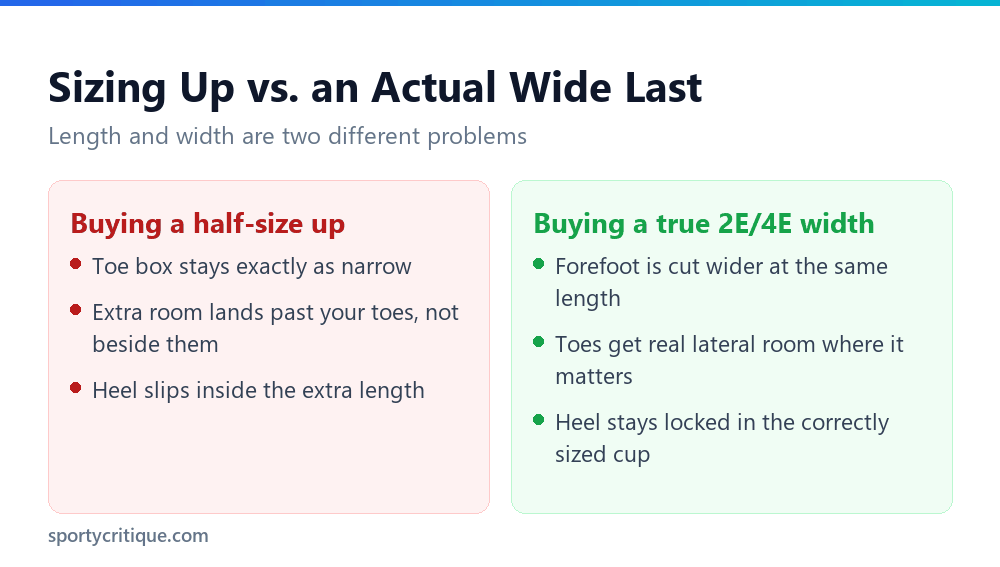
The most common advice for a basketball player with wide feet is also the least useful: buy a half size up. It sounds logical since a bigger shoe has more room everywhere. What it actually does is add length in front of the toes, not width beside them, so the forefoot stays just as pinched while the heel now sits loose in a cup that was never sized for it. On a stop-and-cut sport that depends on the heel staying locked down, that trade is a bad one.
This guide sticks to a narrower, more useful question than most “best basketball shoes” roundups: which shoes are actually built on a wider last, not just tolerant of a bigger foot. That distinction matters more than brand or price at this specific problem, and it’s the one most buying guides skip past entirely.
- →A genuine wide basketball shoe carries a letter-width code (D/2E/4E), not just a marketing adjective
- →Sizing up a half size adds length, not width, and often makes heel slip worse
- →Of the three wide-specific ASINs checked here, only two had confirmed live pricing and stock
- →FitVille builds specifically around wide and extra-wide lasts, including a dedicated basketball model
- →Reebok’s Royal BB4500H XW4E is a retro-styled high-top, not a modern performance shoe, worth knowing before buying
Table of Contents
Why sizing up doesn’t actually fix a narrow shoe
A shoe’s last, the foot-shaped mold it’s built around, sets both length and width at the same time, but scaling a shoe up in size mostly stretches length. Manufacturers do vary the girth slightly across sizes, but not nearly enough to turn a narrow last into a wide one. Two sizes up on a standard-width shoe still leaves a narrow forefoot; it just leaves it further forward, with more dead space at the toe and a heel that no longer stays put during a hard plant or cut.
⚠️ Watch out: Heel slip caused by an oversized shoe is a separate problem from a narrow toe box, and it’s arguably the worse one on a basketball court. A heel that shifts inside the shoe during a cut costs stability exactly when you need it most, which is a real trade against whatever comfort the extra forefoot room provides.
What a real wide-width basketball shoe actually changes
A wide last widens the shoe through the ball of the foot and the toe box specifically, while keeping the heel cup and midfoot sized correctly for the stated length. That’s the entire point of the D/2E/4E system used across US athletic and dress shoes: it separates width from length instead of asking one size number to cover both. A shoe correctly built on a 2E or 4E last gives the forefoot real lateral room without the heel-slip penalty that comes from just buying bigger.
Upper material matters here too, separately from the last. A stretch-mesh or engineered-knit upper gives a little forgiving give across the forefoot even on a standard last, while a stiff synthetic-leather overlay holds its shape and won’t flex to accommodate a wider foot no matter the size. If a true wide SKU isn’t available in a shoe you otherwise want, a stretch-upper standard width is a closer second choice than simply sizing up.
How to tell a real wide listing from marketing language
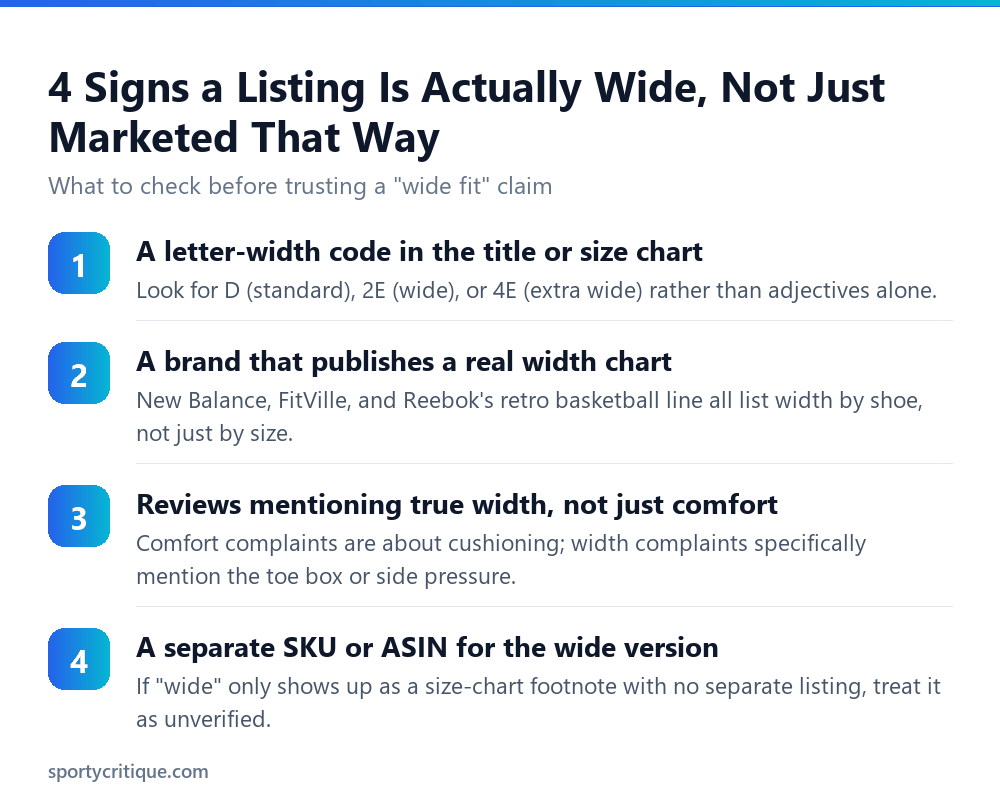
“Roomy fit” and “true to size” are marketing language, not width specifications. “2E” and “4E,” or the words “Wide” and “X-Wide” paired with a separate size selector on the listing, are the actual spec. The clearest sign a shoe is really built wide is a brand that publishes its own width chart by model, rather than a single generic size guide for its whole catalog.
The verified picks
Each shoe below was checked directly against Amazon’s product API immediately before this guide was written. Two came back with confirmed live pricing and in-stock status; the third is disclosed as currently unavailable rather than smoothed over with a guessed price.
FitVille Wide Basketball Shoes for Men with Flat Feet
FitVille builds its entire catalog, walking shoes, pickleball shoes, hiking shoes, and this basketball high-top, around wide and extra-wide lasts rather than treating width as an afterthought size option. That focus is the honest selling point here: this isn’t a performance shoe retrofitted with a wide size, it’s built wide from the last up, with a high-top collar and the ankle-support framing built into the product name itself. It won’t compete with a modern signature shoe on cushioning technology or outsole engineering, and it isn’t trying to. For a player whose main problem is finding a basketball-style shoe that fits a truly wide or flat foot without pressure points, that trade is usually the right one.
FitVille Wide Basketball Shoes for Men with Flat Feet Extra Wide High-top Sneakers with Ankle Support (11.5 X-Wide, All Black) (Verified in stock at $88.89 at the time we checked, size 11.5 X-Wide shown; other sizes and the standard Wide width are available on the same listing.)
Reebok Royal BB4500H XW4E
The Royal BB4500 is a retro-styled high-top pulled from Reebok’s classic 90s basketball silhouettes, and the XW4E in the product name is Reebok’s own width code for X-Wide/4E, built into the SKU rather than added as a checkout option. Worth being clear about what this is: a retro streetwear-leaning high-top, not a current on-court performance shoe with modern cushioning or traction engineering. For casual pickup games or everyday wear where a wide high-top silhouette is what you actually want, it’s a legitimate, affordable option. For competitive play, it’s a weaker pick than either of the other two shoes here.
Reebok Men’s Royal BB4500H XW4E Basketball Shoe, Black/Shark, 11 (Verified in stock at $80.00 at the time we checked, size 11 Black/Shark shown.)
New Balance OMN1S Wide
The OMN1S was Kawhi Leonard’s first signature shoe with New Balance, released in 2019, built with a FitWeave textile upper and a FuelCell midsole for responsive cushioning, and it’s one of the few modern signature basketball shoes New Balance has offered in a dedicated Wide listing. New Balance has a long-standing reputation across its whole shoe range, not just basketball, for actually stocking wide and extra-wide options rather than treating them as a rare exception, and that reputation is a fair reason to watch this listing even while it’s out of stock.
New Balance OMN1S Wide Mens Shoes Size 9, Color: Purple/Neon Green (This ASIN showed as currently unavailable on Amazon when we checked it, with no live price returned. Confirm current availability before assuming it has come back in stock.)
What actually helps if a true wide shoe isn’t an option
- ✓Look for a letter-width code (2E/4E) or the words Wide/X-Wide on a real size selector
- ✓Check whether the brand publishes a width chart specific to that shoe model
- ✓Consider a stretch-mesh or knit upper as a partial fix when no wide SKU exists
- ✓Read reviews that specifically mention toe box or forefoot width, not general comfort
- ✕Assume sizing up a half size solves a narrow forefoot; it mostly adds dead space at the toe
- ✕Trust adjectives like “roomy” or “true to size” as a substitute for an actual width spec
- ✕Buy a stiff synthetic-leather upper expecting it to stretch and accommodate a wide foot over time
- ✕Ignore heel slip that shows up after sizing up; it’s a real stability cost, not a minor annoyance
💡 Pro tip: If a brand you like doesn’t offer that specific model in a wide width, check whether it publishes a width chart at all. A brand with zero wide options anywhere in its catalog is a different situation from one that just hasn’t put this particular shoe in 2E yet, and it changes whether waiting for a restock is worth it.
A note on bunions and other foot conditions
A wide-width shoe addresses forefoot volume, not specific conditions like bunions, hammertoes, or diabetic foot sensitivity, all of which can need more than just a wider last. If you’re shopping around a diagnosed foot condition rather than general width, a podiatrist’s fit recommendation is worth more than any buying guide, this one included. Nothing here is medical advice, and none of the shoes above were tested against a specific medical condition.
📊 Note: Looking for a general multi-brand basketball shoe comparison instead of the wide-feet angle? See our basketball shoes guide. Shopping specifically for ankle support instead? See our guide to basketball shoes for ankle support.
Bottom line
Skip the half-size-up workaround. If wide feet are the actual problem, shop for a real width code, 2E or 4E, tied to a genuine size selector, not a comfort adjective in the product description. Of the three verified wide-specific basketball shoes checked for this guide, the FitVille Wide Basketball Shoe and the Reebok Royal BB4500H XW4E were both confirmed in stock at the time of writing; the New Balance OMN1S Wide is worth watching if it returns to stock, given New Balance’s track record on width generally.
FAQ
Does buying a half size up actually help wide feet in basketball shoes?
Not much. Sizing up mostly adds length past the toes rather than width across the forefoot, and it often makes heel slip worse, which is a real stability problem during cuts and stops. A shoe built on a genuine 2E or 4E last addresses the actual problem instead.
What do 2E and 4E actually mean on a shoe?
They’re standard US width codes. D is standard width for men’s shoes, 2E is wide, and 4E is extra wide, each widening the shoe through the ball of the foot and toe box at the same stated length, rather than changing the length itself.
Are wide basketball shoes as good for performance as standard ones?
It depends on the specific shoe, not the width category itself. A wide-width version of a modern performance shoe, when a brand offers one, keeps the same cushioning and traction technology. A shoe built primarily around comfort and width, like FitVille’s basketball model, is a stronger choice for casual and recreational play than for competitive performance.
Why was one of the three shoes in this guide listed as unavailable?
The New Balance OMN1S Wide returned no live price or stock data when checked directly against Amazon’s product API. Rather than guess a price or assume it’s purchasable, that status is disclosed here so you can check current availability yourself before assuming it’s back.
Is a stretch-mesh upper a real substitute for a true wide width?
It’s a partial fix, not a full one. A stretch-mesh or knit upper gives some forgiving give across the forefoot even on a standard last, which helps mild width issues. It doesn’t change the underlying last shape the way an actual 2E or 4E build does, so it works better as a fallback than a first choice.
As an Amazon Associate, we earn from qualifying purchases through links on this page.