How to Ask for a Correct Canter Lead

A wrong canter lead is almost never the horse being stubborn. It’s usually a sequencing problem in the rider’s own aids. Here’s the exact bend, leg, and timing sequence that gets a correct lead reliably, and how to fix it fast when it doesn’t happen.
Ask for canter with your outside leg slid a few inches behind the girth while your inside leg stays at the girth to hold the bend. Time the aid to the moment the horse’s outside hind leg is about to lift, on a circle or through a corner where the bend is already set. That combination, correct bend plus a clear outside-leg cue, is what actually determines which lead the horse takes, far more than how hard you ask.
A wrong lead almost never means the horse is being difficult. It usually means the rider’s aids arrived unclear, or the horse wasn’t bent correctly before being asked to strike off, so it defaulted to whichever lead its body happened to be loaded for at that moment. Fixing wrong leads is less about correcting the horse and more about cleaning up the sequence of aids you’re giving before the transition even happens.
- →Correct bend before the ask matters more than how strongly you apply the leg aid
- →The outside leg, slid back a few inches from the girth, is what tells the horse which lead to take
- →Timing to the horse’s stride, not just the aid itself, determines whether the cue lands cleanly
- →Corners and circles help because they set the bend for you before you ask
- →A wrong lead should be corrected by walking or trotting back down and re-asking properly, not by riding through it hoping it self-corrects
Table of Contents
Why the correct lead matters
At canter, a horse leads with one front leg reaching further forward than the other on every stride. On a circle or turn, leading with the inside leg lets the horse balance through the bend without cross-firing its stride. Cantering on the wrong lead through a turn throws the horse’s balance outward, which is why it feels rough, unbalanced, and occasionally like the horse is about to trip over its own feet. It isn’t just a scoring issue in the show ring, it’s a real balance problem for the horse.
The aids, in the order they actually happen
Every reliable canter departure follows the same sequence, and skipping or reordering a step is the single most common reason riders get an unpredictable lead.
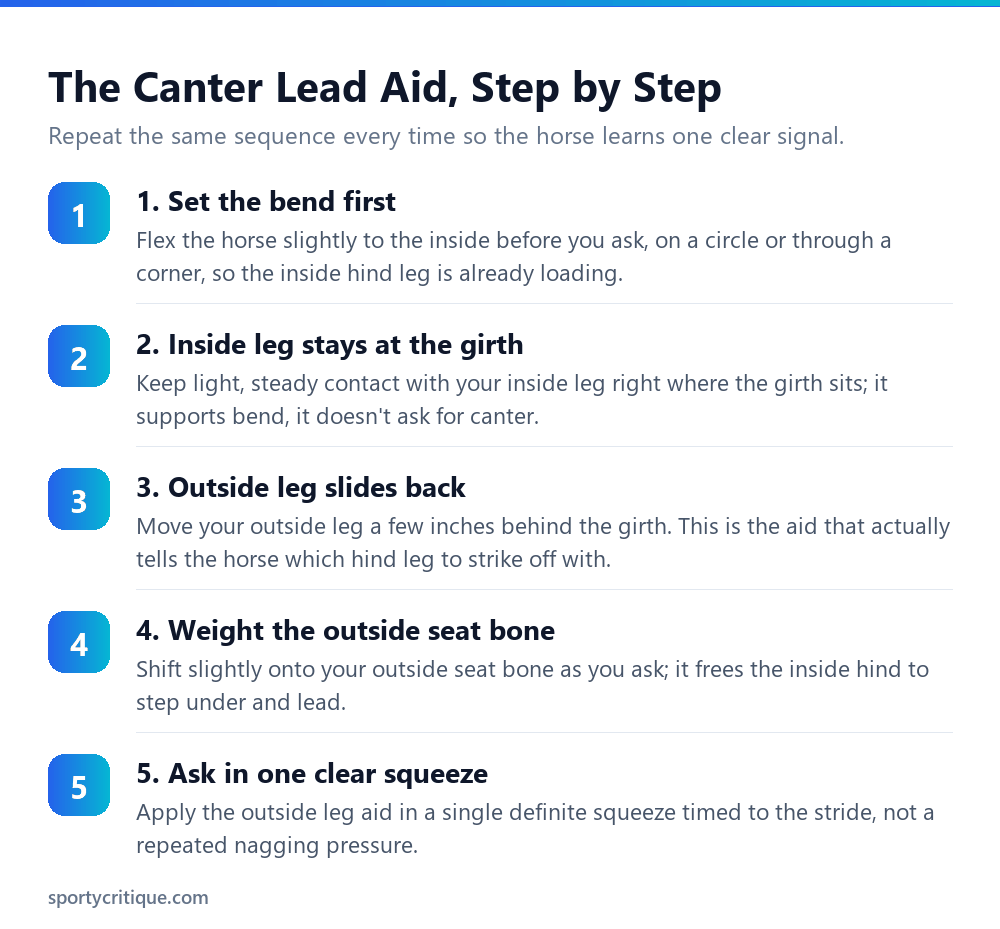
The part riders skip most often is step one. Asking for canter on a straight line, with no bend established, means you’re relying entirely on the leg aid to communicate which lead you want, and horses read body position and weight more than most riders realize. Set the bend on a circle or through a corner first, and the aid becomes almost a formality.
⚠️ Watch out: Don’t lean forward or collapse your inside hip as you ask. Tipping forward is the most common way riders unbalance a horse into taking whichever lead is easiest for it in that moment, rather than the one you asked for. Sit up, stay tall, and let your weight aid do the work through your seat bones, not your upper body.
Timing the aid to the stride
The outside leg aid needs to land the moment the horse’s outside hind leg is about to leave the ground, not whenever you happen to think of it. Feel for the corresponding hip dropping slightly under you at the walk or trot just before that leg lifts, that’s your window. Riders who ask on a random beat instead of that specific moment get inconsistent leads even when every other part of their position is correct.
This is genuinely difficult to feel at first, and it’s normal to ask on the wrong beat repeatedly while you’re learning it. A instructor calling out the beat from the ground, or watching video of your own transitions, closes that gap faster than trying to feel it out alone over weeks of guessing.
Use the arena, not just your aids
Corners and circles do half the work for you because they physically require the horse to bend before you ask. Asking for canter coming out of a corner, with the bend already established from the turn, is dramatically more reliable than asking on a straight rail. If you’re consistently getting wrong leads on a straight line, move the exercise to a 20-meter circle until the aid sequence becomes automatic, then reintroduce straight-line departures once it’s reliable.
💡 Pro tip: Practice canter departures on a 20-meter circle in both directions before you try them on a straight line or through a corner in competition. The circle removes the bend variable entirely and lets you isolate whether your leg and seat aids alone are clear enough.
A gear note on reinforcing the outside leg aid
If a horse is consistently dull to the outside leg specifically, a light tap from a HORZE Black & White Dressage Whip applied just behind your leg, in the same spot and same moment as the leg aid, can sharpen the response over a few sessions. The whip isn’t there to punish a wrong lead after the fact, it’s a reinforcement tool used at the exact instant of the leg aid so the horse learns to respond to the leg alone over time. Used inconsistently or after the fact, it teaches nothing and just adds noise to the cue.
Common mistakes that cause wrong leads
Asking with too much inside leg and not enough outside leg is probably the most common error; the inside leg supports bend, but riders who lean on it heavily while asking for canter often get a trot lengthening instead of a clean transition, or a wrong lead if the horse does jump into canter. Collapsing the inside hip to compensate for a horse that feels stiff is another frequent one, and it does the opposite of what riders intend, it tips the horse’s balance toward the outside instead of supporting the inside bend.
Nagging with repeated small leg bumps instead of one clear aid is a third pattern worth watching for in yourself. Horses that get bumped repeatedly before a transition often become dull to the leg altogether, which then requires a stronger aid to get any response at all, a cycle that gets harder to break the longer it continues.
Feeling a wrong lead without looking down
Looking down to check your lead throws off your own balance and often makes the transition worse in the process. Instead, feel for the rock: on the correct lead, the horse’s shoulders and your hips rock in the same rhythm as the bend of the turn, a smooth, swinging feel. On the wrong lead, you’ll feel choppier, almost like the horse is fighting its own stride through the turn, and the outside shoulder will feel like it’s falling out rather than staying up under you.
- ✓Correct a wrong lead by coming back to trot or walk and re-establishing bend before asking again
- ✓Set the bend through a corner or circle before every canter departure while you’re still building consistency
- ✓Keep your upper body tall and let the seat and leg aids do the work
- ✓Time the outside leg aid to the horse’s stride, not to a random moment
- ✕Don’t try to fix a wrong lead by kicking harder mid-stride; it rarely works and confuses the horse further
- ✕Don’t lean forward or collapse your inside hip when asking
- ✕Don’t nag with repeated small aids instead of one clear, timed cue
- ✕Don’t ask on a straight line before the sequence is reliable on a circle
Green horses versus schooled horses
A young or green horse hasn’t yet built the strength to hold a bend and strike off cleanly every time, so occasional wrong leads at this stage are a normal part of development, not a training failure. Keep the aid sequence exactly the same regardless of how the horse responds; consistency is what teaches a green horse the pattern, even through weeks of inconsistent results. A schooled horse getting wrong leads repeatedly is a different situation, and it usually points back to the rider’s own aids drifting out of habit rather than anything the horse forgot.
If a horse that has always picked up leads cleanly suddenly starts missing them consistently on one side, it’s worth ruling out a physical cause before assuming it’s an aids problem again. Saddle fit that’s pinching through the shoulder, mild hind-end stiffness, or hoof balance issues can all show up first as a reluctance to strike off correctly on one lead specifically. A vet or bodyworker check is a reasonable step if the pattern is new and one-sided.
Counter-canter as a diagnostic, not just an exercise
Once departures are reliable, deliberately riding counter-canter, cantering on the outside lead through a gentle turn, is a useful way to confirm the horse is actually responding to your aids rather than guessing based on which way the arena turns. If a horse breaks stride or swaps leads the moment you ask for counter-canter on a shallow loop, that’s a sign the canter departure itself was still being helped along by the direction of the turn rather than by your aids alone. It’s an advanced exercise, so don’t reach for it until basic departures on both reins are already solid.
Fixing a wrong lead mid-ride
If the horse picks up the wrong lead, the fix is simple even if it doesn’t feel satisfying in the moment: bring the horse back to trot or walk, re-establish the bend on a circle or corner, and ask again cleanly. Riding through a few strides of wrong-lead canter hoping it corrects itself rarely works and just reinforces an unbalanced stride pattern for both of you. The reset costs a few seconds; riding on the wrong lead through a whole exercise costs a lot more in the long run, both in the horse’s balance and in what it’s learning about your aids.
Bottom line
A correct canter lead comes from bend set before the ask, a clear outside leg aid a few inches behind the girth, and a weight shift onto the outside seat bone, all timed to the horse’s stride rather than applied on a random beat. Get that sequence consistent on a circle first, and straight-line departures get dramatically more reliable without needing to ask any harder.
See also: How to Become an Equestrian if you’re still early in building a riding foundation.
What leg tells the horse which canter lead to take?
The outside leg, slid back a few inches from the girth, is the primary aid. The inside leg stays at the girth to support bend rather than to ask for the lead itself.
Why does my horse keep picking up the wrong lead?
Almost always unclear bend before the ask, mistimed leg aid, or a rider leaning forward and unbalancing the horse’s weight toward the outside. Fix the sequence, bend first, then a clear timed outside leg aid, before assuming it’s a training gap in the horse.
Should I keep riding if I get the wrong lead?
No. Bring the horse back to trot or walk, re-establish the bend, and ask again. Riding through several strides of a wrong lead reinforces an unbalanced stride and rarely self-corrects.
Do circles really make a difference for canter departures?
Yes. A circle sets the bend for you before you even ask, which removes one whole variable from the transition. Practicing departures on a 20-meter circle in both directions before trying them on a straight line makes the aid sequence far more consistent.
As an Amazon Associate, we earn from qualifying purchases through links on this page.