Cue Tip Shape Explained: Nickel, Dime, and Quarter Radius


Pool cue tip shape decides how much of the tip actually touches the cue ball on contact, and that single detail affects spin, squirt, and how many miscues you eat on shots that should have been routine. Here is what nickel, dime, and quarter radius actually mean, and how to check and fix your own tip.
Pool cue tip shape comes in three common curves, named for the coin whose edge matches the dome: dime radius is the sharpest curve and concentrates contact into the smallest area, which helps generate spin but shrinks the margin for error. Nickel radius is a slightly flatter, more forgiving curve and is the most common shape in American pool. Quarter radius is nearly flat, spreads contact over the widest area, and suits beginners and players who mostly hit center ball. None of the three is objectively best; the right one depends on how much English you actually use.
Most players never think about pool cue tip shape until a miscue costs them a game, and even then they usually blame the chalk instead of the tip underneath it. The shape of that tip, specifically how sharply it curves from edge to center, changes how much of the tip actually touches the cue ball on contact. That single detail affects spin, squirt, and how forgiving your stroke is allowed to be off-center.
This is a maintenance topic more than a shopping topic. You do not need to buy a different tip to change its shape, you need to reshape the one you already have, and most players go years without doing it even though a tip flattens and distorts with every stroke.
- →Dime radius: sharpest curve, smallest contact area, most spin potential, least forgiving off-center
- →Nickel radius: the middle ground and the most common shape among American pool players
- →Quarter radius: nearly flat, most forgiving, best for center-ball players and beginners still building a consistent stroke
- →Tip shape flattens gradually with normal play; check it every few weeks, not just after a miscue
- →Reshaping takes minutes with a basic shaping tool and does not require replacing the tip itself
Table of Contents
What “tip shape” actually means
A cue tip is not flat, it has a slight dome, and the curvature of that dome is what people mean by shape or radius. The three common references, dime, nickel, and quarter, describe how closely the tip’s curve matches the edge profile of that coin when you hold it against the tip. A sharper curve concentrates the contact patch with the cue ball into a smaller area at the moment of the hit. A flatter curve spreads that same contact over more surface.
This matters because spin comes from hitting the cue ball away from its exact center, and a sharper tip curve lets you strike further off-center before the tip starts to slide instead of grip, which is what causes a miscue. A flatter tip curve reaches that slipping point sooner on an off-center hit, which is exactly why it feels more forgiving on straight, center-ball shots and less forgiving the moment you try to load up heavy side spin.
Dime radius: the spin-focused curve
A dime-radius tip is the sharpest of the three and the one most associated with advanced players who lean on side spin, particularly in 9-ball and 10-ball where position play depends on it. The tradeoff is a smaller sweet spot. Because less of the tip touches the ball at contact, a slightly mishit stroke is more likely to slide off the ball entirely rather than grip and transfer spin, which is exactly what a miscue is. Players who shape their own tips to a dime curve are usually doing it deliberately, not by accident, because the payoff in spin control is worth the reduced margin for error to them specifically.
Nickel radius: the default most players never think about
Nickel radius sits in the middle and is what most cues come shaped to from the factory or the pro shop. It gives up a little spin potential compared to a dime curve but gains back real forgiveness on shots that are not hit perfectly center. For most recreational and league players, this is the shape they are already playing on without having chosen it consciously, and there is nothing wrong with leaving it there. The main reason to know the difference is so you can recognize when your tip has drifted away from this shape through wear, not necessarily so you can chase a different one.
Quarter radius: the forgiving, flatter curve
A quarter-radius tip is nearly flat across the dome, which maximizes the contact patch with the cue ball. That makes center-ball hits feel more solid and consistent, which is genuinely useful for a beginner still developing a repeatable stroke. The cost shows up the moment you try to apply real side spin: because the flatter curve reaches its slip point sooner on an off-center hit, heavy English is harder to control and more prone to miscuing than it would be on a dime or nickel curve. Some players also find a very flat tip feels dead on soft touch shots, though that has as much to do with tip hardness as with shape.
⚠️ Watch out: A tip that has gone flat from wear is not the same thing as a deliberately shaped quarter radius. Worn-flat tips usually also have a mushroomed edge overhanging the ferrule, which changes the effective diameter of the hit and makes miscues more likely regardless of which curve you were aiming for. If the edge overhangs the ferrule, that needs trimming before reshaping the dome does any good.
How to check what shape your tip actually is
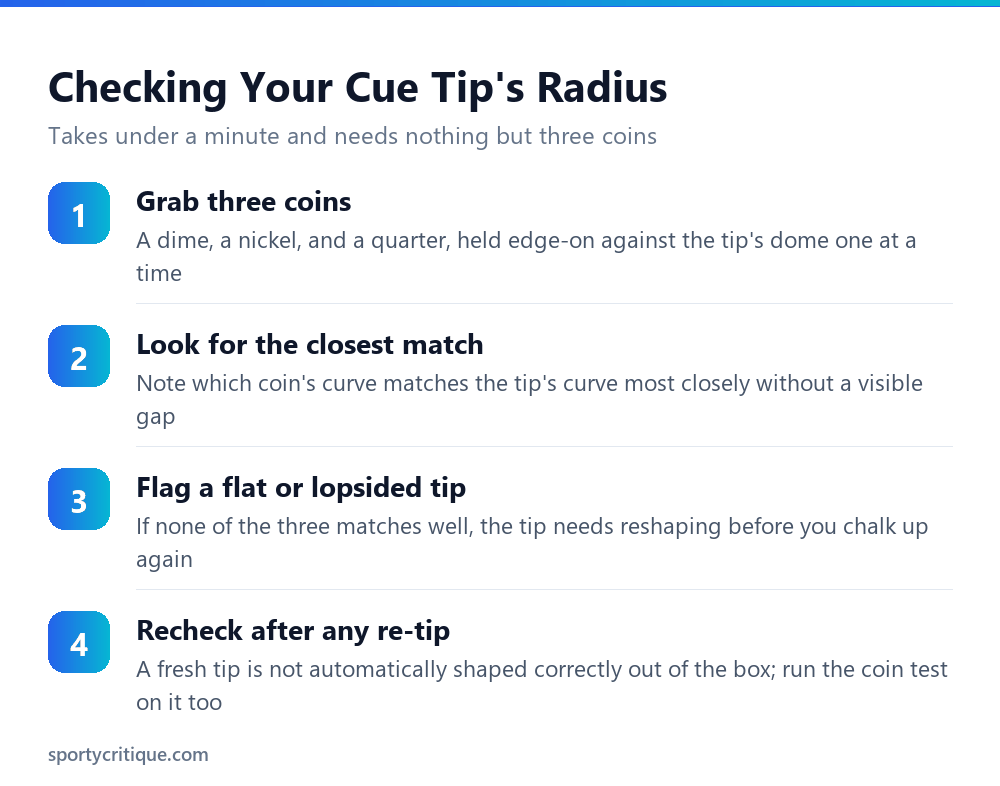
Hold a dime, a nickel, and a quarter against the tip’s dome one at a time, edge on, and look for daylight between the coin and the tip. Whichever coin’s curve sits flush against the tip with the least visible gap is roughly the shape you are playing on right now. This is a rough check, not a precision measurement, but it is accurate enough to tell you whether your tip has drifted noticeably flat or lopsided from uneven chalking and play.
Reshaping a tip yourself
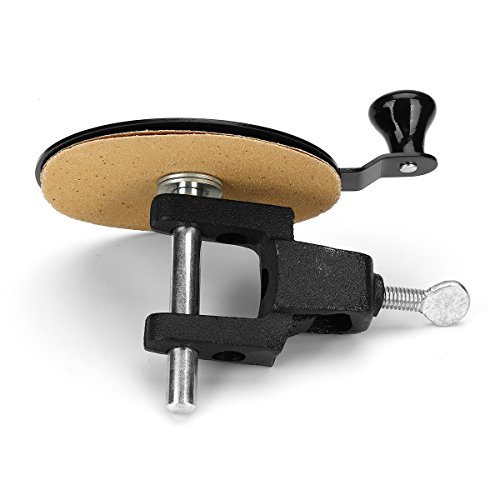
A dedicated shaping tool makes this a five-minute job rather than a guessing game with sandpaper. The Willard Pool Cue Tip Shaper is built specifically around a dime radius curve, so running it across the tip in light, even passes pulls a flattened or lopsided tip back toward that shape without you needing to eyeball the curve freehand. Go slow and check progress often with the coin test above rather than trying to fix everything in one long pass, since it is much easier to take more material off than to put it back on.
If you want a nickel or quarter curve instead of dime, a curved sanding tool or a shaping puck sold for that specific radius works the same way. The principle does not change: light, even pressure, frequent checks, and stop as soon as the coin test lines up rather than continuing out of habit.
💡 Pro tip: Reshape before you re-chalk, not after. Chalk sitting in the low spots of an unevenly worn tip can mask the actual shape underneath it, which makes the coin test less reliable and can lead you to over-correct a curve that was not actually as flat as it looked.
Which shape should you actually pick
- ✓Stick with nickel radius if you are not sure which one you have or need; it is the safest default
- ✓Move toward dime radius once you are deliberately using heavy side spin for position play
- ✓Consider quarter radius if you are brand new and still working on hitting the cue ball consistently center
- ✓Recheck shape every few weeks of regular play, since normal wear flattens any curve over time
- ✕Chasing a dime radius before your stroke is consistent enough to make use of the extra spin
- ✕Assuming a factory tip stays at its original shape forever without maintenance
- ✕Reshaping aggressively in one pass instead of checking progress with the coin test along the way
- ✕Ignoring a mushroomed edge overhanging the ferrule and only addressing the dome curve
Common myths about tip shape
Shape versus hardness: two different decisions
It is easy to lump tip shape and tip hardness together since both get decided at the same time a tip goes on, but they solve different problems. Hardness, soft, medium, or hard, controls how much the tip compresses on contact and how much cue ball feel you get on touch shots. Shape controls how much of that tip actually reaches the ball off-center. A hard tip shaped to a dime radius and a soft tip shaped to a dime radius will both concentrate contact into a small area, but they will feel completely different on a soft safety shot. If a tip feels wrong after reshaping, check whether the actual problem is hardness rather than curve before you reshape it again.
How often to check and reshape
A tip that sees regular play, several sessions a week, is worth checking with the coin test every three to four weeks. Casual players who play once a week or less can usually stretch that to every couple of months. The real trigger is not a calendar date, it is an uptick in miscues that has nothing to do with your stroke, which is usually the tip telling you it has flattened or gone lopsided before you consciously notice the shape has changed.
Bottom line
Pool cue tip shape is a maintenance habit, not a one-time purchase decision. Nickel radius is the safe, all-around default. Move toward dime radius once your stroke can actually take advantage of the extra spin, and lean toward quarter radius while you are still building consistency. Whichever shape you land on, check it with the coin test every few weeks, because the curve you started with does not stay that way on its own.
What is the difference between a nickel and dime radius cue tip?
A dime radius has a sharper curve with a smaller contact area, which helps generate more spin but leaves less margin for an off-center hit. A nickel radius is slightly flatter and more forgiving, and it is the shape most cues come with by default.
Which tip shape is best for beginners?
Quarter radius or nickel radius. Both give a larger, more forgiving contact area for center-ball hits while a beginner’s stroke is still developing. A dime radius rewards precise, deliberate off-center hits, which is a harder standard for someone still learning to hit center ball consistently.
How do I know what shape my current tip is?
Hold a dime, a nickel, and a quarter against the tip’s dome, edge on, one at a time. Whichever coin’s curve sits flush against the tip with the least visible gap is roughly your current shape. It is a rough test, but accurate enough to catch a tip that has flattened or gone lopsided from wear.
How often should I reshape my cue tip?
Regular players should check every three to four weeks; casual players can usually go a couple of months between checks. An increase in miscues that is not explained by your stroke is usually a sign the tip has flattened or gone lopsided and needs reshaping sooner than your usual schedule.
As an Amazon Associate, we earn from qualifying purchases through links on this page.