Best Hockey Shin Guards for Youth Players

Best youth hockey shin guards are not the ones with the highest price tag, they are the ones sized correctly for a player who is still growing. Here is how sizing actually works, what separates the price tiers, and five real options currently listed across that range.
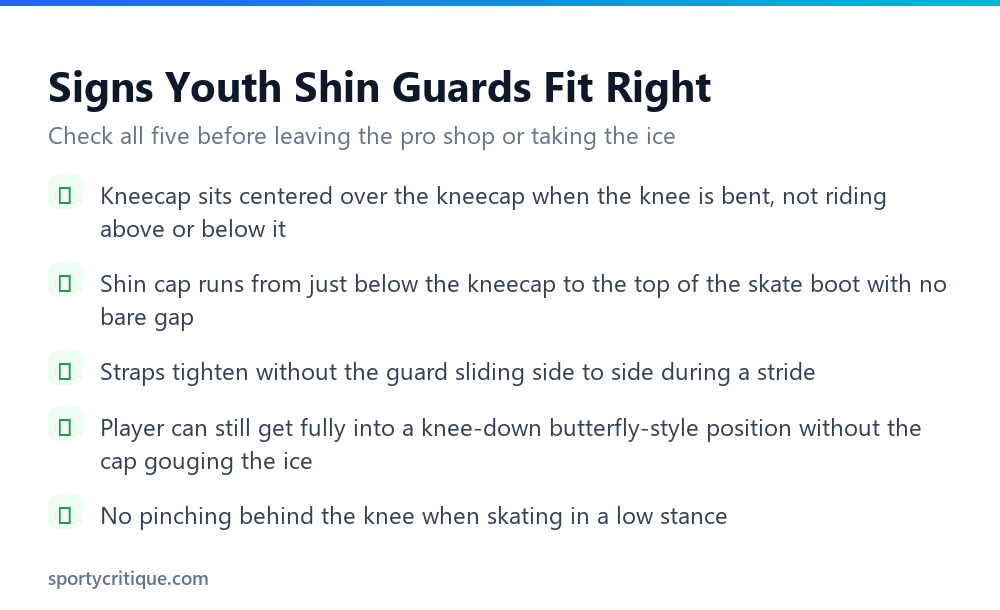
The best youth hockey shin guards fit snugly from just below the kneecap to the top of the skate tongue, with the kneecap centered over the knee joint when bent. Across price tiers, the TronX Force Junior (around $50) is a solid mid-range pick with a confirmed in-stock listing, and the Bauer Youth/Adult Hockey Shin Guards sit at the premium end with a molded X-Flex shin cap. Size by height, not age, and replace anything the player has outgrown by more than an inch of exposed skin above the boot.
A youth player grows out of shin guards faster than almost any other piece of gear, which is exactly why so many parents end up buying the wrong size twice. Best youth hockey shin guards are not the priciest ones on the wall, they are the ones that actually cover the gap between the kneecap and the skate boot for this season, with a kneecap that stays centered when the knee bends. Get the sizing wrong and even a $150 pair leaves a strip of bare shin exposed to a slap shot.
This guide walks through how sizing actually works for kids (it is not the same chart as adult shin guards), what separates a $25 guard from a $160 one, and five real, currently listed options across that range so you know what you are actually paying for at each tier.
- →Size by height in inches, not by age or jersey number; most brands publish a height-to-guard-length chart
- →The gap to avoid is between the bottom of the shin cap and the top of the skate tongue; a good fit leaves none
- →A vented, molded plastic shin and knee cap beats a soft foam-only guard for a growing skater who blocks shots or falls often
- →Budget guards ($20-50) protect fine for house league and learn-to-skate; travel and check hockey benefit from a reinforced knee cap higher up the range
- →Re-check fit every 4-6 months during a growth spurt, not just at the start of the season
Table of Contents
Why youth sizing is its own chart, not a smaller adult chart
Adult and junior shin guards size roughly to leg length in inches, and that part carries over. What does not carry over is the proportion. A younger player’s knee sits relatively higher on a shorter leg, so a guard scaled down from an adult pattern often leaves the kneecap riding too low, exactly where a puck or stick blade is most likely to catch it. Youth-specific guards are cut with a shorter upper section and a wider knee cap relative to overall length to correct for that, which is one reason a youth 8-inch guard and a junior 8-inch guard from the same brand do not fit the same player.
⚠️ Watch out: Do not size up “to grow into it.” An oversized shin guard rides down the leg during a stride, which pushes the kneecap below the actual knee joint and leaves the real knee unprotected. It is a common mistake and it defeats the point of the extra money spent on a better guard.
What actually separates a cheap guard from an expensive one
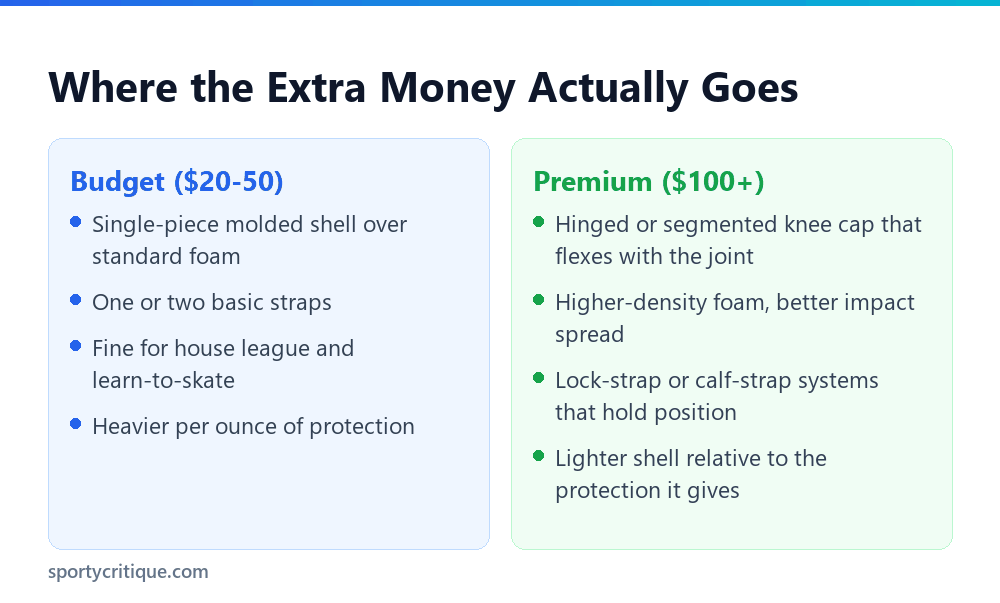
Three things change as price goes up in this category: the shin cap material, how the knee cap is shaped and reinforced, and the strap system. Budget guards use a single molded plastic shell over foam. Mid-range and premium guards add a hinged or segmented knee cap that flexes with the joint instead of digging into it on a deep knee bend, plus higher-density foam that absorbs a shot better without adding much bulk.
Strap systems matter more than most parents expect. A single-strap guard is lighter and easier for a young player to pull on themselves, but it can rotate slightly during play. A two-strap or calf-lock system holds position better through a full stride and a season of practices, at the cost of being slightly harder for a 6-year-old to buckle alone before you step in to help.
Five real youth shin guards across the price range
Availability and pricing on youth gear shift constantly as sizes sell out mid-season, so treat the figures below as a snapshot and confirm the current price on the listing before buying. Two of the five below had a confirmed live price at the time this was written; the other three are real, currently listed products where Amazon’s own listing did not surface a price through our data feed, so check the page directly for those.
The budget tier: JAMM 5001 and similar single-shell guards
The JAMM 5001 Youth Shin Guards is a straightforward single-shell design aimed at first-time skaters and house-league players who are not blocking shots or taking regular contact yet. It covers the basics: a molded plastic cap over foam, adjustable straps, and enough coverage for casual practice and small-area games. It is not the guard to buy for a kid who has moved into travel hockey or started playing defense in front of the net, but for a first pair of shin guards on a player who is still learning to skate, it does the job without overspending on features that will be outgrown in a year anyway.
The mid tier: TronX Force Junior and Winnwell AMP700
The TronX Force Junior is where the segmented knee cap shows up, and it is the pair on this list with a confirmed price around $50 at the time of writing. That knee design flexes through a deeper bend than a single-piece shell, which matters for a kid who is starting to drop into a butterfly-style stance or just generally moves around more aggressively than a beginner. The vented shell also helps with the smell problem that youth gear is famous for, though it will never fully solve it.
The Winnwell AMP700 Junior sits at a similar tier but leans on its CleanSport NXT liner as the main selling point, an antimicrobial treatment baked into the fabric rather than a spray-on. If the guard is going to live in a hockey bag between three practices a week, that is a more practical upgrade than it sounds. Protection-wise it is comparable to the TronX: molded shell, decent knee coverage, nothing exotic.
The premium tier: CCM Jetspeed FT350 and Bauer Youth/Adult
The CCM Jetspeed FT350 Junior is built around keeping weight down while still using a hard shell, which is the usual premium-tier trade: less bulk, less drag on the stride, similar or better protection through smarter foam placement rather than just piling more of it on. It is aimed at a travel or AA-level player who is on the ice enough that saved weight over a season actually adds up.
The Bauer Youth/Adult Hockey Shin Guards is the most protective option here and it has a confirmed in-stock listing with a real price around $166. Its X-Flex shin cap hinges instead of sitting rigid, so it absorbs a shot at an angle rather than transferring the full impact straight through to the shin, and the ErgoDynamic knee cap is shaped closer to the actual joint than a generic rounded cap. That is a genuine step up in protection, and the price reflects it. For a house-league player, it is more guard than necessary. For a kid blocking shots regularly, it is a reasonable investment.
Budget tier vs. premium tier, side by side
Who should buy which tier
- ✓Buy budget for a first season or learn-to-skate program where growth will outpace the gear anyway
- ✓Buy mid-tier once a player is skating regularly and blocking the occasional shot in practice
- ✓Buy premium for travel, AA, or any level where the player is dropping into a butterfly stance or taking regular contact
- ✓Re-measure height every 4-6 months during a growth spurt, not just once a season
- ✕Buying premium gear for a player who will outgrow it in four months
- ✕Buying oversized to save money on next season’s pair
- ✕Ignoring the knee cap position once the guard is on; that is the actual protection zone
- ✕Assuming a higher price guarantees a better fit for a specific kid’s proportions
💡 Pro tip: Try the guard on with the skates the player actually wears, not sneakers. The gap between the bottom of the shin guard and the top of the skate boot is the single most common fit failure, and it only shows up once both pieces are on at the same time.
Common myths about youth shin guards
When to replace them
Replace shin guards when there is more than about an inch of bare skin between the bottom of the guard and the top of the skate boot, when the knee cap visibly sits below the actual knee when the player is standing in skates, or when straps have stretched out enough that they no longer hold the guard in place through a full practice. None of those are wear-and-tear problems with the gear itself, they are growth catching up to last season’s size, and it happens faster than most parents expect during an active hockey season.
Bottom line
For most youth players, a mid-tier guard like the TronX Force Junior covers house league and regular practice without overspending on features a growing kid will outgrow before they matter. Step up to something like the Bauer Youth/Adult guard once a player is blocking shots regularly or playing at a travel level where the extra knee protection earns its price. Whatever tier you land on, get the height-based sizing right first. A $160 guard that rides down the leg protects worse than a $30 guard that actually stays in place.
How do I know what size shin guards my kid needs?
Measure height in inches or feet and check it against the brand’s own size chart, since most youth shin guards size to height rather than age. As a rough guide, a player around 3’7″ to 4’0″ typically wears an 8-inch guard, and a player around 4’5″ to 4’10” typically wears a 10-inch guard, but always confirm against the specific listing before buying.
Should I buy shin guards a size bigger so my child can grow into them?
No. An oversized guard slides down during a stride, which pushes the knee cap below the actual knee joint and leaves the real knee exposed. It is safer to buy the correct current size and replace it again next season than to size up for future growth.
What is the actual difference between a $30 pair and a $160 pair?
The shin cap material, how the knee cap is shaped and hinged, and the strap system. Budget guards use a single molded shell over standard foam. Premium guards add a hinged or segmented knee cap that flexes with the joint and higher-density foam that spreads impact better without adding much bulk.
Do youth shin guards need to match the brand of skates or other gear?
No, shin guards from any brand work with skates or other pads from a different brand. The only fit relationship that matters is between the bottom of the shin guard and the top of the skate boot, so always try the guard on with the actual skates the player wears before deciding on a size.
As an Amazon Associate, we earn from qualifying purchases through links on this page.