Draw, Follow, and Stun: Cue Ball Control Shots Explained

Potting the ball is only half of every shot in pool; where the cue ball ends up afterward decides whether your next shot is easy or a scramble. Draw, follow, and stun are the three foundational ways to control that, and all three come down to one variable: where you strike the cue ball vertically.
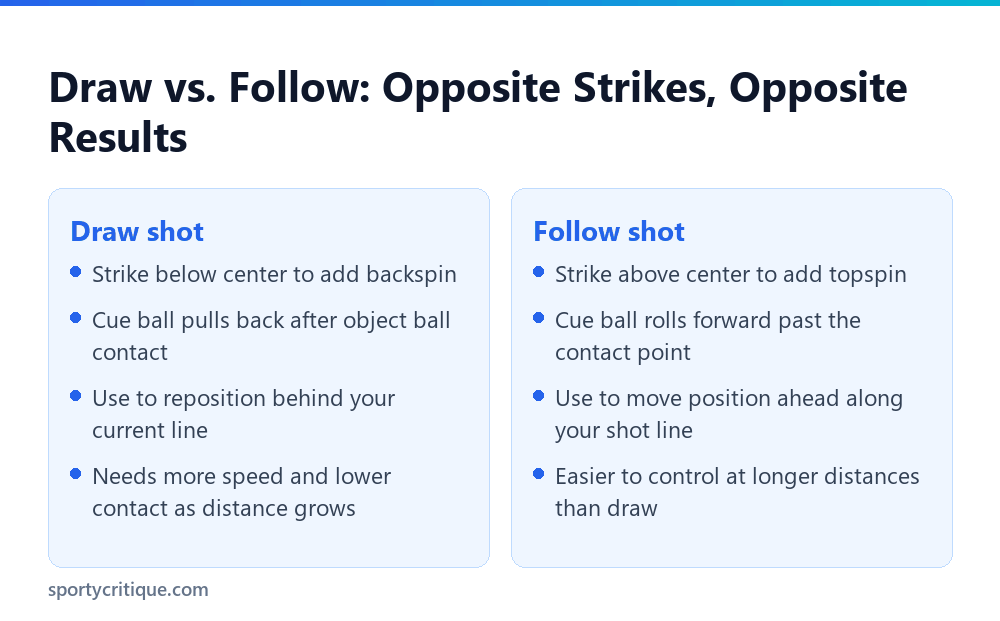
Where you strike the cue ball vertically determines what it does after contact with the object ball. Hit below center for a draw shot and the cue ball pulls backward. Hit above center for a follow shot and it rolls forward. Hit dead center, or low enough to cancel out roll by the moment of contact, for a stun shot, and the cue ball stops or deflects at a predictable 90-degree angle from the object ball’s path. All three depend on tip contact point and speed working together, not tip contact point alone.
Cue ball control is the actual game inside the game of pool. Potting a ball is only half the shot; where the cue ball ends up afterward decides whether your next shot is easy or a scramble. Draw, follow, and stun are the three foundational ways to manage that, and they all come from the same basic idea: where you strike the cue ball vertically changes how it spins, and that spin determines what happens the instant it contacts the object ball.
- →Vertical tip placement, not power, is what determines draw, follow, or stun; power controls distance, not direction of travel after contact
- →A stun shot needs the cue ball to have zero forward roll or backspin at the exact moment of contact, which requires adjusting strike point for distance
- →Draw gets harder to control the farther the cue ball travels before contact, since natural roll fights the backspin over distance
- →Follow is generally more forgiving over long distances than draw, which is why most beginners find it easier to learn first
- →Chalk and tip condition affect all three shots, but they matter most on draw, where miscues from low, off-center contact are most common
Table of Contents
The physics in plain terms
When a cue tip strikes the cue ball below its vertical center, it imparts backspin. That backspin doesn’t fully show itself while the ball is sliding across the felt toward the object ball; friction is already working to convert that backspin into forward roll the whole time it travels. What matters is how much backspin remains at the instant of contact with the object ball. If enough survives, the cue ball reverses direction after the collision, a draw shot. Strike above center and the same logic runs in reverse: topspin survives to contact and the cue ball continues forward past the point of collision, a follow shot.
The stun shot: neither spin at the moment that matters
A stun shot isn’t a separate strike location so much as a target condition: zero forward roll and zero backspin at the exact instant of contact. Close to the object ball, this is nearly automatic, hit the cue ball dead center and there simply isn’t enough time or distance for friction to add roll before contact happens. Farther away, dead center alone won’t get you there, because friction has more time to convert whatever spin state the ball started in in toward natural roll. To stun from distance, you need a slightly below-center strike combined with enough speed that the ball is still effectively sliding, not yet rolling, when it reaches the object ball.
Once you’ve hit a clean stun shot, the object ball travels down the cut angle toward your target, while the cue ball’s path runs along a line roughly perpendicular to that angle. That 90-degree relationship is one of the most useful predictable patterns in the entire game, and it’s the reason stun shots are taught so early: once you can produce one reliably, you can start planning position two and three shots ahead instead of one.
⚠️ Watch out: Never chase draw or follow by striking further off-center at the same speed you’d use for a centered hit. Going too far below or above center dramatically increases the risk of a miscue, the tip sliding off the ball instead of gripping it. Increase speed and refine your strike point together, don’t just push the contact point to its extreme.
Why distance changes everything
The single biggest adjustment beginners miss is that vertical strike point alone doesn’t determine the outcome, distance to the object ball changes what strike point produces what result. A draw shot struck with a given low contact point and speed will pull back hard from three feet away but might barely draw at all, or even roll forward, from nine feet away, because friction has had more time and distance to convert that backspin into roll before contact. The fix isn’t a different technique, it’s recalibrating: strike lower, hit harder, or both, as the distance to the object ball increases.
Follow shots are more forgiving over distance because you’re working with friction rather than against it; topspin naturally increases toward full roll the farther the ball travels, so a follow shot that starts a little weak at long range often still follows through fine. Draw fights that same natural tendency the whole way, which is exactly why it’s considered the harder of the two shots to master.
💡 Pro tip: Practice draw shots at three fixed distances, one foot, four feet, and eight feet, from the object ball, using the same speed each time and adjusting only your vertical strike point. This isolates exactly how much lower you need to hit as distance increases, which is the actual skill most players never deliberately practice.
A note on tip and chalk
Consistent draw and follow shots depend on the tip actually gripping the cue ball at contact rather than sliding across it, which is where chalk quality matters more than most players give it credit for. A chalk like Kamui ROKU Pool Billiard Chalk, built specifically for higher grip and finer particle adhesion, reduces miscues on the low or high strikes that draw and follow shots require. It won’t fix a fundamentally bad stroke, but a worn or low-grip chalk will sabotage even a technically correct draw attempt by letting the tip slip at the exact moment it needs to bite.
Common mistakes on each shot
On draw shots, the most frequent error is decelerating through the stroke instead of accelerating smoothly into contact; a decelerating stroke robs the shot of the speed needed to preserve backspin to the object ball, especially at longer distances. On follow shots, the common mistake is actually overhitting, adding far more speed than the position play requires simply because follow feels more forgiving, which sends the cue ball rolling much farther past the intended landing spot than planned. On stun shots, the usual issue is inconsistent speed control, since the exact speed needed to cancel spin by contact time shifts with every different distance, and players who use one fixed speed for every stun attempt get inconsistent results.
Building the skill in order
- ✓Start with stun shots close to the object ball before attempting draw or follow at any distance
- ✓Practice each shot at multiple fixed distances to feel how strike point needs to change
- ✓Chalk before every shot when practicing draw or follow specifically; a dry tip fails these shots first
- ✓Accelerate smoothly through the stroke rather than decelerating into contact
- ✕Don’t attempt long-distance draw shots before short-distance draw is fully consistent
- ✕Don’t strike further off-center than necessary just to add more spin; it mainly adds miscue risk
- ✕Don’t use identical speed for stun shots at every distance; recalibrate each time
- ✕Don’t judge your draw or follow technique on a single distance; test it across several
Putting it together in position play
Once all three shots are reliable independently, the real skill is deciding which one a given position actually calls for before you get down on the shot, not after. Ask where you want the cue ball to land relative to your next shot before deciding on strike point: need it to come back toward you, that’s draw; need it to continue on past the object ball roughly along your current line, that’s follow; need a predictable, controlled stop with a known deflection angle, that’s stun. Committing to that decision before the stroke, rather than hoping the right thing happens, is what separates position play from just avoiding scratches.
How side spin changes the picture
Everything above describes pure vertical strikes, straight above or below center. Adding side spin, striking left or right of center in addition to high or low, introduces a curve to the cue ball’s path and changes how it reacts off both the object ball and any rail it touches afterward. Side spin is a separate skill worth learning only after straight draw, follow, and stun are already reliable, since it adds a variable on top of everything already discussed and makes it harder to isolate what’s actually causing a shot to miss its target when something goes wrong.
A useful rule while you’re still building the fundamentals: keep side spin out of practice reps for draw, follow, and stun entirely. Hit dead center, above, or below on the vertical axis only, with no left or right offset, until you can predict where the cue ball lands within a few inches on a repeated shot. Mixing side spin in before that baseline is solid just adds noise that makes it harder to tell whether a miss came from your vertical strike point or the side spin you added on top of it.
Bottom line
Draw, follow, and stun all come from the same underlying mechanic: where you strike the cue ball vertically sets its spin, and that spin, combined with how much of it survives the trip to the object ball, determines what happens at contact. Master stun first at close range, then build out draw and follow across increasing distances, adjusting strike point and speed together rather than treating either one as fixed. That’s the actual skill behind every position-play shot you’ll ever need.
See also: How to Hold and Bridge a Pool Cue Properly for the fundamentals these shots build on.
What’s the difference between a stun shot and a stop shot?
A stop shot is a specific case of a stun shot where the cue ball and object ball collide nearly head-on, so the cue ball stops dead. A stun shot covers any angle, where the cue ball still has zero spin at contact but continues along a path roughly 90 degrees from the object ball’s direction rather than stopping completely.
Why is my draw shot inconsistent at different distances?
Because a fixed strike point and speed only produce a given amount of draw at one specific distance. Friction converts backspin into forward roll the longer the cue ball travels before contact, so longer shots need a lower strike point, more speed, or both, to preserve enough backspin to still pull back.
Is follow easier to learn than draw?
Generally yes. Follow works with the cue ball’s natural tendency to roll forward over distance, so it’s more forgiving of small timing or speed errors. Draw fights that same tendency, which is why it’s considered the harder shot to control consistently.
Does chalk quality actually affect these shots?
Yes, especially draw and follow, which require striking well above or below center. Low-grip or worn chalk increases the chance of a miscue on those off-center strikes, which can ruin an otherwise correctly executed shot.
As an Amazon Associate, we earn from qualifying purchases through links on this page.