How to Read Diamonds for Bank Shots and Kick Shots


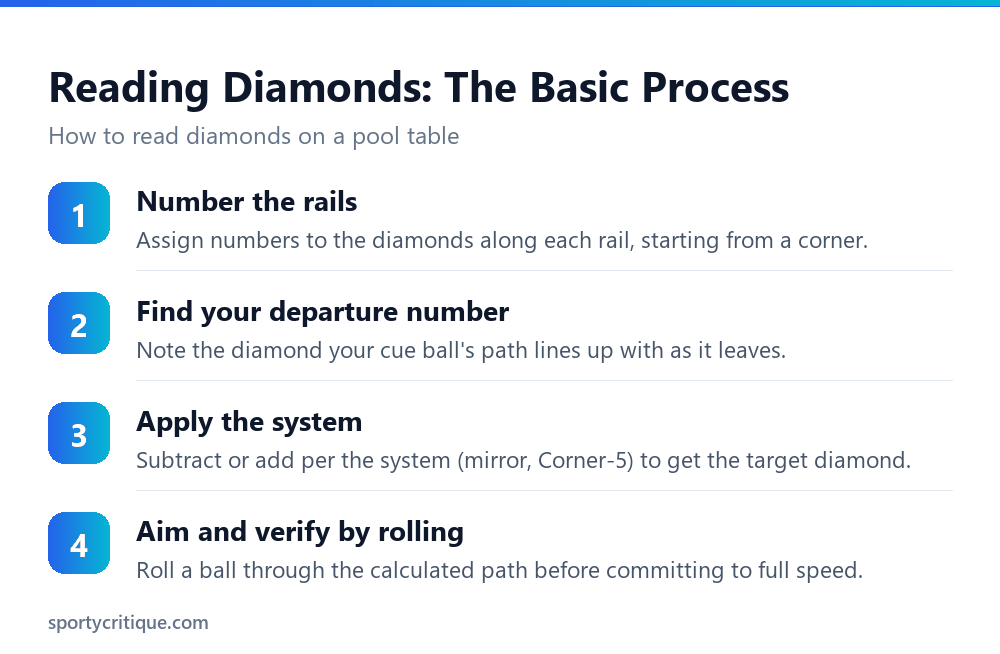
To read diamonds on a pool table, use the inlaid markers along each rail as numbered reference points and apply simple geometry to predict where a ball will travel after bouncing off a rail. For a basic bank shot, the angle in equals the angle out: count the diamonds between the object ball’s rail position and the pocket, then aim at the rail point that splits that distance evenly. For multi-rail kick shots, systems like the Corner-5 assign a number to the cue ball’s starting position and subtract the target diamond number to find where to aim on the first rail.
The diamonds inlaid along a pool table’s rails aren’t decorative. They’re a built-in coordinate system that lets a player calculate rail paths with actual numbers instead of guessing an angle by eye. Most players never learn to use them past a vague sense that banking a ball off the middle of the rail probably sends it toward the middle of the other side, which works often enough on easy shots and falls apart completely on anything requiring precision.
Two related but different problems use diamonds: banking an object ball off a rail into a pocket, and kicking the cue ball off one or more rails to contact an object ball when there’s no direct path to it. Both rely on the same numbered-diamond framework, but the systems used for each are different, and mixing them up is a common source of confusion for players first learning this.
- →Diamonds are numbered reference points along the rails, used to calculate paths with math instead of guessing by eye
- →Basic bank shots follow the mirror principle: angle in equals angle out
- →Kick shots, especially multi-rail ones, use systems like Corner-5 that assign numbers to the cue ball’s position
- →Rail numbering typically starts from a corner and runs to the foot or head spot, depending on the system
- →Table conditions (cloth speed, rail firmness) shift the calculated path slightly, and adjusting for that comes with practice
Table of Contents
How the Diamonds Are Numbered
Standard tables have diamonds spaced along each long rail and each short rail. For most diamond systems, the long rails get numbered from 0 at one corner up toward the far corner, and the short rails get their own separate numbering, typically running from the corner pockets toward the center. Some systems number in single digits, others in tens to avoid fractions when the math produces a number between two diamonds.
This numbering isn’t universal across every system, which is part of why diamond systems have a reputation for being confusing. The mirror system for simple banks and the Corner-5 system for three-rail kicks both use diamond numbers, but they don’t number the rails identically, so learning one doesn’t automatically transfer to the other without adjustment.
The Mirror System for Bank Shots
For a straightforward one-rail bank, the underlying principle is that the angle the ball approaches the rail at equals the angle it leaves at, the same reflection principle as light bouncing off a mirror. Using the diamonds, a player counts the number of diamonds between the object ball’s position (measured perpendicular to the rail) and the target pocket, then aims at the rail point that divides that distance evenly.
💡 Pro tip: A simple version to start with: if the object ball sits 2 diamonds from the rail and the pocket sits 6 diamonds from the rail on the same line, aim for the rail point 4 diamonds from the ball’s position, the midpoint. It won’t be perfectly accurate on every table because of cloth speed and rail firmness, but it’s a reliable starting point before adjusting by feel.
Real tables never play the mirror system perfectly, since throw off the rail, cloth speed, and how hard the ball is struck all shift the actual path slightly from the pure geometric prediction. Experienced players use the diamond math to get close, then adjust the aim point based on how a specific table has played on previous shots that session.
The Corner-5 System for Multi-Rail Kick Shots
Kick shots come up when there’s no legal direct path to the object ball, so the cue ball has to be sent off one or more rails first. The Corner-5 system, one of the clearest methods for three-rail kicks, assigns the corner pocket a value of 5 and numbers outward from there along the rail. The cue ball’s starting position gets a number based on where it sits, and subtracting the target diamond’s number from the cue ball’s starting number gives the diamond to aim at on the first rail contact.
There’s also a simpler pattern some players use as a sanity check on three-rail kicks, sometimes called the Sixes System: the diamond of separation between the cue ball’s line and the target, plus the diamond where the calculated path converges on the fourth rail, should add up to 6. It’s not a full replacement for Corner-5, but it’s a fast way to check whether a calculated aim point is roughly in the right neighborhood before committing to the shot.
📊 Note: Diamond systems assume rolling cue ball contact with consistent speed and, in some versions, running English. A stunned or heavily spun cue ball won’t follow the calculated path the same way, which is why most instructional material introduces these systems using a plain rolling ball before adding spin into the calculation.
The Plus System for Two-Rail Kicks
Not every kick shot needs three rails. When the cue ball can reach the object ball off a single rail contact but doesn’t have a legal straight path, a two-rail kick off the short rail often works, and the Plus System is the common approach for calculating it. Like Corner-5, it assigns a number to the cue ball’s position and the target diamond, but the specific numbering and the formula differ enough that treating it as interchangeable with Corner-5 produces wrong aim points.
The name comes from the calculation itself: rather than subtracting one number from another the way Corner-5 does, the Plus System adds the cue ball’s number and the target’s number together, then applies a correction factor specific to the table’s numbering convention to find the first rail contact point. It’s less commonly taught than Corner-5 because two-rail kicks come up less often than three-rail ones in most amateur play, but it’s worth knowing for the situations where a full three-rail kick would be overkill.
A Worked Example: A Simple One-Rail Bank
Picture an object ball sitting 2 diamonds off the long rail, with the target pocket at the far corner, which sits 8 diamonds down that same rail from the ball’s position when measured along the rail line. Using the mirror principle, the rail contact point splits the total distance based on the two perpendicular distances involved, not simply the midpoint of the rail length. In practice, most players estimate this with the ball’s distance-from-rail ratio rather than doing full trigonometry at the table.
This is where diamond counting earns its keep over eyeballing the shot. A player who’s never used the system will often aim at a point that looks roughly right and miss by enough to not reach the pocket, especially on a longer bank where a small angle error compounds over distance. Counting diamonds and applying the ratio gets the aim point close enough that only a small table-condition adjustment is needed, rather than guessing the entire angle from scratch.
⚠️ Watch out: A common beginner mistake is measuring the object ball’s distance from the rail incorrectly, using the ball’s position along the rail instead of its perpendicular distance from it. That single measurement error throws off every diamond calculated from it, even when the rest of the math is done correctly.
None of this needs to happen instantly at the table under pressure. Working through a handful of practice banks away from any real game situation, with time to count carefully and check the actual result against the calculation, builds a feel that eventually becomes fast enough for live play. Rushing straight to full-speed match shots before the counting itself is automatic is the most common reason players give up on diamond systems as “too complicated,” when the actual math involved is simple arithmetic.
Bank Shots vs. Kick Shots: Quick Reference
Practicing the System and Adjusting for Real Tables
Diamond systems are learned faster by rolling balls slowly through calculated paths than by trying to memorize the numbers in the abstract. Setting up a simple one-rail bank, calculating the aim point, and rolling the ball at low speed to see how close the actual result lands to the prediction builds the feel for how much a specific table’s conditions shift the outcome.
- ✓Start with simple one-rail banks before attempting multi-rail kicks
- ✓Roll shots slowly at first to check the calculated path against reality
- ✓Account for table conditions like cloth speed and rail firmness
- ✓Learn one system fully before mixing in a second one
- ✕Assuming diamond math is perfectly accurate on every table without adjustment
- ✕Jumping straight to three-rail kicks before understanding basic banking
- ✕Mixing numbering conventions from two different systems in the same calculation
- ✕Ignoring how spin changes the path predicted by a rolling-ball system
Chalk matters more on bank and kick shots than on a straightforward pocket shot, since a mishit or a slight miscue changes the angle enough to throw off a calculated diamond path entirely. Keeping a consistent chalk routine, something like Master Billiard Pool Cue Chalk, Premium (Dozen) ($10.95), reduces the chance that a diamond-system shot misses on a clean miscue rather than a calculation error, which makes it much easier to actually learn whether the math or the execution needs adjusting.
Frequently Asked Questions
Do all pool tables have diamonds in the same place?
Standard regulation tables have diamonds spaced consistently relative to table size, which is what makes diamond systems transferable between tables. Non-standard or novelty tables may have different spacing, which throws off calculations based on the standard system.
Is the diamond system accurate on every table?
It gets close, not perfect. Cloth speed, rail firmness, and humidity all shift the actual path slightly from the pure geometric prediction. Diamond systems give a reliable starting aim point that experienced players then adjust based on how a specific table has been playing that session.
What’s the easiest diamond system to learn first?
The mirror system for one-rail bank shots, where the angle in equals the angle out. It requires basic counting and no complex subtraction, and it builds the foundational understanding that the multi-rail kick systems build on later.
Do I need to use diamonds for every bank or kick shot?
No. Many players develop a feel for simple, short-distance banks without consciously counting diamonds. The system becomes most valuable on longer or multi-rail shots where eyeballing the angle is unreliable and the cost of a miss is higher.
What’s the difference between the Corner-5 and Plus systems?
Both calculate multi-rail kick paths using numbered diamonds, but Corner-5 is built around three-rail kicks using a subtraction formula, while the Plus System handles two-rail kicks off the short rail using addition and a table-specific correction factor. They aren’t interchangeable, and using one system’s numbering with the other’s formula produces a wrong aim point.
As an Amazon Associate, we earn from qualifying purchases through links on this page.