Best Swim Caps for Long Hair

A standard swim cap is sized around short hair, and forcing long hair into one either fails to seal or pulls painfully at the hairline within a few laps. Here are five real long-hair silicone caps, checked for current price and stock, plus how to fit one so it actually stays comfortable through a full workout.
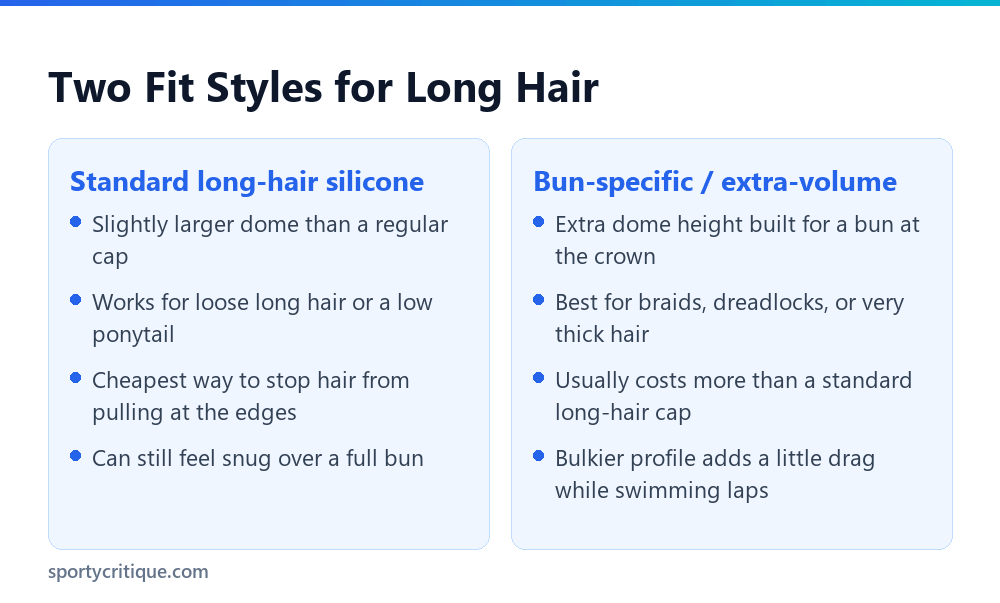
A regular swim cap is sized for short hair and will either not fit over long hair at all or pull painfully at the hairline within a few laps. A cap built specifically for long hair, like the TYR Long Hair Silicone Comfort Cap ($11.01), adds extra dome room and a softer edge without the premium price of specialty brands. If you wear your hair in a bun while swimming, look specifically for a bun-rated cap with extra crown height rather than a standard long-hair cap, which usually isn’t tall enough to cover a full bun comfortably.
Long hair and swim caps have an adversarial relationship in practice. A standard cap is cut and sized around the assumption of short or fully-tied-back hair, so cramming a thick ponytail or a full head of long hair into one usually means either the cap won’t stretch far enough to seal properly, or it seals but pulls hard enough at the hairline to give you a headache by the end of a workout. Caps built specifically for long hair solve this with extra dome volume and, in some cases, a softer silicone blend at the edge where most of the pulling happens.
- →A cap labeled specifically for long hair fits meaningfully differently than a standard cap; don’t assume a regular cap will just stretch to fit
- →If you swim with your hair in a bun, buy a bun-specific cap with extra crown height rather than a standard long-hair cap
- →Silicone is the better material for long hair over latex; it doesn’t yank hair the way latex can when removing the cap
- →A tighter fit isn’t automatically better; over-tight caps cause headaches during longer swims regardless of hair length
- →Double-capping, a thin cap underneath a silicone cap, helps for very thick or long hair when a single cap still isn’t containing everything
Table of Contents
Why a regular cap doesn’t work for long hair
Most swim caps are built around a head circumference assumption that doesn’t account for hair volume at all, let alone a foot or more of length. Force long hair into a standard cap and one of two things happens: the cap doesn’t fully seal at the hairline, which lets water in and defeats the purpose, or it seals but the tension concentrates right at the edge where hair meets scalp, which is uncomfortable almost immediately and often turns painful after 20 or 30 minutes of swimming. Long-hair caps solve this with a larger overall dome, sometimes an asymmetric shape that gives extra room toward the back and crown rather than just scaling the whole cap up uniformly.
Five real options across the price range
All five were checked for live price and stock before publishing. Note that prices on swim caps swing more than most gear categories because of how many third-party sellers list the same core products; check the current listing price before assuming these figures are still exact.
The TYR Long Hair Silicone Comfort Swim Cap is a straightforward, well-reviewed option from a swim-specific brand at a notably low price. It’s built with a wrinkle-reduced design and a softer edge than a generic cap, which matters most in the first few minutes of wear before the cap has warmed to body temperature and relaxed slightly.
The Sporti Long Hair Silicone Swim Cap is one of the few caps at this price point built with a bun specifically in mind, with extra dome height at the crown and an anti-slip interior grip. If your hair goes up in a bun for swimming, this is worth trying before spending more on a premium brand, since the core feature that matters, crown height, is already addressed here.
The Nike Voluminous Hair Swim Cap splits the difference between a standard long-hair cap and a full bun cap, with noticeably more internal volume than a basic long-hair design without going as tall as a dedicated bun cap. It’s a reasonable pick for thick hair that isn’t necessarily worn in a bun but still doesn’t fit comfortably in a standard cap.
The Soulchen Extra Large Swim Cap 4-set is built for braids, dreadlocks, and very thick or voluminous hair specifically, and the listing bundles in a nose clip and earplugs along with four caps, which is useful if you swim regularly enough to want backups on hand or if you’re buying for a household with more than one long-haired swimmer.
The Speedo Long Hair Swimming Cap sits well above the rest of this list on price, and that premium buys brand-name silicone construction from a company with a long track record in competitive swim gear. It’s worth the jump mainly for swimmers already invested in a training routine where cap durability and consistent fit across many months of pool time actually pays that difference back; casual swimmers are likely just as well served by one of the cheaper options above.
⚠️ Watch out: Silicone caps stretch to fit rather than coming in multiple sizes, so a listing that says ‘one size’ is describing a stretch range, not a universal guarantee. If your hair is on the very thick or long end, read reviews specifically mentioning thick or long hair rather than trusting the product photos alone.
Fitting a long-hair cap without it slipping
Start by gathering hair loosely rather than in a tight, high ponytail; a high, tight ponytail actually makes it harder to fit a cap over the resulting volume concentrated at one point. For a bun-style cap, keep the bun low and loose rather than piled high, since the caps are shaped to accommodate volume at the back and crown, not stacked straight up. Wet your hair before putting the cap on, since dry hair creates more friction and resistance against the silicone, making the cap harder to seat properly and more likely to bunch or fold at the edges.
Roll the cap on from front to back rather than trying to stretch it uniformly over your whole head at once. Starting at the forehead and working backward gives you more control over where the extra material ends up, which matters more with a long-hair cap than a standard one because there’s simply more material to manage.
💡 Pro tip: If a single cap still isn’t containing very thick or long hair, try double-capping: a thin, inexpensive cap underneath to smooth and compress the hair first, then the long-hair silicone cap on top for the actual seal. Competitive swimmers with long hair use this combination often, and it solves fit problems a single cap sometimes can’t.
Silicone versus latex for long hair specifically
Latex caps are cheaper and more common in basic multi-packs, but they grip hair more aggressively than silicone does, both while wearing the cap and especially when removing it. For short hair that’s a minor annoyance; for long hair, a latex cap can actually pull and tangle hair on removal in a way that gets old fast. Silicone’s smoother surface glides over hair more easily in both directions, which is the main reason nearly every cap marketed specifically for long hair uses silicone rather than latex, regardless of price point.
Who needs a dedicated long-hair cap
- ✓Your hair reaches past your shoulders or you regularly swim with it in a bun
- ✓You’ve had a standard cap pull painfully at your hairline or fail to seal within a few laps
- ✓You swim often enough that hair snagging or pulling on cap removal has become a recurring annoyance
- ✓You’re deciding between a standard long-hair cap and a bun-specific one based on how you actually wear your hair in the water
- ✕Your hair is above shoulder length and easily tucks into a standard cap without discomfort
- ✕You swim rarely enough that a basic latex cap from a multi-pack is a reasonable stopgap
- ✕You haven’t tried wetting your hair and rolling the cap on front-to-back before assuming you need a bigger size
- ✕You’re shopping on price alone without checking whether a listing is actually rated for long hair specifically
Caring for a long-hair silicone cap
Rinse the cap in fresh water after every pool session to clear chlorine residue, which degrades silicone faster than plain water exposure does over time. Let it dry fully before storing, ideally inside out, and avoid folding it tightly in the same crease every time, since silicone can develop a permanent crease line that eventually turns into a weak spot or tear. A lightly powdered interior, using the talc some caps ship with or a bit of cornstarch, makes the next application easier and reduces the friction that causes premature wear at the edges.
Bottom line
A cap labeled specifically for long hair, not just a larger standard cap, is worth the small price difference for anyone dealing with regular hairline pulling or a cap that won’t seal. Start with a budget option like the TYR or Sporti cap if you’re not sure yet whether you need bun-specific volume; move up to Nike’s Voluminous cap or a premium Speedo pick once you know exactly what your hair actually needs from the fit. The fit problem is solvable for almost any hair length or thickness once you’re shopping the right category instead of just sizing up a standard cap and hoping.
See also: Swimming gear guides and other buying guides on the site for more pool-ready picks.
Will a regular swim cap stretch to fit long hair?
It might stretch enough to go on, but it will likely pull painfully at the hairline or fail to fully seal. Caps built specifically for long hair use a different, larger dome shape, not just a bigger overall size, which is what actually solves the fit problem.
Should I buy a bun-specific cap or a standard long-hair cap?
If you regularly swim with your hair in a bun, get a bun-specific cap with extra crown height. A standard long-hair cap usually isn’t tall enough at the crown to comfortably cover a full bun, even though it handles loose long hair or a low ponytail fine.
Is silicone or latex better for long hair?
Silicone. It grips hair less aggressively than latex both during wear and on removal, which matters a lot more with long hair than short hair, since latex can actually pull and tangle longer strands when the cap comes off.
What if one cap still doesn’t contain my hair?
Try double-capping: a thin, inexpensive cap underneath to compress and smooth the hair first, then your long-hair silicone cap on top for the seal. It’s a common fix among competitive swimmers with very thick or long hair.
As an Amazon Associate, we earn from qualifying purchases through links on this page.