What Does a Middle Blocker Do in Volleyball? Role & Key Responsibilities

A middle blocker covers more ground per rally than any other position on a volleyball court, reading the setter to block the fastest attack in the sport while also running the quick offense that keeps opposing blockers honest. Here’s the full role, broken down by what actually happens on defense, offense, and in transition.
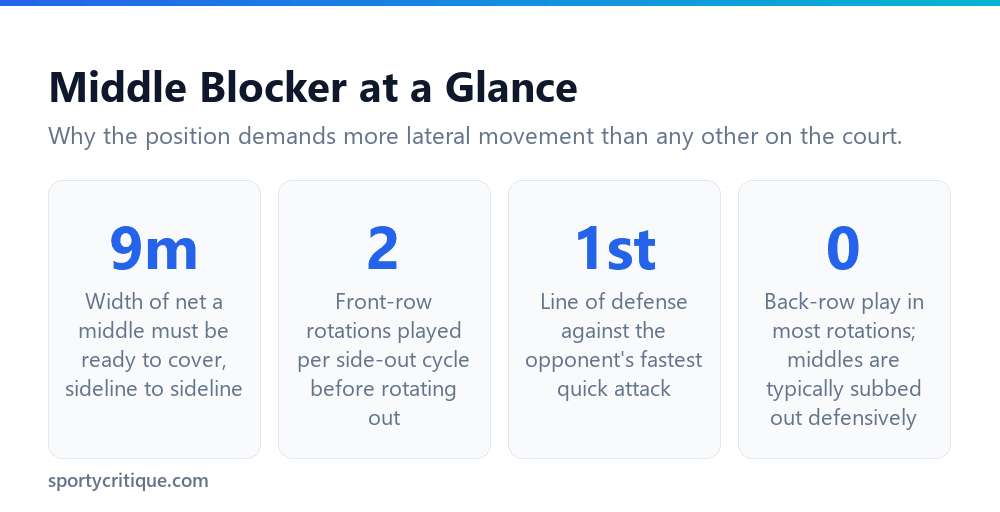
A middle blocker’s core job is defending the entire width of the net, reading the setter to block the opponent’s quick middle attack, then closing out to either sideline to help block the outside or opposite hitter. On offense, they run fast, low sets through the center of the court designed to pull the opposing middle blocker out of position and open the outside attack for teammates. It’s the most physically demanding position on the court because of how much ground it covers on nearly every single rally.
Watch a middle blocker for a full rotation and the position looks almost frantic compared to the outside hitters standing relatively still at their spots. That’s accurate. A middle covers more lateral ground per rally than any other position, closing to block the quick attack in the center, then shuffling or crossing over to help block a wing attack, then transitioning immediately to hit a quick set of their own on the next offensive possession. It’s a role built around reading the game a half-second faster than everyone else on the court, because there isn’t time to react after the fact.
- →Primary defensive job: block the fastest, shortest-developing attack in volleyball, the quick middle set
- →Must close out laterally to help block outside or opposite hitters after committing to the middle read
- →Offensively runs quick, low sets through the center specifically to pull the opposing middle out of position
- →Almost never plays back row; most teams substitute a libero in for the middle on defense
- →Footwork, shuffle steps and crossover steps, matters as much as jump height for blocking success
Table of Contents
The defensive job: reading before reacting
A quick middle attack develops faster than any other set in volleyball, often in well under a second from the setter’s release to contact. There simply isn’t time for a middle blocker to watch the ball and react; by the time the ball is visibly moving toward the hitter, a blocker starting from a standing position is already too late. Instead, middles read the setter, hand position, shoulder angle, and the timing of the set relative to the passer’s contact, to start moving before the ball even leaves the setter’s hands. That anticipation is the single hardest skill in the position to teach and the biggest separator between a good middle blocker and a great one.
Closing out: blocking beyond the middle
Once a middle blocker commits to defending the quick attack and the setter instead sends the ball outside, the job doesn’t end, it shifts immediately to closing out on the pin. That means a fast shuffle step or crossover step to get from the center of the net to either sideline in time to form a double block with the outside or opposite hitter. This closing footwork happens dozens of times a match, and it’s largely why the position is considered the most conditioning-demanding on the court; the distance covered adds up fast over a five-set match.
The standard footwork pattern for closing to the right sideline starts with a big first step from the outside leg, followed by a crossover step, then the block jump. Going left typically mirrors that pattern. Rushing the first step, or skipping the crossover in favor of a straight shuffle, is a common technical breakdown that costs a blocker the extra half-step they need to actually get their hands set before the hitter makes contact.
⚠️ Watch out: Jumping too early on a read is one of the most common mistakes new middle blockers make. A blocker who commits to a jump before the setter has actually released the ball is often coming back down by the time the hitter makes contact, which turns a potential block into an easy kill for the offense. Read first, jump second.
The offensive job: quick sets and spacing
On offense, a middle blocker’s primary weapon is the quick set, sometimes called a one or a slide depending on the system, a low, fast ball delivered to the middle before the opposing blockers have time to fully read and commit. The purpose isn’t just to score directly, though a well-run quick attack often does. It’s to force the opposing middle blocker to respect the center of the net, which opens space for the outside and opposite hitters by preventing the opposing middle from cheating early toward the pins.
This is why a middle’s offensive value gets measured differently than a typical hitter’s. A middle who runs the quick attack effectively, even with a modest kill percentage on the actual swing, can be dramatically valuable to a team’s overall offense simply by keeping the opposing block honest and undecided.
Transition speed: the most demanding part of the job
After landing from a block attempt, a middle blocker has to immediately reset and get ready to hit a quick set if their own team gains control of the ball. That block-to-attack transition, land, move off the net a few feet to get approach room, then explode into an attack approach, happens in a matter of seconds and repeats dozens of times a match. Few positions in any sport demand that specific combination of explosive lateral movement, vertical jumping, and immediate recovery, repeated at high volume for an entire match.
💡 Pro tip: If you’re new to the position, drill the closing footwork, big step, crossover, jump, in isolation before adding a live read. Most technical breakdowns at the middle position trace back to rushed or skipped footwork, not poor jump timing.
Why middles rarely play back row
Most volleyball teams substitute a libero in for the middle blocker whenever the middle rotates to the back row, which is why you’ll rarely see a middle blocker actually passing serve receive or playing back-row defense in a competitive match. The position is built and trained almost entirely around front-row blocking and quick-attack offense, and the physical demands of the role, repeated max-effort jumping and lateral sprinting, make resting in the back row a sensible trade-off for most rotations rather than a skill gap.
A gear note on protecting the knees
Because a middle blocker is landing from a jump and often diving or dropping to the floor in transition far more than any other position, low-profile knee protection matters more here than it does for a setter or a back-row specialist. A pair like the ASICS Ace Low Profile Knee Pad stays thin enough underneath a uniform not to interfere with the footwork a middle relies on, while still absorbing repeated hard landings over the course of a long match or tournament weekend.
Skills that actually separate good middles
- ✓Reads the setter’s hands and shoulders, not just the ball, to start moving early
- ✓Uses proper crossover footwork to close out to either sideline quickly
- ✓Times the block jump to the hitter’s approach rather than jumping early on instinct
- ✓Transitions off the net immediately after landing to get ready for the next offensive touch
- ✕Watches only the ball and reacts late to where the set is actually going
- ✕Relies on a straight shuffle instead of a crossover step when closing distance is greater
- ✕Jumps before the setter releases the ball, coming down before the hitter even makes contact
- ✕Stays flat-footed at the net after landing instead of resetting for the next play
How the position differs by level
At lower levels, middle blockers often get away with pure height and jump timing because attacks develop more slowly and setters are less consistent. As competition level rises, the read becomes the whole job; college and professional quick attacks develop fast enough that a middle blocker who’s purely reactive simply can’t get to the ball in time, regardless of how high they can jump. That’s the biggest adjustment most middles face moving up a level: the physical tools that worked before stop being enough on their own.
Communication with the outside blockers
A middle blocker rarely blocks alone on an outside attack, which means the role includes a communication job that’s easy to overlook from the stands. Calling out the set, the hitter’s approach angle, or which way to set the block, inside or outside the attacker’s hitting shoulder, happens in the half-second before contact and has to be loud and clear enough for a teammate to actually adjust their footwork in time. Middles who read well but communicate poorly often end up out of sync with their outside blocker, forming a block with a gap between the two players rather than a sealed wall, which is exactly the seam a good hitter is trained to find.
What recruiters and coaches actually look for
Height and reach still matter for recruiting purposes, since they set a physical ceiling on how much net a player can realistically cover. But coaches evaluating middle blockers at any serious level are watching footwork and anticipation more than a single measured vertical jump. A player who reads the setter early and closes with clean footwork consistently outperforms a taller player who’s purely reactive, and that shows up on film far more clearly than a raw jump number ever does. Lateral quickness testing, shuttle runs and similar agility drills, has become a bigger part of how middles get evaluated for exactly this reason.
Bottom line
A middle blocker’s job is defending the widest area of the net against the fastest attack in the sport, while also running quick offensive sets designed to keep the opposing block honest. It’s a position built on early reads, precise footwork, and repeated explosive movement, more than on height or jump reach alone, which is why the best middles tend to be the players who anticipate fastest, not just the tallest ones on the roster.
See also: What Does a Setter Do in Volleyball? and How to Block in Volleyball for the mechanics behind the middle blocker’s core skill.
What is the main job of a middle blocker in volleyball?
Defending the widest area of the net by reading the setter and blocking the quick middle attack, then closing out to help block the outside or opposite hitter. On offense, middles run quick sets through the center to keep the opposing block honest.
Do middle blockers play in the back row?
Rarely in competitive volleyball. Most teams substitute a libero in for the middle blocker whenever they rotate to the back row, since the position is trained almost entirely around front-row blocking and quick-attack offense.
What footwork does a middle blocker use to close out on a block?
A big first step with the outside leg followed by a crossover step, then the block jump. Skipping the crossover in favor of a straight shuffle is a common technical error that costs blockers the extra half-step they need.
Why do middle blockers need to be tall if the position is about reading, not height?
Height still helps reach over the net and contest a wider vertical space, but it doesn’t compensate for poor anticipation. A tall middle who reacts late gets beaten just as often as a shorter one, since the block depends on arriving early, not just jumping high once there.
As an Amazon Associate, we earn from qualifying purchases through links on this page.