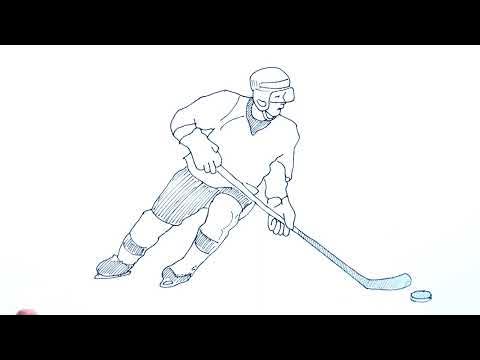
How to Pass a Hockey Puck Accurately

To pass a hockey puck accurately, cup it with the blade, keep the blade low and slightly open toward the target, and push the puck off the blade with a smooth motion rather than slapping at it, transferring weight from the back foot through the hips as you release. Follow through with the blade pointed exactly where you want the puck to go, since the blade’s final position at release is the single biggest predictor of where the pass actually ends up.
Passing gets treated as a simpler skill than shooting, something that develops naturally alongside stickhandling and doesn’t need dedicated practice the way a slap shot or wrist shot does. That’s a mistake. A team’s ability to actually execute its systems depends more on crisp, accurate passing than on any single player’s shot, and passing accuracy breaks down under pressure faster than most other skills specifically because it never got the deliberate practice attention it needed.
- →Blade angle at release determines pass direction; an open blade sends it wide, a closed blade sends it the other way
- →Weight transfer from the back foot through the hips adds pace without needing a harder arm motion
- →Follow through with the blade pointed at the target; where the blade ends up is where the puck goes
- →A saucer pass starts at the heel of the blade and rolls to the toe before a wrist flick lifts it
- →Pass to where the receiving player is going, not to where they currently are
Table of Contents
The Flat Pass: The Default Option
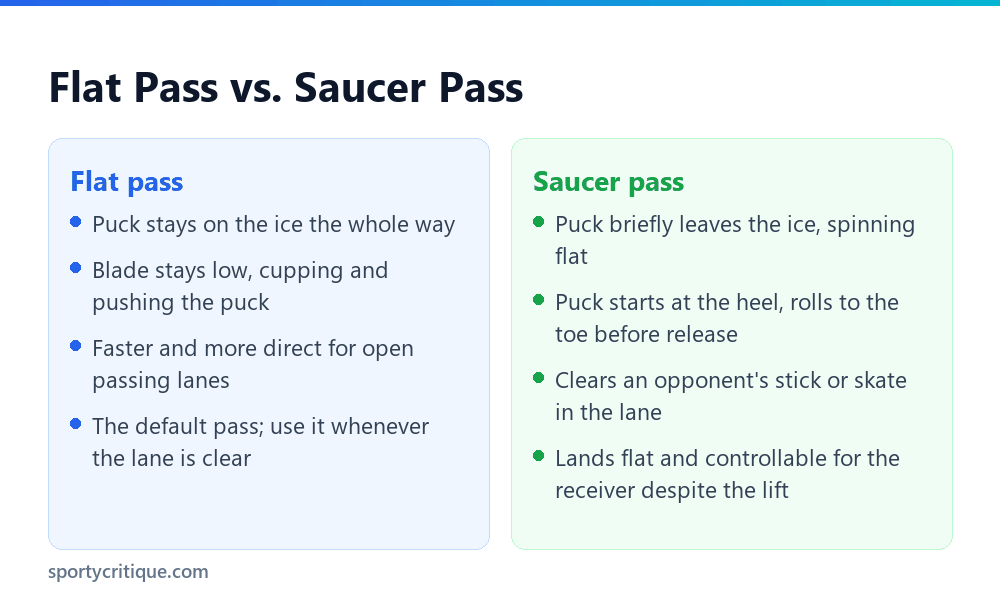
A flat pass keeps the puck on the ice the entire way. Cup the puck with the blade, keep the blade low, and push the puck forward with a smooth, continuous motion, letting it roll off the blade rather than slapping or snapping at it the way a shot would. The blade should stay low through the release; flaring it upward causes the puck to lift and flutter, which kills both power and accuracy on what’s supposed to be the simplest, most direct pass in the game.
Follow-through determines direction more than any other single part of the motion. The blade should finish pointed directly at the intended target, since the puck leaves the blade at whatever angle the blade is presenting at that exact moment, not at some earlier point in the motion. A pass that veers wide or narrow almost always traces back to where the blade ended up at release, not to how hard the pass was pushed.
⚠️ Watch out: A closed blade at release sends the pass wide of the intended line; a blade flared too far open sends it the other direction and adds unwanted lift. Checking blade angle at the finish of a missed pass, not just at the start of the motion, usually reveals exactly where the error happened.
Weight Transfer: What Actually Adds Pace
A pass thrown entirely with the arms, without any weight shift from the back foot through the hips, relies purely on wrist and forearm strength for pace. That works over short distances but breaks down on longer passes, where the puck arrives soft and slow enough for a defender to step into the lane and intercept it before it reaches the intended target.
Shifting weight forward through the pass, the same general principle that powers a wrist shot, adds pace without needing extra arm strength or a bigger, more telegraphed motion. Players who pass flat-footed every time are giving up a real amount of available pace for no actual benefit, since the weight transfer doesn’t cost anything in terms of disguise or setup time.
The Saucer Pass: Clearing Sticks and Skates
A saucer pass briefly lifts the puck off the ice, spinning it flat like a tiny flying disc, so it clears an opponent’s stick or skate blade sitting in the direct passing lane, then lands flat and controllable for the receiving player despite the momentary lift. It’s specifically a problem-solving pass for a blocked lane, not a replacement for the flat pass when the lane is already clear.
The technique starts with the puck positioned at the heel of the blade rather than the middle or toe. Pulling the blade in toward the body while rolling the puck from the heel toward the toe puts spin on it, which is what keeps it flying flat and stable in the air instead of tumbling unpredictably. A quick wrist flick right before release provides the lift, timed to happen at the very end of that heel-to-toe roll, not throughout the whole motion.
💡 Pro tip: Keep the hands separated, top hand up and away from the body, for a saucer pass specifically. That extra leverage and control matters more here than on a flat pass, since generating clean spin on the puck requires more precise blade manipulation than a simple push does.
A saucer pass thrown when the lane was already open wastes the extra difficulty and risk for no real benefit; the flat pass is faster, more direct, and easier to control in that situation. Reaching for a saucer pass specifically when a defender’s stick or skate is genuinely blocking the direct passing lane is the correct read, not a default habit.
Passing to Where the Player Is Going
A pass aimed at a teammate’s current position arrives behind them if that player is skating at any real speed, forcing them to slow down or reach back awkwardly to collect it. Leading the pass, aiming slightly ahead of a moving teammate so the pass and the player arrive at the same spot at the same time, keeps the play moving at full speed instead of forcing a momentum-killing adjustment.
This requires keeping the eyes up and reading teammate positioning and speed continuously, not just at the moment of release. A passer who looks down at the puck through the whole motion loses the ability to adjust the target location for a teammate who’s accelerated, decelerated, or changed direction in the time it took to set up the pass.
Common Passing Mistakes
- ✓Keep the blade low and finish pointed at the target
- ✓Transfer weight from the back foot through the hips for pace
- ✓Lead a moving teammate rather than passing to their current spot
- ✓Keep eyes up throughout the motion, not just at release
- ✕Slapping at the puck instead of a smooth push-and-follow-through
- ✕Passing entirely with the arms, flat-footed, with no weight shift
- ✕Defaulting to a saucer pass when the lane is already open
- ✕Watching the puck through the whole motion instead of reading the play
Backhand Passing Deserves Equal Practice
Backhand passes get even less deliberate practice than forehand ones, despite coming up constantly in game situations where a player’s body position makes a forehand pass impossible without an awkward reset. The same core principles apply: blade low, smooth push rather than a slap, and a follow-through pointed at the target, adjusted for the different blade face presented on the backhand side.
Weight transfer works the same way on a backhand pass too, though it’s easier to skip unconsciously since the backhand motion already feels less natural for most players. Deliberately including backhand reps in passing practice, not just forehand ones, closes a gap that shows up constantly in game situations but rarely gets addressed in casual, unstructured practice time.
Practicing Passing Accuracy
Passing against a wall or boards works for basic repetition, but a rebounder built specifically for hockey passing returns the puck more consistently and at more realistic angles than an ordinary flat surface. A ACE HOCKEY Rapid Rebounder (24″, Double-Sided) ($67.95) lets a single player run structured passing reps solo, which matters since passing is specifically a skill that degrades without regular touches, more than shooting does for most players.
Setting a specific target, a taped spot on a wall, a rebounder’s marked zone, or a stationary teammate standing in a fixed spot, turns passing practice from vague repetition into a measurable skill with a clear pass-or-miss result on every rep. That feedback loop is what actually drives improvement, more than volume of reps alone without a defined target to hit.
Receiving Matters Just as Much as Passing
A perfectly placed pass still fails if the receiving player doesn’t handle it cleanly. Softening the blade on contact, essentially giving slightly with the stick as the puck arrives rather than holding the blade rigid, absorbs the puck’s momentum and keeps it under control instead of bouncing off the blade uncontrolled. This matters more on a hard, fast pass than a soft one, since there’s more momentum to absorb.
Positioning the blade to receive on either the forehand or backhand side before the puck arrives, rather than reacting after it’s already close, gives a much larger effective target for the passer and reduces the number of passes that get fumbled purely because the receiving player wasn’t ready in the right position. Good passing and good receiving develop together in practice; focusing on one while ignoring the other slows progress on both.
Why Passing Breaks Down Under Pressure
Technique that looks clean in an unpressured passing drill often falls apart the moment a backchecking defender closes in, because pressure compresses decision time and tempts a player to rush the motion, cutting the follow-through short or skipping the weight transfer entirely. The mechanics don’t actually change under pressure; what changes is how consistently a player executes them when there’s less time to think through each step.
This is exactly why passing drills that introduce a defender or a time constraint matter more than pure repetition drills once the basic mechanics are reasonably solid. A player who can execute a clean saucer pass in an empty rink but rushes and flubs it the moment a defender approaches hasn’t actually learned the skill to game speed yet, regardless of how it looks in isolated practice.
📊 Note: Small-area games, drills confined to a tight space with active pressure from other players, are one of the more effective ways to practice passing under realistic pressure without needing a full-ice team session. They force quick decisions and quick execution in a way isolated passing drills against a wall or rebounder simply can’t replicate.
Passing Development for Younger Players
Younger players often default to a slapping motion when first learning to pass, since it mimics the shooting motion they’ve usually practiced more and feels more natural than the smoother push-and-follow-through a clean pass actually requires. Coaches commonly address this by isolating the pass from the shot early on, explicitly naming and drilling the different motion before combining passing back into full-speed play.
Saucer passing specifically should come after flat passing is solid, not alongside it from the start. The added complexity of generating clean spin and lift is easier to learn once the underlying blade control and weight transfer from a basic flat pass are already comfortable, rather than trying to build both skills at the same time from scratch.
Frequently Asked Questions
Why do my passes keep floating or fluttering?
A flared blade lifting off the ice during the push is the most common cause. Keeping the blade low and cupped through the entire motion, rather than letting it rise as the puck releases, keeps a flat pass flat instead of floating unpredictably.
When should I use a saucer pass instead of a flat pass?
Specifically when a defender’s stick or skate is blocking the direct passing lane along the ice. If the lane is open, a flat pass is faster, more direct, and easier for the receiver to control than a saucer pass.
How do I make my passes harder without losing accuracy?
Weight transfer from the back foot through the hips adds pace without requiring extra arm strength or a bigger, more telegraphed motion. Passing purely with the arms is what forces players to choose between accuracy and pace instead of getting both.
Should I practice passing as much as shooting?
Most players practice shooting far more, but passing accuracy degrades without regular practice just as much as shooting does, and a team’s ability to execute its systems depends more directly on passing quality than on any individual’s shot.
As an Amazon Associate, we earn from qualifying purchases through links on this page.