Best Pool Ball Sets: Standard, Aramith, and Budget Options Compared


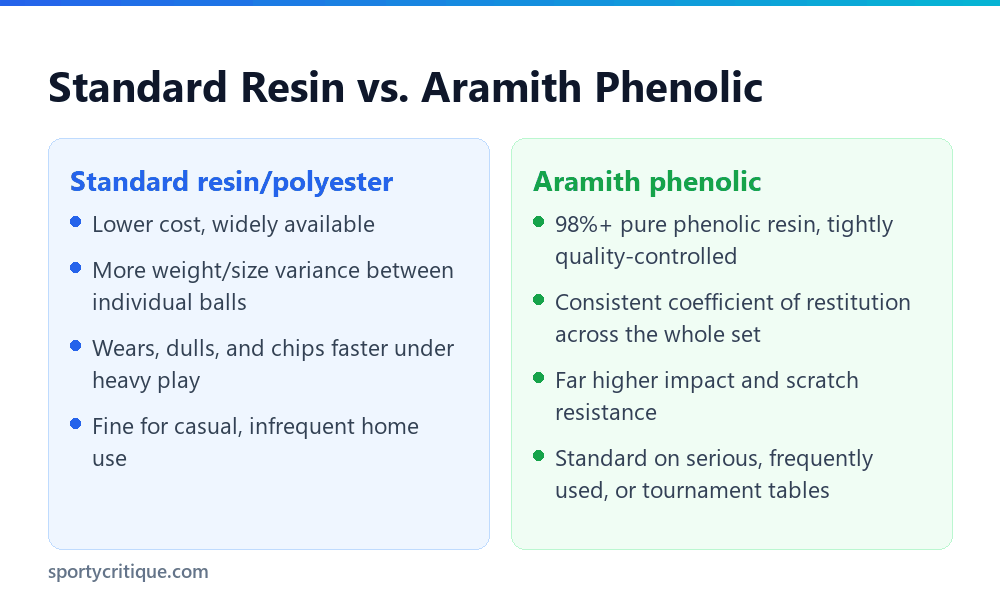
The best pool ball set depends entirely on how the table gets used. A standard resin set in the $25 to $55 range is fine for casual, infrequent home play. Aramith phenolic sets, starting around $190 and running up to $500 or more for tournament-grade sets, deliver measurably more consistent weight and bounce across all 16 balls and hold up far longer under heavy or competitive play. Four real sets across that range are compared below.
Pool balls get treated as an afterthought behind the table itself, the cue, and even the cloth, but they’re the one piece of equipment that touches every single shot. A cheap, inconsistent set undermines a good cue and good cloth just as much as a bad cloth undermines a good set of balls; the whole system has to work together, and balls are the part most players never think to upgrade.
- →Standard resin sets ($25-$55) are fine for casual, infrequent home play
- →Aramith phenolic sets (from roughly $190) are 98%+ pure phenolic resin with far tighter quality control
- →Consistency across all 16 balls matters as much as any single ball’s individual quality
- →Aramith balls withstand dramatically more impact before showing wear, chips, or dulling
- →A tournament-grade set is overkill for casual play but standard for serious, frequently used tables
Table of Contents
What Actually Separates a $28 Set From a $500 One
Aramith’s balls run over 98 percent pure phenolic resin, with the remainder being color pigments and minor additives. Many competitor balls marketed as “phenolic” are actually blends running closer to 85 percent phenolic resin mixed with other polymers, a difference that shows up directly in hardness, density, and how the balls hold up over years of play.
That material difference translates into real durability numbers. Aramith balls are rated to withstand roughly 50 times more impact than standard polyester balls before showing wear, and are roughly twice as scratch-resistant. Standard polyester balls can start showing matte spots, micro-cracks, and edge chipping after just a few thousand strikes, a fraction of what a heavily used table sees in a single busy season.
Why Consistency Across the Set Matters
A single high-quality ball doesn’t fix a set with meaningful variance between balls. Standard sets can show 3 to 5 percent variance in coefficient of restitution (how much energy a ball returns on contact) from ball to ball, which is enough to throw off position play in a way that’s surprisingly hard to diagnose, since it looks like a stroke problem rather than an equipment one.
Aramith sets are quality-controlled against eight specific criteria per ball, including density, balance, diameter, roundness, and hardness, before earning the Aramith name. That level of control is what produces a set where all 16 balls behave nearly identically, which matters more to a player working on precise position play than to someone playing purely casual, low-stakes games.
4 Real Sets, Compared
📊 Note: The jump from the Japer Bees mid-tier set to the Aramith Premier set is the biggest single step up in this comparison, both in price and in material quality. For most players deciding whether to upgrade from a standard resin set, that’s the specific jump worth thinking through carefully, more than choosing between the two Aramith tiers, which differ from each other in smaller, more incremental ways.
When the Upgrade Actually Matters
A casual home table used a handful of times a month by family or friends simply doesn’t need Aramith-level consistency to be enjoyable. Standard resin balls play perfectly fine for relaxed, low-stakes games, and the cost difference is better spent elsewhere, on cloth quality or cue selection, if budget is limited.
The upgrade earns its cost specifically for players practicing precision position play, running a table that sees heavy or daily use, or hosting any kind of competitive or league play where consistent equipment across a match matters to fairness, not just personal enjoyment. A bar, pool hall, or serious home practice setup is where the durability and consistency gap actually pays for itself over time.
Choosing the Right Tier
- ✓Choose standard resin for casual, infrequent home play
- ✓Choose Aramith for heavy use, precision practice, or competitive play
- ✓Weigh the cloth and cue budget together with ball quality, not in isolation
- ✓Expect a standard set to need replacement sooner under heavy use
- ✕Assuming every table needs tournament-grade balls to be enjoyable
- ✕Ignoring ball-to-ball consistency and judging quality by a single ball alone
- ✕Buying the cheapest available set for a table seeing daily, heavy play
- ✕Overspending on balls while neglecting cloth quality on the same table
Standard Size and Weight
Regulation American-style pool balls measure 2-1/4 inches in diameter and weigh between 5.5 and 6 ounces each, a standard shared across nearly every set marketed for a full-size table regardless of price tier. All four sets compared above meet this regulation size, so size isn’t a differentiator between them; the differences are entirely in material quality and consistency, not dimensions.
Some snooker and specialty tables use different ball sizes entirely, and buying a mismatched size for a specific table type produces play that’s inconsistent regardless of material quality. Confirming a table’s actual regulation ball size before ordering any replacement set avoids this straightforward but surprisingly common mistake.
Cue Ball Differences Worth Knowing
Standard cue balls are sized identically to the object balls in most home sets, but some coin-operated bar tables use an oversized or magnetic cue ball specifically so the table’s internal mechanism can separate it from the object balls after a shot, dropping only the object balls into the collection system. Buying a standard-size replacement cue ball for a coin-operated table won’t work correctly with that separation mechanism.
For a standard, non-coin-operated home table, this distinction doesn’t matter, and any of the four sets above ships with a correctly matched cue ball for normal play. It’s worth double-checking specifically if the table in question is a converted or purchased coin-operated model, since that detail isn’t always obvious from the table’s general appearance alone.
💡 Pro tip: A cue ball with a visible logo or a colored dot pattern, sometimes called a training or measle cue ball, helps beginners see cue ball spin and rotation clearly during practice. It’s a small addition worth considering separately from the object ball set itself, since most standard sets ship with a plain white cue ball with no spin-tracking markings.
Buying a Complete Set vs. Replacing Individual Balls
A full 16-ball set (15 numbered balls plus a cue ball) is the standard purchase for outfitting a table from scratch or fully replacing a worn-out existing set. When only one or two individual balls are damaged, chipped, or have lost their number markings, some manufacturers, including Aramith, sell individual replacement balls by number rather than requiring a full set purchase.
Mixing an individual Aramith replacement ball into an otherwise standard resin set introduces the same consistency problem discussed earlier, just concentrated in one ball rather than spread across the set. For a standard set with one or two damaged balls, replacing with a matching individual ball from the same or a comparable manufacturer keeps the set behaving consistently; mixing tiers doesn’t.
Checking whether a specific manufacturer sells individual replacements before deciding to replace an entire set saves real money on an otherwise still-usable set, particularly at the Aramith price tier where a full replacement represents a meaningful expense. Not every manufacturer offers this option, so it’s worth a quick check rather than an assumption either way before committing to a purchase decision.
Extending the Life of Either Tier
Regular cleaning with a proper ball cleaner or a simple mild soap-and-water wipe-down, followed by full drying before returning balls to the table, removes the chalk and hand-oil buildup that dulls a set’s surface and slightly changes how balls roll over time. This matters for both tiers, though a lower-cost set benefits proportionally more, since it starts with less material durability margin to begin with.
Avoid abrasive cleaners or anything that could scratch the surface, since a scratched or roughened ball surface behaves inconsistently regardless of the underlying material quality. A soft cloth and a cleaner specifically made for billiard balls is worth the small extra cost over a generic household cleaner.
Storage matters too, particularly for a set that isn’t in daily use. Leaving balls loose on a table surface or piled in a bag lets them knock against each other and pick up small scratches over time, even without active play. A dedicated ball case or tray, or simply racking them properly on the table between sessions, reduces that incidental wear at no real cost beyond a small habit change.
Frequently Asked Questions
Is Aramith worth the price difference for a home table?
It depends on frequency of use and whether precision position play matters to the players involved. For occasional, casual games, a standard resin set is genuinely sufficient. For daily or serious practice, the consistency and durability difference becomes noticeable and worth the cost.
How long do standard resin pool balls last?
It varies with frequency of use, but standard polyester or resin-blend balls can start showing visible wear, chipping, or dulling after a few thousand strikes, which for a regularly used table can mean a year or two before replacement makes sense.
Can I mix an Aramith cue ball with a standard object ball set?
It’s not recommended for serious play, since the weight and bounce characteristics likely won’t match closely enough to feel consistent, and cue ball control specifically depends on predictable behavior. For casual play it’s a minor issue at most.
Do all Aramith sets cost the same?
No. Aramith makes multiple tiers, from the Premier line up through tournament-grade sets used in televised professional play, with meaningful price differences between them reflecting additional quality control and finish standards at the top tier.
Will an oversized cue ball work on a normal, non-coin table?
It can physically work, but it’s not necessary and can feel slightly different in weight and roll compared to a standard-size cue ball. Oversized and magnetic cue balls exist specifically for coin-operated table mechanisms, not to improve play on a standard table.
How do I know if my table needs a special cue ball?
If the table is coin-operated and drops balls into an internal collection system after a shot, it likely uses an oversized or magnetic cue ball so the mechanism can separate it from the object balls. A standard home table with no coin mechanism uses a normal-size cue ball matched to the rest of the set.
Whichever tier ends up making sense, the underlying decision is simple: match the set to how the table actually gets used, confirm the size and cue ball type fit the specific table, and budget for cloth and cue quality alongside ball quality rather than treating any one piece of equipment as the single lever worth pulling.
As an Amazon Associate, we earn from qualifying purchases through links on this page.