How to Mount and Dismount a Horse Safely

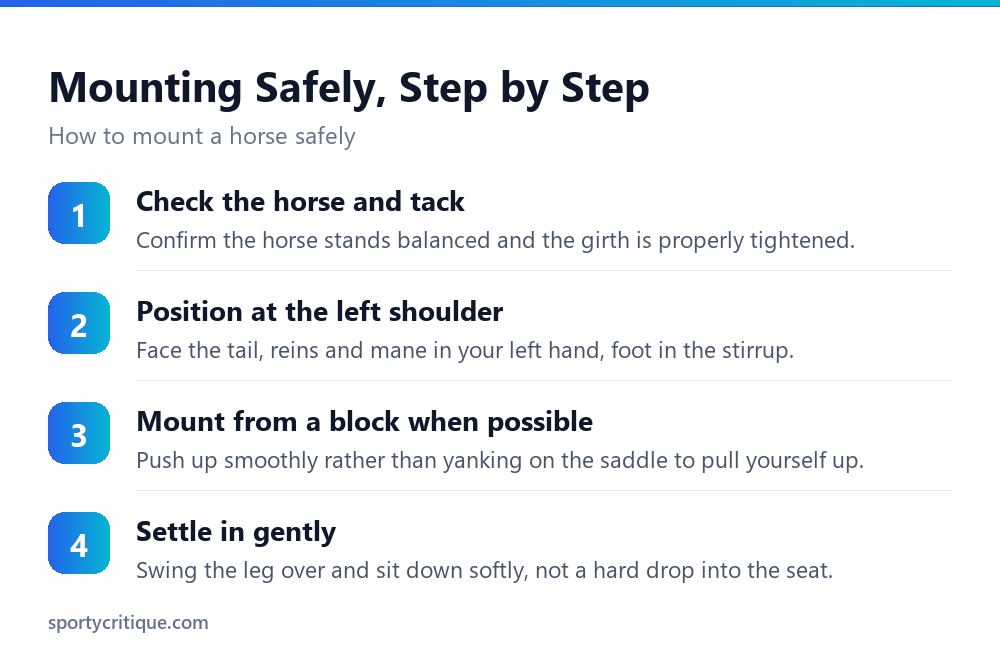
To mount a horse safely, check that the horse is standing balanced and the girth is properly tightened, then stand at the left shoulder facing the tail, hold the reins and mane in your left hand, place the ball of your left foot in the stirrup, and push up smoothly using a mounting block whenever one is available rather than pulling yourself up on the saddle. Dismounting safely means removing both feet from the stirrups before swinging off, so a sudden movement can’t catch a foot in the stirrup as you come down.
Mounting and dismounting happen at the start and end of essentially every ride, which is exactly why sloppy habits here go unexamined for years. A rider who’s mounted a thousand times without incident can still be doing it in a way that stresses the horse’s back, unbalances the saddle, or leaves a genuine safety gap that simply hasn’t been tested by circumstance yet.
- →Always check the horse and confirm the girth before mounting, every single time
- →Use a mounting block whenever one is available; it reduces saddle stress on the horse’s back significantly
- →Never pull yourself up using both hands on the saddle; grip the mane, not the saddle itself
- →Keep the reins short enough for control but not so tight they signal the horse to move
- →Remove both feet from the stirrups before dismounting, every time, without exception
Table of Contents
Before You Mount: The Checks That Matter
A quick safety check on both sides of the horse and its tack, confirming the girth is properly tightened and the horse is standing balanced on all four legs, takes seconds and catches problems before they become mounting accidents. A loose girth specifically can let the saddle slip sideways under the rider’s weight during mounting, which is dangerous in a way that’s entirely preventable with a five-second check.
Having someone hold the horse while a newer rider is still learning to mount removes one variable, the horse shifting or stepping away mid-mount, while the rider focuses purely on their own technique. This isn’t a permanent requirement; it’s a reasonable training-wheel step for the learning phase specifically.
Mounting Technique
Stand at the horse’s left shoulder facing the tail, holding both reins along with a handful of mane in the left hand near the top of the neck. Using the right hand to hold the stirrup steady, insert the ball of the left foot into it, then place the right hand on the pommel or the middle of the seat, not gripping the far side of the saddle with both hands, before pushing up and swinging the right leg over the horse’s back.
⚠️ Watch out: Pulling up using both hands on the saddle is one of the most common mounting mistakes, and it’s a real problem, not just a style issue: it pulls the saddle out of position and can genuinely hurt the horse’s back over repeated mounts. Grip the mane with the left hand instead of adding a second hand to the saddle itself.
As the right leg swings over, turn and settle down with the body’s side against the horse rather than dropping straight down into the seat, landing facing forward once seated. A hard, sudden drop into the saddle is uncomfortable for the horse and can cause bracing or fidgeting that makes the whole process feel harder than it needs to be, for both horse and rider.
Why a Mounting Block Matters
Mounting from the ground, especially for a taller rider or a shorter horse, puts real torque and pressure on the horse’s back and the saddle tree as the rider’s weight comes up and over. A mounting block reduces that stress meaningfully by starting the rider closer to the horse’s back height, turning the motion into a smoother step-and-swing rather than a strenuous pull-up.
💡 Pro tip: A sturdy, portable mounting block, something like the Horsemen’s Pride 3-Step Mounting Block ($159.95), is worth keeping on hand at home even if the barn or arena already has one, since consistent access removes any temptation to skip it and mount from the ground purely out of convenience.
Some horses need training to stand quietly at a mounting block, since the block itself, an unfamiliar object near their side, can initially cause fidgeting or stepping away. That’s a trainable behavior, not a reason to abandon the mounting block and default back to ground-mounting, which is harder on the horse’s back regardless of how well-trained the horse is to standing still.
Dismounting Safely
Remove both feet from the stirrups before swinging off, every single time, on both English and western tack. This is the single most important dismounting safety habit, since a foot still caught in a stirrup during an unexpected horse movement or a stumble is a genuinely dangerous situation that a rider can be dragged by, not just an awkward moment.
With both reins held in the left hand, lean forward, swing the right leg over the horse’s back, and turn to slide down with the body’s side against the horse, landing facing forward the same way as the mounting motion, just in reverse. Landing with soft, bent knees rather than stiff, straight legs absorbs the impact of hitting the ground and reduces strain on the rider’s own joints, particularly after a longer ride.
Common Mounting and Dismounting Mistakes
- ✓Check the girth and horse’s stance every time before mounting
- ✓Use a mounting block whenever one is available
- ✓Grip the mane, not the saddle, with the free hand while mounting
- ✓Remove both feet from the stirrups before dismounting
- ✕Pulling up with both hands on the saddle
- ✕Dropping hard into the seat instead of settling in gently
- ✕Mounting or dismounting with reins too long to maintain control
- ✕Swinging off with a foot still in either stirrup
Managing Rein Length While Mounting
Reins that are too long during mounting leave a rider without real control if the horse shifts or steps off before they’re settled in the saddle. Reins pulled too short or too tight, on the other hand, can signal the horse to back up or toss its head right at the moment the rider needs it to stand quietly. The right length keeps light, even contact without pulling on the mouth, adjustable by feel once a rider has practiced the motion enough times to judge it without looking down at their hands.
New riders often default to reins that are too long simply because it feels safer to have slack, when in fact that slack is exactly what removes the control that would let them correct a horse that starts to move during the mount. Practicing rein length specifically, separate from the mounting motion itself, on a patient, standing horse builds the muscle memory needed to get it right under normal mounting conditions.
Adjustments for Physical Limitations
Riders with limited hip mobility, joint issues, or other physical considerations that make a standard mount difficult have real options beyond simply struggling through the standard technique. A taller mounting block, a ramp-style mounting aid, or in some cases a leg-up from an assistant can all provide a safe, dignified path into the saddle without forcing a movement pattern that simply doesn’t work for a particular rider’s body.
Therapeutic and adaptive riding programs have well-developed mounting protocols specifically for riders with a wide range of physical considerations, and consulting with an instructor experienced in adaptive riding is worth doing rather than assuming there’s only one correct way to get into the saddle. The core safety principles, secure tack, a calm horse, controlled movement, apply regardless of which specific mounting method fits a given rider best.
Mounting Considerations for Young or Green Horses
A young or inexperienced horse still learning to accept a rider needs extra patience and often a slower, more deliberate mounting process than an experienced, well-trained horse. Extra groundwork confirming the horse stands quietly at the mounting block before ever adding a rider’s weight, and having an experienced handler present for early mounts, both reduce risk during this specific training phase.
Rushing this stage, particularly moving to unassisted solo mounting before a green horse has fully internalized standing quietly through the process, is a common source of avoidable incidents. The extra time invested in this specific phase of a horse’s training pays off in safer, calmer mounting for the rest of that horse’s working life.
Introducing desensitization exercises around the mounting block itself, letting the horse see, sniff, and stand calmly next to it before any rider weight is added, builds confidence gradually rather than forcing the horse to process an unfamiliar object and a rider’s weight at the same time. Small, incremental steps at this stage generally produce a more reliably calm horse than trying to shortcut the process.
Saddle Fit Affects Mounting Comfort Too
A poorly fitting saddle can make mounting genuinely painful for the horse, since the mounting motion itself creates extra pressure and torque on the back beyond what normal riding does. A horse that’s developed a negative association with being mounted, pinning ears, shifting away, or tensing up specifically at the mounting stage, is sometimes reacting to a saddle fit problem rather than a training or temperament issue.
Ruling out saddle fit before assuming a horse’s mounting resistance is purely behavioral saves a lot of misdirected training effort. A saddle fitter’s evaluation is a relatively quick way to confirm or rule out this cause before working through it as a pure behavioral problem instead, and it’s a far cheaper first step than months of retraining aimed at the wrong underlying cause.
Frequently Asked Questions
Which side should I always mount from?
The left side is the traditional and most common convention, and most horses are trained specifically to be mounted from that side. Some riders do train horses to accept mounting from either side, which has practical value in certain situations, but the left side remains the default most horses and tack are set up for.
Is it bad for the horse if I mount from the ground occasionally?
Occasional ground mounting isn’t likely to cause lasting harm on its own, but making it the regular default, especially for a heavier or taller rider, adds cumulative stress to the horse’s back over time that a mounting block avoids.
Why does my horse move away when I try to mount?
This can stem from several causes: an ill-fitting saddle causing pain, incomplete training around standing still at a mounting point, or a girth that’s too tight or too loose causing discomfort. Ruling out tack fit first is a reasonable starting point before assuming it’s purely a training issue.
What’s the biggest safety risk when dismounting?
A foot still caught in a stirrup during the dismount, which can result in being dragged if the horse moves unexpectedly. Removing both feet from the stirrups before swinging off eliminates this specific risk entirely.
Should I always have someone hold the horse while I mount?
It’s a reasonable practice during the learning phase or with a young, inexperienced horse, but it’s not a strict requirement for an experienced rider on a well-trained, reliably standing horse. The underlying goal, a calm horse and a controlled mount, matters more than whether an assistant is physically present.
None of this is complicated once broken down into its individual pieces, but each piece matters. A rider who checks tack, uses a mounting block, keeps hands correctly placed, and clears both feet before dismounting has addressed essentially every common source of mounting and dismounting risk, without needing anything beyond consistent attention to habits already within easy reach for riders and horses at any level of experience.
As an Amazon Associate, we earn from qualifying purchases through links on this page.