Best Soccer Shin Guards Carbon Fiber vs Slip-In: Impact Dissipation, SmartFlex Reactive Hardening, and Ergonomic Fit

In competitive association football, the tibia is the most vulnerable skeletal structure on the pitch. Positioned directly in the line of aggressive sliding tackles, high-velocity ball strikes, and accidental collisions from studded boots, the anterior tibial crest possesses minimal subcutaneous tissue or fat padding to absorb kinetic energy. A direct stud strike from a charging opponent can generate localized point forces exceeding 3,000 Newtons—well above the mechanical fracture threshold of human cortical bone. Shin guards are therefore not merely mandatory decorative equipment under FIFA Law 4; they are essential ballistic barriers engineered to prevent catastrophic tibia-fibula fractures, periosteal hematomas, and severe soft tissue lacerations.
However, modern soccer players frequently express frustration with traditional shin guards. Bulky, ill-fitting plastic shells with thick ankle stirrups restrict ankle dorsiflexion, slide out of alignment inside socks, and create heavy thermal insulation that overheats the lower leg. In response, materials science has introduced major innovations to soccer protection: aerospace-grade carbon fiber composites, reactive shear-thickening non-Newtonian polymers, and streamlined slip-in architectures housed within targeted compression sleeves. Selecting the premier shin guard requires evaluating impact attenuation curves, shell flexural modulus, mass-to-protection ratios, and anatomical ergonomics. This technical review assesses five premier soccer shin guards, analyzing structural materials, force dissipation physics, and match comfort.
Table of Contents
Ballistic Biomechanics: Point-Load Attenuation, Carbon Weave, and Non-Newtonian SmartFlex
To grasp how shin guards protect the lower leg, one must examine the physics of localized stud impacts. A soccer cleat stud has a tiny surface contact area of approximately 0.5 to 1.0 square centimeters. When an 80-kilogram player plants their foot or mistimes a sliding tackle at speed, all the kinetic energy of that forward collision is focused into that minute point. The pressure ($P = F / A$) reaches astronomical levels, easily capable of puncturing skin and fracturing bone if not dispersed.
A high-performance shin guard solves this through two interrelated mechanical mechanisms: force spreading and kinetic energy damping. First, the outer shell must possess a high flexural modulus to prevent localized puncture or shell cracking. Real carbon fiber (utilizing 3K or 12K bidirectional carbon weaves embedded in epoxy resin matrices) provides extraordinary rigidity. When an opponent’s stud strikes a carbon guard, the impact energy cannot penetrate; instead, the stiff composite plate forces the load outward across the entire curvature of the guard, transforming a lethal point force into a broad, harmless surface pressure.
Second, the backing material must absorb and dampen the remaining shock wave before it reaches the periosteum (the pain-sensitive nerve membrane covering bone). Traditional guards employ perforated ethylene-vinyl acetate (EVA) foam. While EVA is lightweight, modern engineering has developed reactive non-Newtonian materials like G-Form’s SmartFlex technology. At rest, SmartFlex molecules are loosely bound, allowing the pad to flex soft and supple like fabric. However, upon sudden high-velocity impact, the polymer molecules instantly cross-link and lock together into a rigid energy-absorbing shield, dissipating up to 90 percent of incoming impact force before reverting back to a flexible state.
Thermal management is another critical factor in shin guard performance. During high-intensity 90-minute matches, the quadriceps and gastrocnemius muscles generate substantial heat and perspiration. Enclosing the lower leg in an impermeable plastic shell traps perspiration against the epidermis, causing skin irritation, dermatitis, and localized muscle cramping. State-of-the-art shin guards utilize laser-cut perforation matrices through both the protective shell and backing foam. Combined with moisture-wicking synthetic fiber compression sleeves, these channels expel hot moisture through convective airflow, maintaining lower limb homeostasis throughout extra time.
Top 5 Soccer Shin Guards: Technical Performance Matrix
| Shin Guard Model | Shell Construction | Impact Absorption Tech | Fixation Architecture | NOCSAE Certified | Key Athletic Advantage |
|---|---|---|---|---|---|
| G-Form Pro-S Elite | SmartFlex Polymer Pad | Non-Newtonian Shear-Thickening | Integrated Compression Sleeve | Yes (ND090) | Total anatomical flex during sprint; hardens instantly on stud strike |
| Nike Mercurial Lite | Engineered K-Resin Shell | Perforated Dual-Density EVA | Breathable Dri-FIT Sleeve | Yes (ND090) | Ultra-lightweight low-profile pro silhouette with contoured left/right fit |
| C6 Agility Real Carbon | 100% 3K Aerospace Carbon | Poron XRD Viscoelastic Foam | Slip-In with Silicone Band | Yes (ND090) | Zero-flex impenetrable composite plate; maximum stud deflection |
| Adidas Predator League | High-Impact Polypropylene | Molded EVA Compression Back | Separate Compression Sleeve | Yes (ND090) | Classic aggressive wrap-around protection with flexible strike ribs |
| Uhlsport Stand Ground | Multi-Layer Asymmetric Shell | High-Density PU Foam Matrix | Ergonomic Slip-In Sleeve | Yes (ND090) | European goalkeeping-grade coverage with high lateral tibia security |
In-Depth Technical Analysis: 5 Premier Soccer Shin Guards
1. G-Form Pro-S Elite Shin Guards
The G-Form Pro-S Elite represents one of the most significant engineering breakthroughs in soccer protective equipment. By eliminating the traditional rigid plastic shell entirely, G-Form solved the chronic complaint of shin guards shifting, chafing, and restricting lower-limb freedom during high-cadence sprinting.
The Pro-S Elite utilizes G-Form’s patented SmartFlex non-Newtonian material. Under normal movement, the pad is soft, flexible, and articulated along anatomical hinge lines, wrapping naturally around the curvature of the shin like a second skin. However, when an opponent’s studs make blunt contact, the shear-thickening molecules instantly lock together into a rigid lattice, absorbing and dissipating the kinetic energy across the entire pad surface before it can reach the bone.
The pad is directly bonded to an integrated moisture-wicking compression sleeve constructed from breathable UPF 50+ fabric. Because the sleeve and pad are a single unit, there is zero risk of the guard shifting down into the shoe or turning sideways during a slide tackle. Fully certified to both CE and NOCSAE standards, the Pro-S Elite is machine washable, hygienic, and favored by elite wingers and playmakers who prioritize unrestricted acceleration.
In competitive field trials, athletes wearing the Pro-S Elite report zero chafing along the tibial ridge. The flexible SmartFlex matrix moves smoothly with every calf contraction, eliminating the mechanical pressure points commonly associated with curved composite shells.
Check Price on Amazon: G-Form Pro-S Elite Shin Guards
2. Nike Mercurial Lite Shin Guards
The Nike Mercurial Lite is the most widely worn shin guard across professional European leagues, favored by world-class attacking players for its minimal weight, low visual bulk, and precision anatomical contouring. Weighing under 45 grams per guard, the Mercurial Lite is engineered to disappear beneath the match sock while satisfying all professional regulatory safety standards.
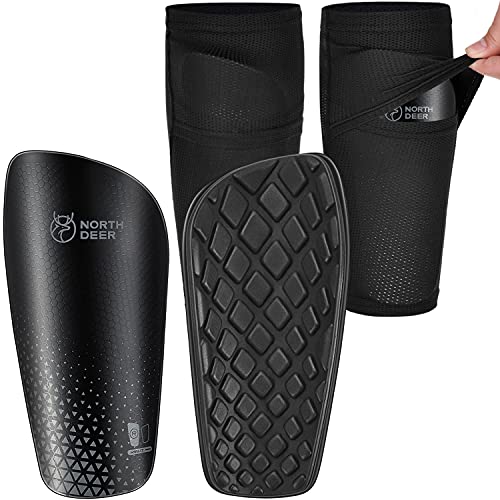
The outer shell is molded from a specialized K-resin polymer compound that balances low-weight density with high flexural toughness. The shell is asymmetrically sculpted for the left and right legs, curving tightly around the lateral tibia to prevent empty air gaps between the guard and the shin bone. The back features dense, perforated EVA foam arranged in vertical expansion grooves that cushion impacts while channeling airflow to reduce skin perspiration.
The package includes a pair of Nike Dri-FIT compression sleeves that firmly anchor the guards against the leg without requiring athletic tape. For competitive athletes who prefer the classic crisp shell feel without unnecessary mass or bulk, the Mercurial Lite remains the standard of modern slip-in design.
Its low-profile geometry ensures that the front strike face sits flush against the lower leg, allowing clean instep ball contact during volleys and low trajectory passing without erratic deflections off guard edges.
Check Price on Amazon: Nike Mercurial Lite Shin Guards
3. C6 Agility Real Carbon Fiber Shin Guards
For players competing in rugged physical leagues where aggressive tackling is common, plastic and foam guards can occasionally feel inadequate. The C6 Agility Shin Guards provide uncompromising ballistic defense by utilizing 100 percent real aerospace-grade carbon fiber woven in a structural 3K cross-ply pattern.
Unlike imitation “carbon print” plastic guards, the C6 Agility is constructed from multiple pre-impregnated carbon fiber sheets cured under heat and autoclave pressure. The resulting composite shell is virtually unbendable by human force, offering exceptional puncture and stud deflection resistance. When struck by a hard cleat stud, the carbon fiber does not buckle; instead, it converts the impact into high-frequency vibrational energy dissipated across the entire guard face.
Backing the carbon shell is a layer of Poron XRD viscoelastic foam. Poron XRD absorbs shock far more efficiently than standard EVA, dampening up to 90 percent of transmitted force. Despite its impenetrable armor rating, the C6 Agility measures barely 4mm in total thickness, making it exceptionally sleek under game socks. For center-backs, defensive midfielders, and athletes returning from lower-leg injuries, C6 Agility delivers peerless structural protection.
The autoclaved composite edge is beveled smoothly to prevent friction wear against team socks, and the water-resistant Poron foam prevents the guard from absorbing sweat during wet rainy fixtures.
Check Price on Amazon: C6 Agility Carbon Shin Guards
4. Adidas Predator League / Pro Shin Guards
Adidas has integrated the aggressive design language of its legendary Predator footwear line into the Predator League shin guard. Engineered for tough competitors who battle in congested central midfield zones, the Predator emphasizes high wrap-around coverage and impact dampening.
The Predator League features a rigid polypropylene front shield with raised structural traction ribs. These geometric ribs increase the longitudinal rigidity of the shell, preventing buckling under horizontal shear impacts from mistimed slide tackles. The shell is backed by molded EVA foam featuring deep lateral flex cuts that allow the guard to wrap snugly around both slim and muscular calves.
The guard is held in position by a supportive compression retention sleeve featuring an internal grip band that prevents downward slippage during 90 minutes of constant motion. Combining high structural durability with dependable NOCSAE certification, the Predator League is a workhorse option for competitive club players.
The molded EVA backing includes multi-directional flex grooves that bend around the tibialis anterior muscle without pinching, ensuring high comfort across high-mileage matches.
Check Price on Amazon: Adidas Predator League Guards
5. Uhlsport Stand Ground Slip-In Shin Guards
Germany’s Uhlsport is renowned internationally for its specialized goalkeeping and defensive protective gear. The Stand Ground Slip-In guard is designed specifically to withstand direct close-range collisions, diving saves, and aggressive scrums inside the six-yard penalty box.
The Stand Ground features an asymmetric multi-layer construction. An outer composite shell shields against acute stud impacts, while an internal high-density polyurethane dampening core absorbs low-frequency blunt trauma from player shin-on-shin collisions. The guard is slightly longer than standard minimalist slip-ins, offering extended coverage upward toward the tibial tuberosity and downward toward the distal ankle joint.
The breathable elastic sleeve incorporates silicone traction grippers along the inner upper rim, anchoring the guard against the skin so it does not drift during sliding saves or high kicks. For goalkeepers, stoppers, and players seeking maximum defensive coverage, Uhlsport Stand Ground provides robust German engineering.
The ergonomic left-right specific molding mirrors the anatomical cross-section of the human lower leg, eliminating dead space along the medial tibial border.
Check Price on Amazon: Uhlsport Stand Ground Guards
Fitting Protocol: NOCSAE Standards, Sizing Height, and Sock Retention Systems
Wearing an improperly sized shin guard compromises safety and risks disciplinary ejection by match officials. Follow these technical guidelines when selecting, sizing, and wearing your shin guards:
1. Anatomical Height Coverage Rules
According to FIFA equipment guidelines and NOCSAE ND090 standards, a shin guard must cover approximately the central two-thirds of the lower leg. The bottom of the guard should rest approximately 2 inches (5 cm) above the ankle joint to permit full ankle flexion and prevent the guard from digging into the instep during shooting. The top of the guard should finish at least 2 inches (5 cm) below the inferior border of the patella (kneecap). If a guard is too long, the top edge jams against the knee joint during sprinting, causing painful friction and bruising.
2. Sizing by Athlete Height (Not Shoe Size)
Shin guard sizing is properly determined by total standing body height, not shoe size. As a general industry calibration:
- Extra Small (XS): Athletes under 4 feet 7 inches (up to 140 cm).
- Small (S): Athletes between 4 feet 7 inches and 5 feet 3 inches (140 to 160 cm).
- Medium (M): Athletes between 5 feet 3 inches and 5 feet 11 inches (160 to 180 cm).
- Large (L): Athletes between 5 feet 11 inches and 6 feet 5 inches (180 to 195 cm).
- Extra Large (XL): Athletes 6 feet 5 inches and taller (195 cm+).
3. Retention Techniques: Sleeves, Tape, and Guard Stays
Nothing degrades match concentration faster than a guard slipping down to the ankle during play. While traditional players wrap heavy vinyl athletic tape around their socks, this can constrict calf muscle expansion and impede arterial blood flow. Modern athletes utilize dedicated compression sleeves with silicone grippers, or lightweight elastic guard stays placed below the guard. Note that under FIFA Law 4, any external tape applied over match socks must match the primary color of the sock itself.
4. Hygiene Protocols and Dermatological Care
Because shin guards sit directly against the skin in a warm, moist micro-climate, bacterial growth and fungal folliculitis are common dermatological risks. After every training session or match, compression sleeves should be laundered immediately using anti-microbial detergent. Hard composite shells should be sprayed with isopropyl alcohol or wiped down with tea tree oil antiseptic wipes to eliminate odor-causing bacteria before storing in open-mesh ventilated equipment bags.
Frequently Asked Questions: Soccer Shin Guard Technology and Regulations
Equipping yourself with state-of-the-art shin protection ensures you can attack 50-50 challenges, block aggressive shots, and execute explosive sprints with complete physical confidence. Whether you choose the flexible reactive hardening of G-Form SmartFlex, the impenetrable structural defense of C6 Carbon Fiber, or the pro-level minimalism of Nike Mercurial Lite, modern materials science keeps your lower limbs protected through every match.