Badminton Service Height Rule Explained: The 1.15m Law and Faults

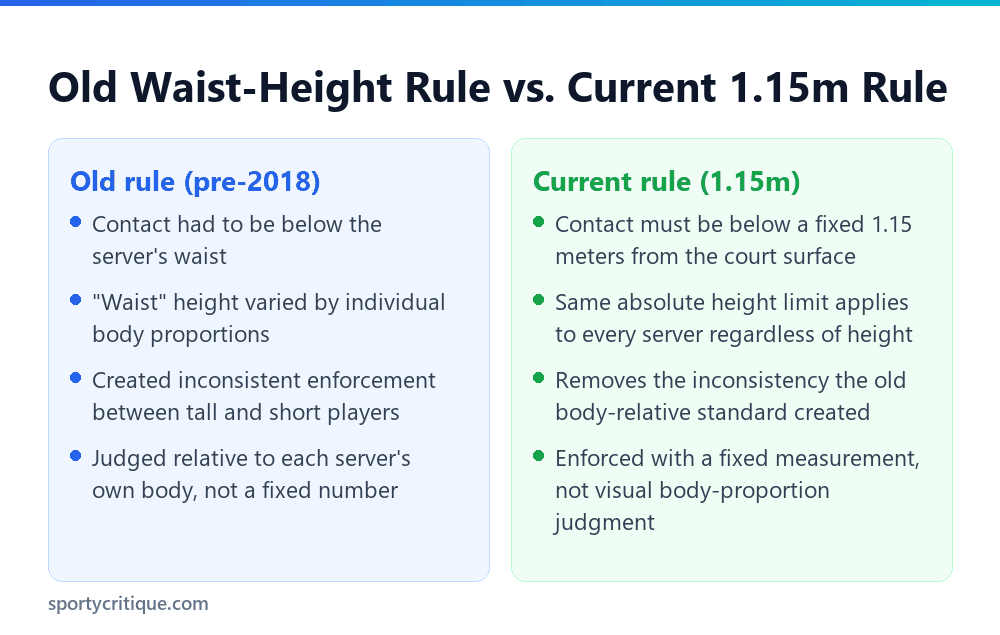
The badminton service height rule requires that a server’s racket contact the shuttle at or below 1.15 meters from the court surface, a fixed absolute height that replaced badminton’s older rule requiring contact below the server’s waist. This change, adopted internationally in 2018, removed the inconsistency the old body-relative standard created between tall and short players, since 1.15 meters applies identically to every server regardless of their individual height or body proportions.
This rule change is relatively recent enough that some players, coaches, and fans still reference the older waist-height standard without realizing the sport moved to a fixed measurement several years ago. Understanding both the current rule and why it replaced the older standard clarifies a detail that trips up even some experienced players unfamiliar with the change.
- →The current rule requires contact at or below 1.15 meters from the court surface
- →This fixed height replaced an older rule requiring contact below the server’s individual waist
- →The change specifically addressed inconsistency between tall and short players under the old rule
- →Racket shaft angle at contact also matters, not just the height of contact alone
- →Officials and, at higher levels, service height sensors help enforce this specific measurement
Table of Contents
The Old Waist-Height Rule
Before 2018, international badminton rules required a server’s racket to contact the shuttle below their own waist, a standard that seems straightforward but created real inconsistency in practice, since “waist height” naturally sits at different absolute measurements for a tall player compared to a notably shorter one.
⚠️ Watch out: Under the old rule, a taller player’s waist sits meaningfully higher off the ground than a shorter player’s, meaning the taller player had more effective room to contact the shuttle higher up while still technically staying within the legal serving zone, a fairness inconsistency that became a documented concern among players and officials.
The Current 1.15 Meter Rule
The Badminton World Federation introduced the fixed 1.15-meter standard specifically to remove this body-proportion inconsistency, applying the exact same absolute height limit to every server regardless of their individual height, eliminating the fairness gap the old relative standard created between players of different statures.
This height is measured from the court surface to the point of racket-shuttle contact, and officials at higher levels of competitive play sometimes use camera-based or sensor technology specifically to verify this measurement objectively, rather than relying purely on a line judge’s visual estimate for what can be a genuinely close, fast-moving determination.
Racket Shaft Angle Also Matters
Beyond the contact height itself, the rule also specifies that the entire racket shaft must point in a downward direction at the moment of contact, meaning even a serve contacting the shuttle below 1.15 meters can still be called a fault if the racket head is angled upward rather than pointing down at that specific moment.
💡 Pro tip: Practicing serves specifically with attention to both height and shaft angle together, rather than focusing purely on keeping contact low, helps a player avoid a fault that technically meets the height requirement but still violates the shaft-angle component of the same overall rule.
Why This Rule Exists at All
Requiring a low, downward-angled contact point specifically prevents a server from generating excessive downward power on the serve, which would otherwise let the serve function almost like an attacking smash rather than the more neutral, rally-starting shot a serve is meant to be under badminton’s broader competitive design.
This rule reflects a deliberate design choice to keep the serve as a fair, relatively neutral starting point for a rally rather than an outright scoring weapon in its own right, a distinction that separates badminton’s serve rules from some other racket sports where a more aggressive serve is specifically permitted and even strategically central to the game.
Common Service Height Faults
- ✓Contact the shuttle at or below 1.15 meters from the court surface
- ✓Keep the entire racket shaft pointed downward at the moment of contact
- ✓Practice height and shaft angle together, not height in isolation
- ✓Stay aware that this fixed rule replaced the older, body-relative waist standard
- ✕Assuming the old waist-height rule still applies rather than the current fixed measurement
- ✕Contacting the shuttle at a legal height but with the racket shaft angled upward
- ✕Focusing only on keeping the racket low while ignoring shaft angle entirely
- ✕Assuming taller players get any effective additional serving height under current rules
How This Rule Gets Enforced at Different Levels
At the highest international levels, service height is sometimes verified using dedicated camera or sensor technology specifically designed to measure this exact contact point objectively, removing reliance purely on a human official’s real-time visual judgment for what can be an extremely close, fast-developing moment.
At most recreational, school, and lower-level competitive matches without access to this kind of technology, a service judge or the presiding official makes this call based on direct visual observation, which is part of why borderline service height calls occasionally generate more disagreement at these levels than at tournaments with dedicated verification equipment available.
Practicing to Stay Within the Legal Serving Zone
Practicing serves specifically with a coach or training partner watching for both height and shaft angle, rather than only self-assessing during solo practice, catches a borderline habit before it becomes an ingrained pattern that draws repeated faults during actual competitive matches.
Some players specifically practice serving next to a fixed height reference, like a mark on a wall or net post set at 1.15 meters, to build a more accurate physical sense of the legal contact zone during training, rather than relying purely on feel without any concrete visual or physical reference point.
Other Serving Requirements Alongside Height
Beyond contact height and shaft angle, a legal serve also requires both feet to maintain contact with the court within their respective service courts without touching any boundary lines during the serving motion, a separate foot-fault rule that works alongside, but independently from, the height and angle requirements already covered.
The entire shuttle must also be below the server’s waist at the start of the service motion, in addition to the contact-height rule already discussed, and the server’s racket must move in a continuous forward motion without any noticeable pause once the service motion actually begins. These combined requirements work together to define what counts as a fully legal serve under current rules.
How the Rule Change Actually Happened
The Badminton World Federation piloted the fixed-height rule in select tournaments before adopting it broadly in 2018, following documented concerns raised by players, coaches, and officials about the fairness inconsistency the old waist-height standard created across players of different heights.
This kind of pilot-then-adopt process is common for significant rule changes in badminton and many other sports, allowing officials to evaluate real competitive impact and enforcement practicality before committing to a permanent rule change applied across every level of organized play worldwide.
What 1.15 Meters Actually Looks Like
For reference, 1.15 meters is roughly 45 inches, or approximately mid-torso height on an average adult, giving players and coaches a rough physical reference point even without a precise measuring tool available during casual practice sessions.
Some training facilities mark this height directly on a wall or net post specifically to give players and coaches an accurate, consistent visual reference during practice, removing the guesswork that comes from estimating the height purely from memory or a rough mental approximation during a live serving motion.
Video Review and Service Judges
At major international tournaments, dedicated service judges positioned specifically to watch for height and foot-fault violations work alongside the main umpire, reflecting how much specific attention this one particular rule area receives given how frequently these calls come up across a long tournament.
Camera-based service height detection systems, where available, provide an additional objective check beyond a service judge’s visual call, and some competitions specifically allow a formal challenge process for a disputed service height ruling, similar to challenge systems used in several other professional sports for close, contested calls.
How This Rule Shapes Serving Strategy
Because the legal serving zone sits relatively low and requires a downward racket angle, badminton serves generally can’t generate the same aggressive, attacking power a serve in some other racket sports can produce, which shapes serving strategy toward placement, deception, and setting up the following shot rather than trying to win the point outright on the serve itself.
This strategic reality connects directly to deceptive serving technique covered in more detail elsewhere on this site, since a server working within this specific legal height constraint relies more heavily on disguise and placement to gain an advantage than on raw serving power alone, a distinct strategic emphasis compared to sports where the serve itself is a primary scoring weapon.
Does This Rule Apply the Same Way at Every Level?
The core 1.15-meter standard applies consistently across international, national, and most organized club-level play, though enforcement precision naturally varies based on whether a specific competition has access to camera-based verification technology or relies purely on a human official’s visual judgment.
Some recreational or informal settings without dedicated officiating may apply this rule more loosely or inconsistently in practice, even though the written rule itself remains the same regardless of the setting, which is worth keeping in mind when transitioning from casual play to more formally officiated competitive matches.
Frequently Asked Questions
What is the current badminton service height limit?
1.15 meters from the court surface, a fixed absolute measurement that applies to every server regardless of their individual height, adopted internationally in 2018.
What was the rule before 2018?
Contact had to occur below the server’s own waist, a body-relative standard that created inconsistency between taller and shorter players before the fixed 1.15-meter rule replaced it.
Does racket shaft angle matter separately from height?
Yes. The entire racket shaft must point downward at the moment of contact, meaning a serve can still fault even at a legal height if the shaft is angled upward instead.
Why did badminton change to a fixed height rule?
To remove the inconsistency the old waist-height standard created, since taller players naturally had more effective serving room than shorter players under that body-relative rule.
How is service height actually measured during a match?
At higher levels, camera or sensor technology sometimes verifies it objectively. At most recreational and lower-level matches, a service judge or official makes the call by direct visual observation.
Can I still find outdated information about the waist-height rule?
Yes, since the rule changed relatively recently in 2018. Older instructional content or unfamiliar players sometimes still reference the outdated waist-height standard.
Understanding both the specific 1.15-meter measurement and the accompanying shaft-angle requirement gives a complete picture of what actually makes a serve legal under current badminton rules, clearing up confusion for anyone still working from the sport’s older, body-relative waist-height standard.
For a player moving between these different settings regularly, adjusting expectations accordingly, expecting stricter, more consistent enforcement at a sanctioned tournament than at a casual club night, avoids confusion or frustration when the same written rule gets applied with noticeably different rigor depending on the specific venue and level of competition.
Regardless of the setting, understanding the actual current standard, rather than relying on outdated waist-height assumptions, puts a player in a better position to both serve legally and correctly interpret a call made against them during an actual match, whatever level that match happens to be played at.
The rule may seem like a small technical detail, but it shapes serving strategy, officiating practice, and even how the sport’s equipment and coaching methods have evolved since the change took effect.
As an Amazon Associate, we earn from qualifying purchases through links on this page.