Best Half Chaps for English Riders


Among the best half chaps horseback riding options, the Dublin Easy-Care Half Chaps II suit most English riders, an established equestrian brand offering durable, low-maintenance synthetic construction at a reasonable price. Budget-conscious riders do well with the DUASASH synthetic option instead. Younger riders need chaps sized specifically for youth proportions, like the HORZE Ribbed Amara Kids option, rather than a scaled-down adult pair. Riders who specifically prefer genuine leather’s traditional look and feel should consider The Nekid Cow leather chaps.
Half chaps exist to bridge the gap between a paddock boot and a full tall boot, providing the lower-leg support and grip a tall boot offers without the higher cost and break-in time a full boot requires. Choosing between synthetic and leather construction, and getting sizing right, matters more to how well a specific pair actually performs than brand name alone.
- →Synthetic (Amara) chaps are lower cost, easier to care for, and more weather resistant than leather
- →Genuine leather chaps offer a traditional look and mold to the leg over time with proper care
- →Youth riders need chaps sized specifically for their proportions, not a scaled adult pair
- →A visible front zip makes on-and-off easier than a hidden or side-zip design for some riders
- →Correct calf and length sizing matters more to comfort than material choice alone
Table of Contents
What Half Chaps Actually Do
Half chaps wrap around the lower leg from just below the knee to the ankle, worn over a paddock boot, to provide the same grip, support, and clean silhouette a tall boot offers, at a significantly lower cost and without the longer break-in period tall boots typically require.
⚠️ Watch out: A common misunderstanding is that half chaps offer equivalent ankle support to a tall boot. They provide similar lower-leg grip and a smoother line against the saddle, but a paddock boot underneath still needs to provide the actual ankle support, since the chap itself doesn’t extend down to fully support that specific joint.
Synthetic vs. Leather: What Actually Differs
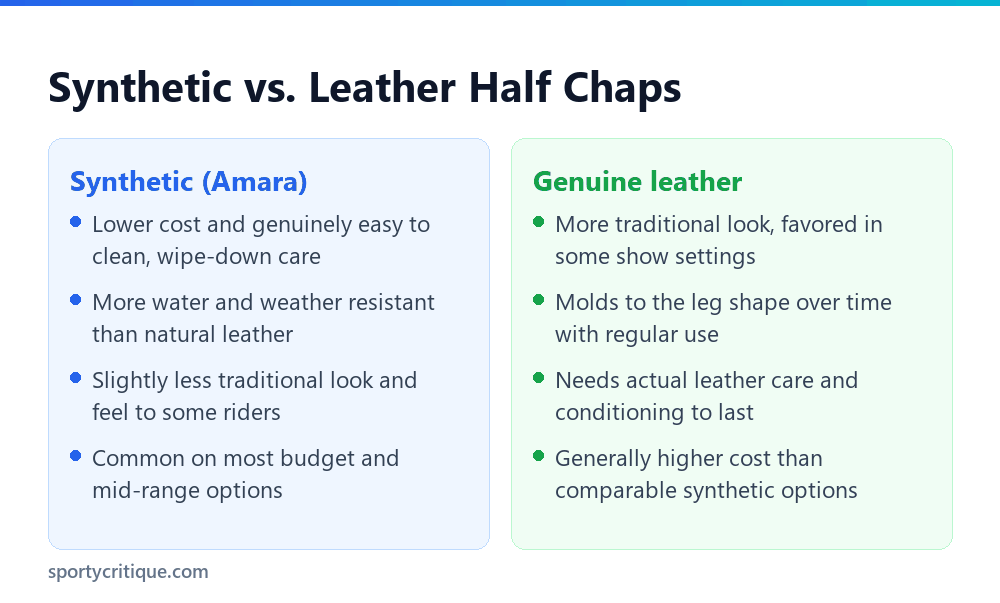
Synthetic half chaps, commonly made from a material called Amara, cost less, clean up easily with a simple wipe-down rather than requiring dedicated leather conditioning, and hold up better to wet, muddy conditions than natural leather does without extra protective care.
Genuine leather chaps offer a more traditional appearance some riders and certain show settings specifically favor, and leather molds to an individual rider’s leg shape over time with regular use in a way synthetic material generally doesn’t replicate as closely. This traditional feel comes at a higher price and requires actual leather care to maintain properly over years of use.
4 Real Options, Compared
📊 Note: The roughly $12 to $27 spread between the budget DUASASH option and the premium leather Nekid Cow pair reflects material and brand differences rather than a dramatic functional gap for typical recreational or lesson-level riding.
Getting Sizing Right
Half chaps are typically sized by both calf circumference and overall length, and checking both measurements against a specific brand’s sizing chart matters more than assuming a general small-medium-large label translates consistently across different manufacturers.
💡 Pro tip: A chap that’s too loose at the top can gap open uncomfortably behind the knee during riding, while one that’s too tight can restrict movement and circulation. Measuring calf circumference at its widest point before ordering avoids the most common sizing mismatch in this category.
Choosing the Right Half Chaps
- ✓Measure calf circumference and leg length before ordering, not just general size labels
- ✓Choose synthetic for easier care and better wet-weather performance
- ✓Choose genuine leather if traditional appearance and feel matter more than easy care
- ✓Buy youth-specific sizing for younger riders rather than a scaled adult pair
- ✕Assuming a general small-medium-large label translates identically across every brand
- ✕Choosing leather without willingness to provide actual leather care and conditioning
- ✕Buying an adult chap sized down for a younger rider instead of true youth sizing
- ✕Ignoring a gapping or overly tight fit as “something that will break in over time”
Zipper Placement and Closure Types
A visible front zip, positioned along the shin, is generally the easiest closure type to manage independently, while a rear or side zip can be harder to reach and close without assistance, particularly for a newer rider still building the flexibility this specific motion requires.
Some chaps also include an elastic panel alongside the main zipper, improving fit flexibility across a range of calf shapes and providing a bit more forgiveness if a rider’s measurements fall between two standard sizes. This detail is worth checking specifically for riders whose measurements don’t clearly match one single size category.
Caring for Half Chaps
Synthetic chaps generally need only a damp cloth wipe-down to remove dirt and dust, an easy maintenance routine that’s part of why this material remains the more popular default choice for riders without time for more involved leather care between rides.
Leather chaps need actual conditioning treatment periodically to prevent drying and cracking, similar to other leather tack and equipment discussed elsewhere in equestrian content on this site, an ongoing care commitment worth factoring into the decision between materials before purchasing.
When Tall Boots Make More Sense Than Half Chaps
Formal show settings in many disciplines specifically require tall boots rather than half chaps paired with paddock boots, making this distinction important for a rider planning to compete rather than ride purely for lessons, casual practice, or recreational trail riding.
For a rider unsure whether their specific discipline or show level requires tall boots, checking the exact rules for a given competition class beforehand avoids arriving improperly dressed for the ring, a straightforward but easily overlooked detail for anyone newer to showing competitively.
Breaking In New Half Chaps
New half chaps, particularly leather ones, typically need a short break-in period before they feel fully comfortable and move naturally with the leg, though this adjustment period is considerably shorter than what a new pair of tall boots usually requires.
Wearing new chaps for shorter rides initially, rather than immediately committing to a long lesson or trail ride, lets a rider identify any rubbing or discomfort early while the stakes are still low, rather than discovering a fit problem partway through an extended, harder-to-interrupt ride.
Pairing Half Chaps With the Right Paddock Boot
The paddock boot worn underneath half chaps matters as much to overall comfort and performance as the chap itself, since an ill-fitting or low-quality paddock boot undermines even a well-chosen, correctly sized pair of chaps sitting on top of it.
Checking that a specific paddock boot and half chap combination doesn’t create excessive bulk or an uncomfortable overlap at the ankle, where the two pieces of equipment meet, is worth doing before committing to a full ride, particularly when trying a new boot and chap pairing for the first time together.
Choosing Half Chaps for Climate and Season
Riders in consistently warm, humid climates sometimes find synthetic Amara material more comfortable over long rides than leather, which can feel warmer and less breathable in sustained heat, though this difference varies somewhat by the specific product’s exact construction and lining material.
For riders facing genuinely cold, wet winter conditions, checking a specific chap’s actual weather resistance claims, rather than assuming any synthetic material automatically handles winter riding well, ensures the chosen pair actually suits year-round use if that’s the intended purpose rather than fair-weather riding alone.
Longevity and When to Replace
Well-maintained half chaps, whether synthetic or leather, typically last several years of regular riding before showing enough wear, cracking, or a zipper failure, to warrant replacement, making this a relatively durable piece of equipment relative to its moderate upfront cost.
Checking zipper function and material condition periodically, similar to other regularly used riding equipment covered elsewhere on this site, catches developing issues before a chap fails unexpectedly mid-ride, a minor inconvenience that a quick periodic inspection easily prevents.
Frequently Asked Questions
Do half chaps replace tall boots entirely?
Not exactly. They provide similar lower-leg grip and appearance at a lower cost, but many riders still use tall boots for shows or more formal settings, reserving half chaps for lessons and casual riding.
Should I choose synthetic or leather half chaps?
Synthetic offers easier care and better wet-weather performance at a lower cost; leather offers a traditional look and feel but requires actual conditioning care and typically costs more.
How do I know what size half chaps to order?
Measure calf circumference at its widest point and overall leg length, then check these measurements against the specific brand’s own sizing chart rather than a general size label.
Do half chaps provide ankle support?
Not directly. Ankle support comes from the paddock boot worn underneath; the chap itself provides lower-leg grip and a clean line but doesn’t extend down to support the ankle joint.
What’s the easiest closure type to manage independently?
A visible front zip along the shin is generally the easiest for a rider to manage alone, compared to a rear or side zip that can be harder to reach without assistance.
Do youth riders need different half chaps than adults?
Yes, generally. Youth-specific sizing fits better than an adult chap scaled down, since younger riders have different leg proportions than a smaller adult.
Families outfitting a growing young rider should also expect to replace youth-sized chaps more frequently than an adult pair, simply due to normal growth rather than any actual wear or product quality issue, a cost worth budgeting for separately from the equipment’s own expected lifespan.
Getting sizing right and choosing the material that matches a rider’s actual care habits and aesthetic preference matters more than chasing a specific brand name alone. Any of the options in this comparison, correctly sized, delivers the practical benefit half chaps are meant to provide.
None of this needs to feel like an overwhelming set of decisions for a first purchase. Measure calf and length accurately, decide between synthetic and leather based on actual care habits and budget, confirm the specific discipline’s dress requirements if showing is a goal, and pick a closure type that’s easy to manage independently.
A well-chosen pair of half chaps, properly sized and cared for, typically outlasts the initial purchase price many times over across years of regular riding, making the small amount of upfront research covered in this guide a worthwhile investment of time before actually placing an order.
Any of the four options covered in this comparison represents a reasonable starting point for a rider new to half chaps, with the final choice coming down to budget, material preference, and the specific sizing that actually fits an individual rider’s leg shape and length, more than any single brand name winning out over the others purely on reputation or marketing alone.
Taking the time to get these basics right the first time saves both money and frustration compared to buying, returning, and re-ordering a second or third pair after an initial sizing or material mismatch.
As an Amazon Associate, we earn from qualifying purchases through links on this page.