Power vs Control Tennis Rackets: How Specs Shape Your Game


Racket listings throw around head size, string pattern, and swingweight like every shopper already knows what they mean. In the power vs control tennis rackets debate, these three specs are what actually separate a forgiving, power-boosting frame from a precise, control-oriented one, and understanding them beats picking by marketing label alone.

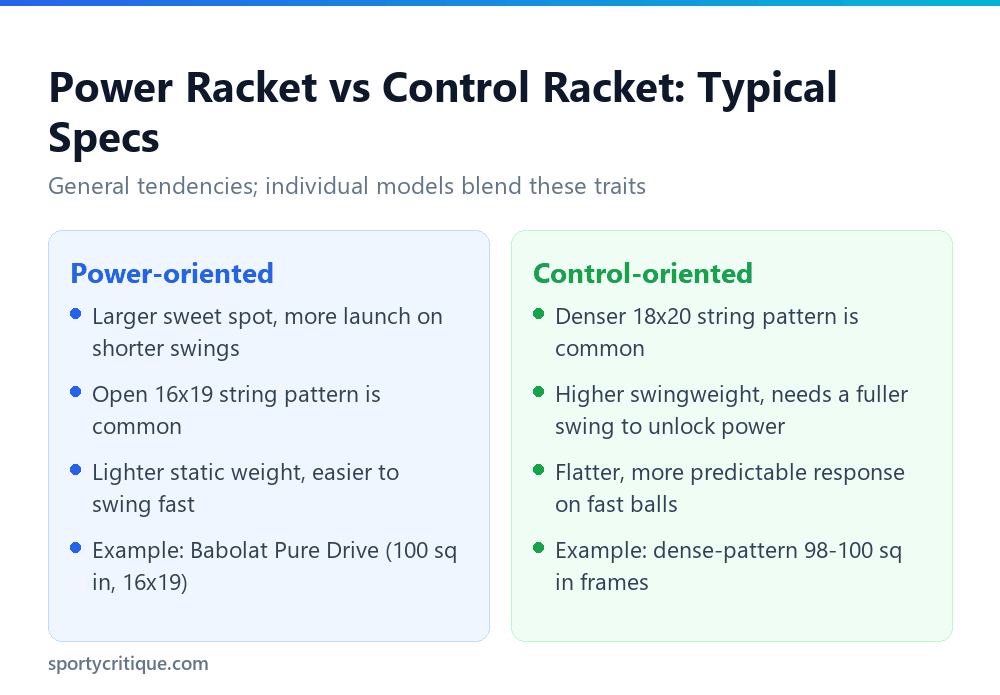
In the power vs control tennis rackets debate, the real differences come down to three specs: head size, string pattern, and swingweight. A larger head (100 sq in or more) with an open 16×19 string pattern and lower swingweight favors power and forgiveness. A smaller head (95-98 sq in) with a denser 18×20 pattern and higher swingweight favors control and precision, but demands a faster, more complete swing to generate pace. Most players do best somewhere between the two extremes rather than at either edge.
If you’ve moved past pure beginner gear and started noticing that racket listings throw around terms like head size, string pattern, and swingweight without explaining what they actually change on court, this guide is for you. Rather than another generic buying list, we’re breaking down what each spec does to the way a racket feels and plays, so you can match a frame to your own swing instead of guessing from a marketing label like power or control.
If you’re still working on your very first racket purchase and haven’t settled into a consistent swing yet, our beginner-focused guides cover that ground in more depth. This post assumes you’ve played enough to have opinions about how a racket feels, not just what it costs.
- →Head size: bigger (100 sq in+) means a larger sweet spot and more forgiveness on off-center hits
- →String pattern: open 16×19 spacing grips and launches the ball more; dense 18×20 flattens the trajectory and adds control at the cost of some spin potential
- →Swingweight: how heavy the racket feels swinging, not just its static weight, sets how much effort is needed to generate pace
- →Frame stiffness (a separate spec from all three above) affects comfort and feel independent of power or control leanings
- →No single spec decides power vs control alone; it’s the combination that shapes how a racket plays
Table of Contents
Head size: the first lever
Head size is measured in square inches of stringed area, and it’s the spec most players already understand intuitively. A larger head, typically 100 to 107 square inches, gives you a bigger sweet spot and more margin for error on shots that aren’t struck dead center. That forgiveness is why most recreational and intermediate frames land in the 100 to 105 square inch range.
Smaller heads, usually 95 to 98 square inches, shrink that margin but reward precise contact with a flatter, more controlled response. Advanced and tournament-oriented players often prefer this trade because they’re consistently hitting the sweet spot anyway and want the extra predictability a smaller head provides on fast exchanges. If your contact point still varies shot to shot, a bigger head is almost always the more forgiving, more enjoyable choice.
String pattern: dense vs open
String pattern describes how many main and cross strings are woven into the head, written as two numbers like 16×19 or 18×20. The first number is mains (the strings running vertically), the second is crosses (running horizontally). An open pattern like 16×19 has more space between strings, which lets the strings move more at contact. That extra string movement grips the ball longer, adding spin potential and a slightly springier, more powerful feel.
A dense pattern like 18×20 packs the strings closer together, restricting that movement. Less string deflection means less trampoline effect but a flatter, more consistent response with less spin. Players who already generate their own spin and power through technique often prefer a denser pattern because it adds control and predictability rather than amplifying shots that are already fast.
⚠️ Watch out: A common mix-up is assuming string pattern and head size always move together. They don’t. You can find a 100 square inch head with a dense 18×20 pattern, or a 98 square inch head with an open 16×19 pattern. Check both specs separately rather than assuming one implies the other.
Swingweight: the spec most players ignore
Static weight, how heavy a racket feels sitting in your hand, gets most of the attention, but swingweight matters more for how a racket actually plays. Swingweight measures how much effort it takes to swing the racket through its arc, accounting for how the weight is distributed along the frame, not just the total amount. Two rackets with identical static weight can feel completely different if one has more weight in the head (higher swingweight, more plow-through power on contact) and the other has more weight in the handle (lower swingweight, quicker to whip through the swing).
A higher swingweight generally means more stability and power on contact but requires a longer, more complete swing to control well, which is why heavier, head-light-balanced frames are common among players with fast, full swings. A lower swingweight is easier to maneuver quickly, which suits players who need to react fast at net or on serve returns, but it can feel like it runs out of plow-through on a hard-hit ball unless your own swing supplies the pace instead.
💡 Pro tip: If you can, demo a racket before buying rather than relying on spec sheets alone. Swingweight in particular is genuinely hard to judge from a number on a page; it’s something you feel in the first few swings.
Matching specs to your playing style
If your game leans on generating your own pace with a full, fast swing and you want the racket to add control rather than extra power, look toward a denser string pattern (18×20), a smaller-to-mid head size (95-100 sq in), and a moderate-to-higher swingweight. If your swing is shorter or more compact and you want the racket itself to help generate pace and spin, an open 16×19 pattern, a 100 sq in or larger head, and a lower swingweight will do more of that work for you.
Neither direction is objectively better; it’s about matching the racket’s tendencies to what your own swing already does well and to what it needs help with. A player who already over-hits and struggles with control benefits more from a control-leaning setup, while a player who struggles to generate pace or spin benefits more from a power-leaning setup, even at the same skill level.
Three rackets that show the spread
These three current rackets illustrate the range rather than representing every option on the market. All three specs below reflect general manufacturer specifications for this racket class; exact numbers can vary slightly by grip size and model year.
The Pure Drive is Babolat’s long-running power frame, and its reputation for a lively, high-launch response has held up across generations. It’s a reasonable pick if you want the racket itself to add pop to shots hit with a shorter or more compact swing.
The Clash 100 V3 takes a different approach to comfort: instead of an open string pattern or a big head being the main lever, Wilson built unusual flex into the frame itself, which is marketed as reducing shock on the arm while still keeping a workable amount of pop. If arm comfort is a bigger priority for you than maximizing raw power or control, this is worth trying.
The EZONE 100+ sits in a middle lane, built by Yonex as a genuinely all-court frame rather than leaning hard into either power or control. It’s a reasonable default if you’re not yet sure which direction fits your game and don’t want to commit to either extreme.
Do you need to size down as you improve?
- ✓Consider a denser pattern or smaller head once your contact point is consistent and you want more predictability on fast exchanges
- ✓Change one spec at a time (pattern, then head size, then swingweight) so you can feel what each one actually does
- ✓Demo before buying whenever a shop or program makes that possible
- ✓Keep a power-leaning, forgiving frame if you’re still working on consistent contact
- ✕Switch to a small head and dense pattern just because it’s marketed as the advanced option
- ✕Assume a control racket will fix inconsistent technique; it usually just removes the power cushion that was compensating for it
- ✕Chase spec numbers without considering how the racket actually feels in your hand
- ✕Buy the exact racket a touring pro uses expecting it to play the same for a recreational swing
Still working on the basics? Start here instead
A simple way to test where you stand
If you’re not sure which side of the power-control spectrum fits you, a useful test is to notice what you complain about most during a session. If you’re consistently frustrated by shots landing short or lacking pace, you likely want more power-leaning specs. If you’re consistently frustrated by shots sailing long or wide, you likely want more control-leaning specs. Your own mis-hits are a better guide than a marketing category.
Bottom line
Head size, string pattern, and swingweight, not a vague power or control label on a box, are what actually determine how a racket plays. Learn what each one does, notice what your own game needs more of, and pick a frame that matches, rather than assuming the more expensive or more advanced-looking option is automatically the right one for where you are right now.
What’s the real difference between power and control tennis rackets?
It comes down to head size, string pattern, and swingweight. Power-leaning rackets typically combine a larger head, an open 16×19 string pattern, and a lower swingweight, all of which make the racket do more of the work generating pace. Control-leaning rackets typically use a smaller head, a denser 18×20 pattern, and a higher swingweight, which flattens the response and rewards a player who already generates their own power.
Does a bigger head size always mean more power?
Generally yes, a bigger head gives a larger sweet spot and more trampoline effect, but string pattern and swingweight also affect power independently, so head size alone doesn’t tell the whole story.
Is an 18×20 string pattern better for spin or for control?
Control, not spin. A denser 18×20 pattern restricts string movement, which reduces the trampoline effect that helps generate power, and generally produces less spin than an open 16×19 pattern, not more.
Do I need to know my swingweight before buying a racket?
Not precisely, but it helps to know the general direction. If you have a full, fast swing, look toward a higher swingweight for stability. If your swing is more compact or you need quick reactions at net, a lower swingweight will be easier to control.
As an Amazon Associate, we earn from qualifying purchases through links on this page.