How to Play Billiards: Rules, Fundamentals & the Rules People Argue About

Quick Answer: To play 8-ball: rack all 15 balls with the 8 in the middle, break from behind the head string, then claim solids or stripes by legally pocketing one. Clear your group, call your pocket, sink the 8 — that’s the game. You keep shooting while you keep pocketing; a foul hands your opponent the cue ball in hand. The catch nobody warns you about: the rules change depending on where you’re playing, and we cover all three rule sets below.
Pool is the easiest game in the world to start and one of the hardest to actually get good at. Twenty minutes and you can play a full game; twenty years and you’re still learning position. This guide covers everything you need to walk into any pool room and play properly — the equipment, the setup, the real rules (including the ones people fight about), the physical fundamentals, and the practice ladder that turns a person holding a cue into a player.
What you’re actually working with
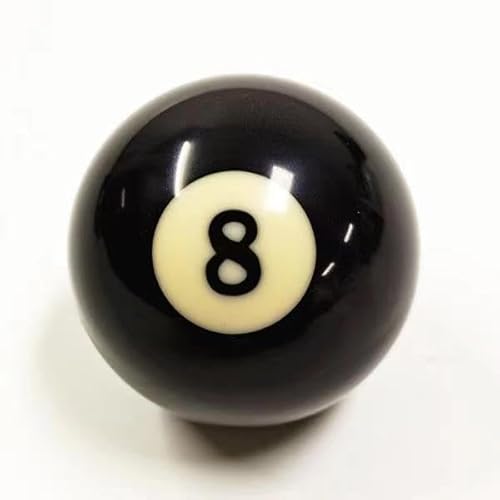
A standard game uses 16 balls: the white cue ball, seven solids (numbered 1–7), seven stripes (9–15), and the black 8-ball. The solids and stripes are your two groups; the 8 is the winner and, if you touch it at the wrong time, the loser.
| Equipment | What matters | Beginner advice |
|---|---|---|
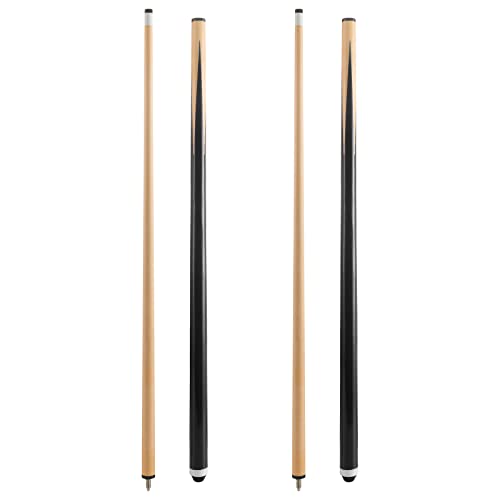
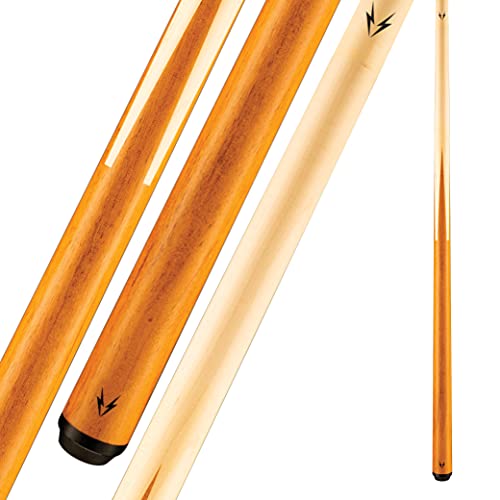
| Cue | Weight (18–21 oz), tip condition, straightness | House cues work — roll one on the table to check it isn’t warped before you commit to it |
| Chalk | Applied before every shot, not once a game | Free at every table and the cheapest miscue insurance there is |
| Rack | Triangle for 8-ball, diamond for 9-ball | Tight rack > perfect pattern — see our racking guide |
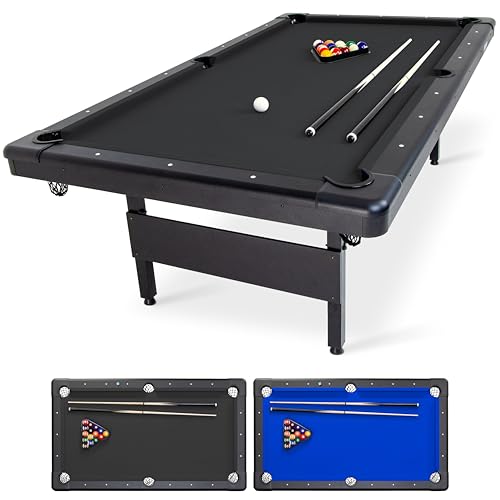
| Table | 7ft (bar), 8ft (home), 9ft (pro) | Bar boxes play very differently — pockets are usually more forgiving |
| Bridge (the stick) | For shots you can’t reach | Use it early; stretching ruins more shots than the bridge ever will |
The cue is the only thing worth thinking about at the start, and even then not much. A house cue with a decent tip beats a $300 cue in untrained hands. When you’re ready to buy your own — and the honest signal is when you start noticing house cues annoy you — our guide to the best pool cues for beginners covers what actually changes at each price tier.
💡 Roll every house cue on the table before you pick it. If it wobbles, it’s warped, and no technique in the world will make a warped cue shoot straight. It takes three seconds and saves an entire evening of blaming yourself for the cue’s crimes.
Setting up the game
Rack all 15 balls in the triangle with the 8-ball in the centre of the third row, one solid in one back corner and one stripe in the other, and the apex ball on the foot spot. Everything else can be random — that’s the actual rule, despite what the person who racks ‘properly’ at your local bar tells you.
The breaker places the cue ball anywhere behind the head string (the imaginary line across the table between the second diamonds) and fires. For a legal break, you must either pocket a ball or drive at least four numbered balls to a rail. Fail that and, depending on the rule set, your opponent can re-rack and break, or accept the table as it lies.
⚠️ Scratching on the break (cue ball in a pocket) doesn’t lose you the game — but it does hand over the table. In 8-ball your opponent typically shoots from behind the head string (‘the kitchen’). In 9-ball they get ball in hand anywhere. Same foul, different consequence, different game.
How 8-ball is actually played
- Break. If you pocket a ball, you keep shooting — but the table is still ‘open’, meaning no one owns solids or stripes yet.
- Claim your group. The table stays open until someone legally pockets a called ball after the break. Pocket a stripe on that shot and stripes are yours for the game.
- Run your group. Keep shooting as long as you keep legally pocketing your own balls. Miss, and it’s your opponent’s turn.
- Call the 8. Once your group is cleared, name the pocket out loud, point at it, make it unmistakable. Then sink it there.
- Win — or lose instantly. The 8 in the wrong pocket, the 8 early, or a scratch while shooting the 8 all lose the game on the spot in most rule sets.
The fouls that decide real games
| Foul | What happens | How often beginners do it |
|---|---|---|
| Scratch (cue ball pocketed) | Ball in hand for opponent | Constantly |
| Hitting the opponent’s group first | Foul — ball in hand | Very often, especially when snookered |
| No rail after contact | Foul — some ball must hit a rail or drop | Common on soft safety attempts |
| Cue ball doesn’t touch any ball | Foul — ball in hand | The airball moment |
| Double hit / push shot | Foul | When the cue ball is frozen to an object ball |
| Pocketing the 8 early | Loss of game | The classic heartbreak |
| 8 in an uncalled pocket | Loss of game | Painful and preventable |
| Feet off the floor | Foul | Reaching for a long shot — use the bridge |
The rules change depending on where you play (this is what people argue about)
Here’s the thing almost every beginner guide skips, and it’s the source of about 90% of all pool disputes: there is no single set of 8-ball rules. There are at least three in common use, and they contradict each other on the exact situations most likely to come up. Learn the differences and you’ll never be the person insisting loudly about a rule that doesn’t apply in the room you’re standing in.
| Situation | BCA / WPA (tournament) | APA (league) | Bar / house rules |
|---|---|---|---|
| Calling shots | Only the 8 must be called — everything else is ‘any pocket’ | Call every shot: ball and pocket | Usually call every shot; varies by bar |
| Slop (accidental pots) | Counts | Doesn’t count (except the marked 8) | Usually doesn’t count |
| Foul while shooting the 8 (not pocketing it) | Ball in hand for opponent — game continues | Ball in hand — game continues | Almost always an automatic loss |
| Scratch on the break | Ball in hand behind the head string | Behind the head string | Behind the head string |
| Jump cues | Allowed | Not allowed | Depends who owns the table |
| Ball knocked off the table | Foul, ball is not spotted | Spot the ball, no foul | Argument, then someone’s cousin decides |
⚠️ The rule that ends friendships: fouling while shooting at the 8 — say you hit it in cleanly but scratch. Under tournament and league rules, that’s just ball in hand and the game goes on. Under bar rules, you’ve lost. Same shot, opposite outcome. Agree on this one before the break, every single time you play somewhere new. It takes four seconds and prevents the entire evening’s worth of arguing.
The practical advice: in a bar, ask ‘bar rules or BCA?’ before you rack. In a league, learn that league’s rule book, because they will be enforced by people who know them cold. And when in doubt, the house rule is whatever the person who owns the table says it is — that’s not a joke, it’s genuinely the convention.
The physical fundamentals — where everyone actually loses
Most beginners think they miss because their aim is off. They miss because their stroke isn’t straight, and no aiming system on earth fixes a crooked stroke. Here’s the physical base, in the order it matters.
1. Stance: your body is the tripod
Feet roughly shoulder-width, weight distributed evenly, front foot pointing loosely toward the shot and back foot planted — a boxer’s stance, not a fencer’s. Bend at the hips and drop your chin toward the cue so you’re sighting down the line rather than across it. The whole point is to be a stable platform: if you can be nudged off balance mid-shot, you’re not in a stance, you’re leaning.
Test it: get down on a shot, then have someone gently push your shoulder. If you wobble, widen your base. Every good player looks stubbornly planted, and that’s not aesthetic — it’s mechanical.
2. Grip: hold it like a bird you don’t want to hurt
Grip roughly 4–6 inches from the butt end — the goal is that your forearm hangs perpendicular to the cue when the tip is at the cue ball. Too far back and you lose control; too far forward and you lose stroke length. Then relax: the cue rests in your fingers, not clamped in a fist. Tension in the hand travels straight up the arm and shows up as a sideways nudge at contact.
⚠️ The thumb-on-top habit: resting your thumb along the top of the cue feels controlled and is quietly wrecking your stroke — it presses the cue down and restricts the swing. Thumb points at the floor, fingers do the holding.
3. Bridge: the front hand does the aiming
The open bridge — hand flat, thumb raised to make a V, cue resting in the groove — is the beginner’s friend: easy to form, clear sightline, plenty stable for most shots. The closed bridge (index finger looped over the cue) locks the cue in and helps on power shots and heavy spin, but it takes practice to form quickly.
Bridge distance: 6–8 inches from the cue ball is the standard. Closer means more control and less power; further means the opposite and more error. Beginners bridge too far away almost universally — it feels grand and shoots wide.
4. Stroke: the pendulum
This is the whole game. Your upper arm doesn’t move. The forearm swings from the elbow like a pendulum — back slowly, forward smoothly, accelerating through the cue ball and following through past it. Your head stays still and your eyes stay down until the balls have stopped.
The single most common fault: poking — stopping the cue at impact instead of stroking through it. It kills power, destroys spin control, and makes every shot a slightly different stroke, which means nothing is repeatable. If you take one thing from this page: finish your stroke. The cue tip should end up past where the cue ball was.
💡 The straight-line test. Put the cue ball and an object ball in a dead line to a corner pocket, three feet apart. Shoot it ten times at medium pace. Miss more than once and your stroke — not your aim — is the problem. Do this at the start of every session for a month; it’s the most honest feedback in the sport. More on aiming systems in our aiming guide.
Cue ball control: the skill that separates players from potters
Beginners think about the object ball. Players think about where the cue ball ends up. Pocketing a ball while leaving yourself hooked behind a cluster is a shot won and a game lost — the whole art is finishing each shot with a look at the next one.
The ladder, in the order you should learn it:
| Shot | Where you hit the cue ball | What it does |
|---|---|---|
| Stop shot | Dead centre, firm | Cue ball stops on contact — the foundation of everything |
| Follow | Above centre | Cue ball rolls forward after contact |
| Draw | Below centre, smooth acceleration | Cue ball comes backward — the one everybody wants first and should learn third |
| Stun/angle | Centre with pace, on a cut | Cue ball slides off at 90° from the object ball |
| English (side spin) | Left or right of centre | Changes the cue ball’s path off rails — and your aim. Learn last. |
⚠️ Do not start with English. Side spin changes where you have to aim (it ‘throws’ the object ball) and curves the cue ball. Beginners apply it because it looks like what good players do — good players use it sparingly and deliberately. Master centre-ball hits and the stop shot first; you’ll beat 90% of casual players with those alone.
The games you’ll be invited to play
| Game | Balls | The idea | Difficulty |
|---|---|---|---|
| 8-ball | 15 | Solids vs stripes, then the 8 | The default everywhere |
| 9-ball | 9 | Always hit the lowest ball first; pot the 9 to win — even off a combo | Faster; rewards shot-making |
| Straight pool (14.1) | 15 | Any ball, any pocket, race to a point total | The purist’s game |
| One pocket | 15 | You may only score in ONE assigned pocket | Chess — see our one pocket guide |
| Cutthroat | 15 | Three players, each defends a set of balls | The party game |
| Bank pool | 15 | Every ball must be banked off a rail | Brutal, brilliant practice |
Learn 8-ball first, then 9-ball — between them they cover almost every game you’ll be offered. If you want to understand the strategic depth this sport hides under its simple surface, spend an evening on one pocket; it will change how you see the table.
Pool room etiquette (learn this before you need it)
- Don’t move in the shooter’s sightline. Stand still while someone is down on a shot — this is the big one, and breaking it marks you instantly.
- Don’t talk during a stroke. Between shots is conversation; during a shot is sabotage.
- Never sit on the table. Not even a lean. Tables cost thousands and rails go out of true.
- Chalk over the floor, not the cloth. Blue dust on the felt is somebody’s job to clean.
- Call your 8 clearly. Point. Say it. Ambiguity is how arguments start.
- Winner racks, or alternate — ask which convention the room uses.
- Concede the obvious. If you fouled and nobody saw it, say so. Pool has a strong self-calling culture and everybody notices who honours it.
Your first month: what to actually practice
Playing games is not practice — it’s testing. If you want to improve rather than just accumulate evenings, structure it:
| Week | Focus | The drill |
|---|---|---|
| 1 | Straight stroke | The straight-line test, 20 shots per session, both sides of the table |
| 2 | Stop shot | Centre-ball, cue ball stops dead. 20 in a row at varying distances |
| 3 | Follow & draw | Same shot, three ways: stop, follow through 6 inches, draw back 6 inches |
| 4 | Simple position | Pot a ball AND leave the cue ball in a marked circle for the next one |
Half an hour of that beats three hours of games, and the difference shows up within a month. When you’re ready to go deeper, our guide on playing billiards better covers the intermediate layer, and solo practice turns an empty table into the best coach you’ll ever have.
Frequently asked questions
Is billiards the same thing as pool?
Colloquially, yes. Technically ‘billiards’ is the umbrella term covering pocket games (pool), carom games played on pocketless tables, and snooker. In American usage the words are interchangeable; in Europe, calling snooker ‘pool’ will earn you a look.
Do I have to call every shot?
It depends on the rule set — BCA/WPA tournament rules require calling only the 8, while APA league and most bar rules require calling every shot. This is exactly why you ask before the break.
What happens if I pot my ball but scratch?
The ball stays down, but it’s still a foul: your opponent gets ball in hand. You don’t get credit for the shot in the sense of continuing your turn.
Can I hit the 8-ball first if I’m hooked?
No — until your group is cleared, contacting the 8 first is a foul in every standard rule set. If you’re snookered, play a safety instead: leave the cue ball somewhere useless to your opponent and make them solve the problem.
How long does it take to get decent?
With deliberate practice — the drills above, not just games — most people reach confident bar-player level in two to three months. Reaching genuinely good (running multiple balls, playing position consistently) is a years-long project, which is the entire appeal.
What size table should I learn on?
Whatever’s in front of you. But know that bar boxes (7ft) have more forgiving pockets and shorter shots than 9ft pro tables — a player who only plays bar boxes gets a rude surprise on a big table, and vice versa.