How to Prevent Swimmer’s Shoulder


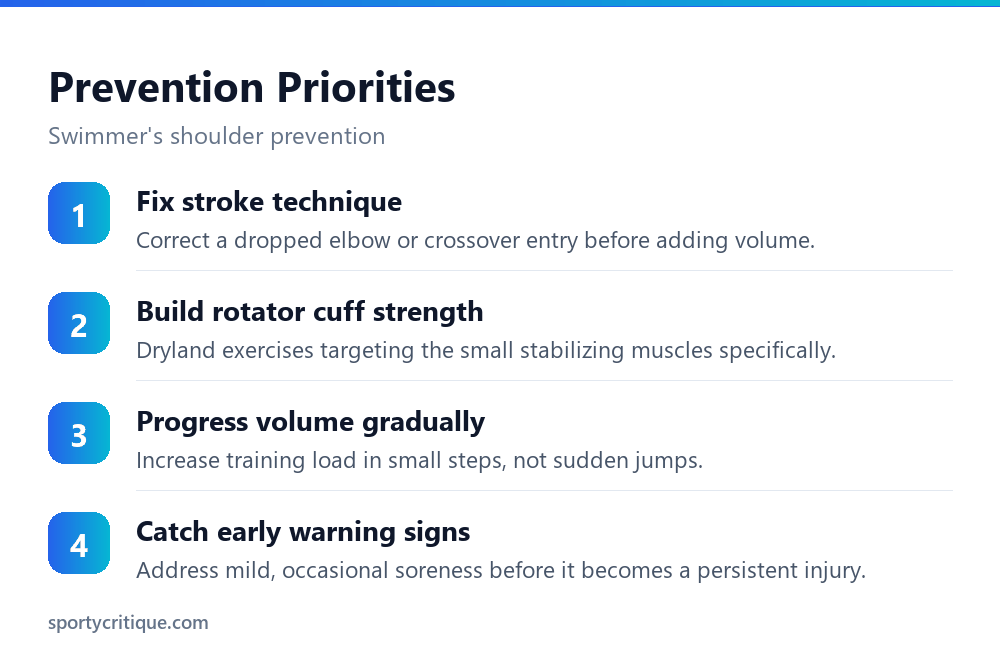
Effective swimmer’s shoulder prevention, since it’s a broad term for overuse injuries affecting the shoulder’s rotator cuff and surrounding structures, comes down to four main strategies: correcting stroke technique flaws like a dropped elbow or crossover arm entry that overload the joint with each stroke, building dedicated rotator cuff and scapular strength through dryland exercises, progressing training volume gradually rather than in sudden jumps, and addressing early, mild soreness before it develops into a persistent, more serious injury.
Swimmer’s shoulder isn’t one single injury but a general term covering several overuse conditions affecting the shoulder’s complex structure, and prevention requires addressing multiple contributing factors together rather than any single fix. Swimmers logging significant weekly volume, repeating the same stroke motion thousands of times, are particularly susceptible without deliberate prevention habits in place.
- →Swimmer’s shoulder is a broad term for several overuse conditions, not one specific injury
- →Stroke technique flaws, especially a dropped elbow or crossover entry, directly increase shoulder load
- →Dedicated rotator cuff and scapular strength work reduces injury risk beyond swimming volume alone
- →Gradual training progression matters more than total volume for preventing overuse injury
- →Addressing mild, early soreness promptly prevents it from becoming a persistent, serious problem
Table of Contents
Stroke Technique Flaws That Increase Risk
A dropped elbow during the underwater pull phase, letting the elbow sink below the hand rather than maintaining a high-elbow catch position, forces the shoulder to work through a less mechanically efficient and more stressful range of motion on every single stroke, a repetitive strain that compounds significantly over thousands of strokes in a typical training week.
⚠️ Watch out: A crossover arm entry, where the hand enters the water across the body’s centerline rather than in line with the shoulder, is a specific and common technique flaw that increases shoulder impingement risk substantially. This flaw is often subtle enough that a swimmer doesn’t notice it without specific video review or coaching feedback.
Correcting these technique flaws through focused drill work and coaching feedback addresses the root mechanical cause of much shoulder overuse stress, rather than only treating symptoms after pain has already developed. This is why technique review is often the first place a knowledgeable coach or physical therapist looks when a swimmer reports shoulder discomfort.
Dryland Strength Work That Actually Helps
Rotator cuff-specific exercises, using light resistance bands for external and internal rotation movements, target the smaller stabilizing muscles that a general upper-body strength program often neglects in favor of larger, more visible muscle groups like the chest and lats that don’t directly address shoulder joint stability.
Scapular stability exercises, strengthening the muscles controlling shoulder blade movement, complement rotator cuff work by improving the overall shoulder complex’s ability to handle repetitive stroke stress, since the scapula’s positioning directly affects how much strain actually reaches the rotator cuff during each stroke cycle.
💡 Pro tip: A consistent, modest dryland routine performed two to three times weekly produces more reliable protective benefit than an occasional, intense session followed by long gaps, since shoulder stability work depends on consistent reinforcement rather than periodic, high-intensity bursts.
Progressing Training Volume Gradually
A sudden, significant jump in weekly swimming volume, common when a swimmer returns from a break or joins a more intensive program, is a well-documented risk factor for overuse shoulder injury, since shoulder tissue needs time to adapt to increased repetitive stress rather than absorbing a large jump immediately.
Increasing weekly volume by small, incremental amounts, commonly cited as no more than roughly 10 percent per week as a general guideline, gives shoulder tissue adequate time to adapt progressively, reducing injury risk compared to an aggressive, rapid volume increase that outpaces the body’s actual adaptation capacity.
Common Prevention Mistakes
- ✓Address a dropped elbow or crossover entry through focused technique work
- ✓Include dedicated rotator cuff and scapular strength exercises regularly
- ✓Increase training volume gradually rather than in sudden, large jumps
- ✓Address mild, early shoulder soreness before it becomes a persistent problem
- ✕Ignoring a subtle technique flaw because it doesn’t cause immediate, obvious pain
- ✕Relying purely on general upper-body strength training without rotator-cuff-specific work
- ✕Jumping into significantly higher training volume after a break or program change
- ✕Continuing full training volume through worsening shoulder pain without any adjustment
Paddle Use and Shoulder Risk
Swim paddles, covered in more detail in other equipment content on this site, add resistance that increases shoulder load during training, and excessive or poorly managed paddle volume is a recognized contributing factor in some swimmer’s shoulder cases specifically, given the added stress on the same joint structures already under repetitive stress from normal swimming.
Introducing paddles gradually, starting with smaller sizes or finger paddles rather than jumping immediately to full-hand designs, applies the same gradual-progression principle already covered for overall training volume to this specific piece of equipment.
Early Warning Signs Worth Addressing
Mild, occasional shoulder soreness that resolves quickly between sessions is common and not necessarily a serious concern on its own, but soreness that persists, worsens over consecutive sessions, or specifically affects stroke mechanics or range of motion deserves prompt attention rather than being pushed through indefinitely.
Consulting a sports medicine physician or physical therapist experienced with swimmers specifically, rather than a generalist unfamiliar with the sport’s particular demands, gives a more accurate assessment of whether persistent shoulder discomfort represents early-stage swimmer’s shoulder or a different issue entirely requiring different management.
The Role of Rest and Recovery
Adequate rest between hard training sessions, allowing shoulder tissue genuine recovery time rather than training at consistently high intensity without sufficient breaks, is a foundational prevention factor that’s sometimes overlooked in favor of technique and strength-focused advice alone.
A training schedule that never includes a lighter week or an active recovery period accumulates shoulder stress without the recovery time tissue needs to adapt and strengthen, which is why well-designed competitive swimming programs typically build periodic lighter training blocks into a full season rather than maintaining maximum intensity continuously.
Body Rotation and Breathing’s Role
Insufficient body rotation through the torso during freestyle and backstroke forces the shoulder to compensate by reaching further and working through a more extreme range of motion than necessary, adding avoidable stress to the joint on every stroke cycle across a full training session.
Breathing technique connects to this same rotation issue, since a swimmer who lifts the head excessively to breathe rather than rotating the body to bring the mouth to the water’s surface naturally disrupts proper body position and often compounds the same shoulder-loading problems that poor rotation causes on its own.
Which Strokes Carry the Most Shoulder Risk
Freestyle and butterfly generally carry higher swimmer’s shoulder risk than backstroke and breaststroke, given the specific overhead arm recovery and repetitive internal rotation these two strokes demand, which places the shoulder joint in positions more associated with impingement and overuse stress.
This doesn’t mean backstroke and breaststroke carry no shoulder risk at all, but a swimmer training heavily in freestyle or butterfly specifically benefits from paying extra attention to the prevention strategies covered throughout this guide, given the elevated baseline risk these two strokes carry compared to the other two competitive strokes.
Warm-Up and Shoulder Mobility Work
A dedicated shoulder mobility warm-up before swimming, dynamic arm circles, band-assisted stretches, and gentle range-of-motion work, prepares the joint for the repetitive stress about to follow, similar to how a proper warm-up benefits any other joint before demanding, repetitive athletic activity.
Skipping this warm-up in favor of jumping directly into a hard main set, a common shortcut when training time is limited, removes a meaningful, low-cost prevention layer that takes only a few minutes but specifically prepares the shoulder for the volume of repetitive motion a training session is about to demand from it.
📊 Note: This mobility warm-up is distinct from the general pool warm-up swimming laps discussed elsewhere in swim training content on this site; both serve a purpose, and neither fully replaces the other’s specific benefit.
Sleep and Overall Recovery’s Role
Adequate sleep supports tissue repair broadly, including the specific rotator cuff and shoulder structures under repetitive stress from swim training, and a swimmer consistently under-recovered from insufficient sleep may see higher injury risk even with otherwise sound technique and training progression.
This connection between overall recovery and localized shoulder injury risk is sometimes overlooked in favor of swimming-specific advice alone, but a swimmer’s general health and recovery habits, sleep, nutrition, stress management, all factor into how well shoulder tissue actually handles the repetitive demands training places on it.
The Value of Coaching and Video Review
A subtle technique flaw like a crossover entry or a dropped elbow is often invisible to the swimmer actually performing it, since these flaws happen underwater and during a motion the swimmer experiences from the inside rather than seeing from an external vantage point.
Regular coaching feedback, or periodic video review specifically checking for these known risk factors, catches issues that self-assessment alone reliably misses, making this outside perspective one of the more valuable and underused prevention tools available to swimmers training largely on their own without consistent coaching oversight.
Frequently Asked Questions
What exactly is swimmer’s shoulder?
A general term for several overuse conditions affecting the shoulder’s rotator cuff and surrounding structures, caused by the repetitive stress of the swimming stroke rather than one single specific injury.
Can technique really cause shoulder injury more than volume?
Yes, technique flaws like a dropped elbow or crossover entry can meaningfully increase injury risk even at relatively modest training volume, which is why coaches often address technique first when a swimmer reports shoulder pain.
What dryland exercises actually help prevent swimmer’s shoulder?
Rotator cuff-specific exercises using light resistance bands and scapular stability work target the smaller stabilizing muscles that general upper-body strength training often neglects.
How much should I increase my swimming volume each week?
A common general guideline suggests no more than roughly 10 percent per week, giving shoulder tissue adequate time to adapt to increased training load progressively.
Should I keep swimming through shoulder soreness?
Mild, quickly resolving soreness is common, but persistent or worsening soreness, especially affecting stroke mechanics, deserves prompt attention rather than continuing at full volume indefinitely.
Does paddle use increase swimmer’s shoulder risk?
Excessive or poorly managed paddle volume is a recognized contributing factor. Introducing paddles gradually, starting smaller, reduces this specific risk.
Preventing swimmer’s shoulder takes a combination of technique correction, targeted strength work, gradual training progression, and attention to early warning signs, none of which alone is sufficient on its own but together meaningfully reduce the overuse injury risk that comes with swimming’s inherently repetitive stroke demands.
Bringing these pieces together, technique, strength, gradual progression, mobility, recovery, and outside feedback, into one deliberate routine rather than treating them as separate, occasional afterthoughts is what actually separates swimmers who train for years without major shoulder trouble from those who cycle repeatedly through injury and recovery.
None of this needs to be complicated or time-consuming to implement well. A short mobility warm-up, a couple of dedicated strength sessions each week, honest attention to how volume increases over time, and a willingness to get technique checked periodically cover the bulk of what actually matters for keeping a swimmer’s shoulders healthy across a long training career.
Treating shoulder health as an ongoing part of training, rather than a problem to solve only after pain shows up, is the mindset shift that separates a genuinely durable swimming career from one repeatedly interrupted by the same preventable overuse injury showing up again and again, season after season, until the underlying causes finally get addressed.
As an Amazon Associate, we earn from qualifying purchases through links on this page.