How to Take a Faceoff in Hockey

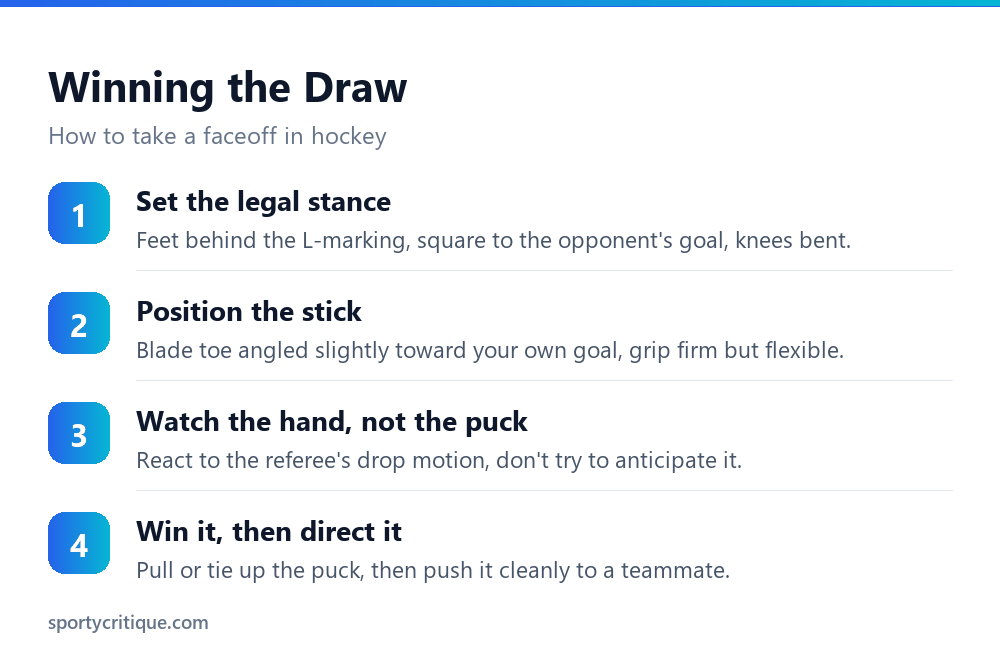
To take a faceoff in hockey, set a balanced, square stance with feet shoulder-width apart and knees bent behind the faceoff circle’s L-shaped markings, position the stick blade with the toe angled slightly toward your own goal, and react to the referee’s hand dropping the puck rather than trying to anticipate the exact moment. Win the draw by pulling the puck backward toward a teammate or tying up the opponent’s stick, and vary technique between draws since a predictable approach is easier for an opponent to counter.
Faceoffs get treated as a minor formality by a lot of players, something that just happens before real hockey starts, when they’re actually a real, coachable skill that decides puck possession dozens of times a game. A center who wins draws consistently hands their team an extra possession advantage that compounds over the course of a full game, even without scoring a single goal directly off it.
- →Stance must be balanced and square, feet behind the L-shaped markings, knees bent for explosiveness
- →Stick blade toe angles slightly toward your own goal to help direct a won puck backward
- →React to the referee’s hand dropping the puck; anticipating it blindly risks a violation
- →Varying technique between draws can meaningfully improve win rate versus relying on one consistent approach
- →No teammate may enter the faceoff circle within 15 feet before the puck is dropped (encroachment)
Table of Contents
Stance and Stick Position
A balanced, powerful stance starts with feet roughly shoulder-width apart and knees bent, weight distributed evenly and leaning slightly forward, ready to explode into the draw the instant the puck drops. A low center of gravity provides both balance and leverage against an opposing center doing the exact same thing at the same moment.
The stick blade’s toe should angle slightly inward, toward the player’s own goal, which helps direct a won puck backward toward a teammate rather than losing control the moment contact is made. Grip should stay firm but not rigid, firm enough for control, loose enough to allow the quick wrist adjustments a real draw often requires mid-motion.
💡 Pro tip: Elite centers adjust grip specifically for the draw they’re anticipating: a standard forehand grip for a stronger, more direct pull, or a reversed bottom hand or choked-up grip for a quicker, snappier reaction. Having more than one grip option ready, rather than using the identical setup for every single draw, is part of what separates a well-rounded faceoff specialist from a one-trick center.
Timing: React to the Drop, Don’t Anticipate It
Watching the referee’s actual hand motion and reacting to the drop, rather than trying to guess the exact instant it happens, is the real skill behind faceoff timing. Anticipating blindly, trying to move a fraction of a second before the puck actually leaves the referee’s hand, is a common tell that risks a faceoff violation and a re-drop, which hands the opponent’s center a second, cleaner opportunity.
Faceoffs are frequently described as won on timing rather than pure strength, since two centers with comparable physical strength will see the more precisely timed reaction win the draw consistently. This is a specific, trainable reaction skill, closer to a sprinter’s start reaction than a raw strength contest.
The Rules That Actually Decide Who Wins
⚠️ Watch out: A center who doesn’t know the stick-down-first rule for a given zone can lose a draw before the puck even drops, since referees strictly enforce proper setup order and will re-set or penalize a player who places their stick incorrectly relative to their opponent.
📊 Note: Encroachment is a teammate violation, not something the center taking the draw controls directly, but it’s worth knowing since a winger creeping into the circle too early can cost a team a faceoff advantage the center did everything right to earn. Communicating positioning expectations with teammates before puck drop helps avoid this avoidable, team-level mistake.
Actually Winning the Puck
Once the puck drops, a center generally either pulls it cleanly backward toward a teammate or ties up the opponent’s stick to prevent them from gaining clean possession, buying time for a winger or defenseman to step in and collect a loose puck. Both are legitimate winning outcomes; a tie-up that denies the opponent possession is just as valuable as a clean pull when it results in the same team retaining the puck.
Pushing the puck directly backward, rather than to the side, gives a supporting teammate the cleanest, most predictable path to collect it. A draw won technically but sent to an unexpected spot on the ice still risks losing the resulting race for possession, which is part of why coordinating with teammates on where the puck should go matters as much as winning the physical contest at the dot itself.
Common Faceoff Mistakes
- ✓Keep a balanced, square stance with knees bent, ready to explode
- ✓React to the referee’s actual hand motion, not a guessed timing
- ✓Learn both stick-down-first rules for defensive/neutral and attacking zones
- ✓Vary grip and technique between draws rather than repeating one approach
- ✕Anticipating the drop blindly and risking a violation
- ✕Using the identical grip and approach on every single draw
- ✕Ignoring zone-specific stick-down rules and losing position before the drop
- ✕Directing a won puck to the side instead of cleanly backward to a teammate
Does Stick Choice Matter for Faceoffs?
Stick flex and blade curve affect faceoff feel the same way they affect shooting and passing, though most centers use their standard everyday stick for draws rather than a specialized faceoff-specific stick the way some players use a dedicated break or jump cue in billiards. A stick like the CCM Ribcor Trigger 8 Composite Grip Stick (Senior, 75 Flex) (price not returned by the Amazon API at time of writing; confirm on the listing) with a moderate flex gives enough stiffness for a strong pull without sacrificing the quick wrist response a snappier draw technique needs.
Blade curve matters more subtly: a curve that suits a center’s shooting and passing style generally works fine for faceoffs too, and switching sticks specifically for draws isn’t a common or necessary practice at most levels of play. The technique and timing described above matter far more than any specific equipment choice, and no stick model compensates for poor positioning or mistimed reactions at the dot.
It’s a Team Play, Not Just a Center’s Job
Wingers and defensemen have specific responsibilities on a faceoff beyond simply staying out of the circle to avoid encroachment. A winger positioned to immediately support a backward-won puck, or a defenseman ready to step up if the draw is lost and the opponent gains possession, turns the faceoff outcome into an immediate, coordinated team action rather than leaving the center to manage the loose puck alone.
Pre-draw communication, a quick call or hand signal indicating which side the center plans to direct a won puck, lets supporting teammates position themselves before the drop rather than reacting purely after the fact. This coordination matters most in the defensive zone, where a lost faceoff with no support positioned correctly can turn directly into a dangerous scoring chance against.
Reading and Adjusting to a Specific Opponent
A center who pays attention to an opposing center’s tendencies over the course of a game, a consistent grip style, a preferred pull direction, a tell in their pre-draw setup, gains real information to adjust against for subsequent draws. This kind of in-game scouting compounds over a season against repeat opponents in the same division or conference, where the same centers face off against each other multiple times.
Coaches at higher levels sometimes prepare specific faceoff scouting reports on upcoming opponents’ centers, tracking tendencies from video review the same way they’d scout a shootout or penalty-kill tendency. At a recreational or youth level, the same principle applies at a smaller scale: paying attention within a single game to what’s working and what isn’t against a specific opponent is a real, usable skill worth developing early.
Practicing Faceoff Technique
Repetition against a variety of practice partners, not just one familiar teammate, builds genuine adaptability, since a single practice partner’s specific tendencies become quickly memorized in a way that doesn’t transfer to an unfamiliar opponent in an actual game. Rotating practice partners regularly, when a team’s structure allows it, closes this gap.
Off-ice reaction drills, responding to a dropped object or a sudden auditory cue with a quick hand movement, build the pure reaction speed a legal faceoff stance depends on without adding the complexity of full stick-on-stick contact and puck control at the same time. This kind of isolated reaction training is a common addition to a dedicated faceoff specialist’s broader practice routine, and it transfers surprisingly well to the ice once the reaction pattern becomes automatic.
Frequently Asked Questions
Why do I keep losing faceoffs even though I’m strong?
Strength matters less than timing and technique variation. Reacting to the referee’s actual drop rather than anticipating it, and mixing up grip and approach between draws, generally improves win rate more than added upper-body strength alone.
What happens if I move my stick before the puck drops?
It’s a faceoff violation. A first instance typically draws a warning, and repeated violations can result in ejection from that specific draw, handing the opponent’s center an uncontested faceoff.
Does the stick-down-first rule really matter that much?
Yes. Referees enforce it strictly, and not knowing which player’s stick goes down first in a given zone can cost a center position and setup time before the draw even starts.
Should I use the same faceoff technique every time?
No. Varying grip and approach between draws makes a center less predictable and harder for an opponent to specifically counter, which several sources cite as meaningfully improving overall faceoff win percentage.
What should wingers and defensemen do during a faceoff?
Position to immediately support wherever the center plans to direct a won puck, and stay ready to step up if the draw is lost instead. Communicating that plan before the drop, not just reacting after, keeps the whole unit coordinated rather than leaving the center to manage the outcome alone.
How important are faceoffs really, compared to other hockey skills?
They’re more impactful than casual players often assume, since winning draws consistently hands a team extra puck possessions across a full game, which compounds over a season even without directly leading to a goal on any single draw.
None of this requires exceptional talent to start improving. Legal, balanced positioning and honest timing practice alone close most of the gap for a center just beginning to take faceoffs seriously as a specific, trainable part of the game rather than an afterthought before the real play starts, and the gains show up in team possession numbers long before they show up in any personal highlight reel.
Small, consistent gains at the dot add up across a full season faster than most players expect.
As an Amazon Associate, we earn from qualifying purchases through links on this page.