How to Watch Equestrian Olympics Events Live


How to watch equestrian Olympics events comes down to one broadcaster in the United States: NBC, which has held the US broadcast rights to the Olympics for decades, with its streaming service Peacock carrying every event live and on demand, equestrian included. Outside the US, the broadcaster changes by country, and it’s worth checking your country’s official listing rather than assuming last cycle’s channel is still right. Exact channel assignments and schedules shift some between Games, so treat the specifics below as a reliable starting point for planning, not a fixed schedule to build your week around.
- →NBC holds US Olympic broadcast rights, with Peacock streaming every event live including equestrian
- →Equestrian spans multiple separate days across the Games, not one concentrated block
- →Outside the US, check your own country’s official broadcaster, since rights holders can change between Games
- →NBCOlympics.com and Olympics.com are the only sources reliably updated with the current schedule
- →Streaming platforms show full live coverage; broadcast TV more often shows condensed highlights
Table of Contents
Watching in the United States: NBC and Peacock
In the United States, NBC’s coverage spreads across more than just its main broadcast channel. Equestrian and other lower-profile sports typically show up on USA Network and E! at various points during a Games, alongside NBC’s own network coverage, since live Olympic programming runs far more hours per day than any single channel can carry. Peacock, NBC’s streaming service, is the most reliable way to actually catch equestrian specifically, since it streams every sport live in full rather than airing only the segments a broadcast producer picked for a general audience.
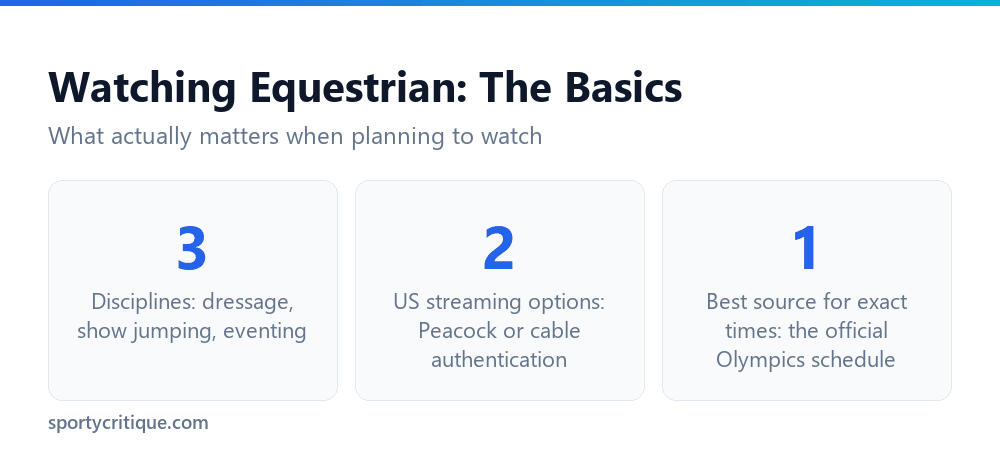
A Peacock subscription is required to stream, and pricing has generally sat in the range of a typical streaming service, though the exact cost changes over time and isn’t something worth quoting a fixed number for here. Cable or satellite subscribers can also usually authenticate through their provider to watch NBC’s Olympic content on NBCOlympics.com or the NBC app without paying for Peacock separately, which is worth checking if you already pay for a traditional TV package.
Streaming coverage has also generally included the ability to run multiple live streams at once and set notifications for specific sports or events, which matters more for a lower-profile sport like equestrian than for something already guaranteed prime-time placement. Setting an alert for equestrian specifically, rather than relying on browsing the home screen during the Games, is a small step that meaningfully reduces the odds of missing a live session you actually wanted to see.
Why equestrian’s schedule spreads across the Games
Equestrian competition at the Olympics is spread across the Games rather than compressed into one or two days, since dressage, show jumping, and eventing each run their own individual and team medal events on separate days. That means checking a single day’s schedule and assuming you’ve seen all the equestrian coverage for the Games is a common mistake. The actual dates and specific event times change every Games depending on the host city’s venue schedule, which is exactly why a page like this can describe the pattern but shouldn’t try to give you the actual dates for a specific upcoming Olympics.
The most reliable way to get the real schedule for whichever Games are coming up is the official source directly: NBCOlympics.com’s schedule page for US viewers, or Olympics.com more broadly, both of which publish sport-by-sport listings closer to the Games and update them as the event schedule firms up. Third-party schedule roundups, including articles like this one, are useful for understanding how to watch in general, but they go stale fast once actual dates and times are set, so verify against the official source before planning your day around it.
Watching outside the United States
Outside the United States, there’s no single answer, since Olympic broadcast rights are sold separately by country and the winning broadcaster can change between Games cycles. Most countries do have a designated national Olympic broadcaster, sometimes a public broadcaster, sometimes a private network that’s paid for exclusive or near-exclusive rights, and that broadcaster’s own website or app is generally the most current source for local schedules and streaming access.
Olympics.com maintains its own country-by-country broadcaster directory ahead of each Games, which is a reasonable first stop if you’re not sure who holds the rights in your country for a specific upcoming Olympics. It’s worth checking fresh each cycle rather than assuming continuity, since rights deals really do change hands between one Games and the next in some markets.
Getting the most out of full-event streaming
If you specifically want to follow equestrian and not just catch it when a broadcast happens to cut to it, streaming through Peacock or your country’s equivalent full-event streaming option is a meaningfully better experience than traditional broadcast TV. Marquee sports like swimming and gymnastics tend to dominate prime-time broadcast slots, which pushes equestrian to less convenient windows or cuts it down to highlight packages on the main channel. A streaming platform that carries every event live sidesteps that entirely, letting you watch a full dressage test or jumping round rather than a ninety-second highlight clip.
It’s also worth setting a reminder or notification through whichever platform you’re using, since equestrian’s exact air times can land at unusual hours depending on time zone differences between your location and the host city. Live cross-country in eventing, in particular, tends to run for an extended block during the day and is worth watching live rather than as a recap, since the tension of watching the clock and the course in real time is a real part of what makes that phase compelling.
What each discipline actually looks like on screen
Dressage looks the least eventful of the three disciplines to a first-time viewer, since a test is a single horse and rider performing a sequence of precise movements in a rectangular arena with no obstacles involved. It rewards patience from a viewer the way figure skating does: the appeal is in the precision and the horse’s apparent effortlessness, not in obvious drama, and commentary that explains what a judge is actually scoring in real time makes it far more watchable for a newer audience than watching it cold.
Show jumping is the most immediately readable discipline for a new viewer, since the goal, clear every fence within the time allowed, is obvious even without knowing the sport’s finer rules. A knocked rail is visually unambiguous, and the jump-off format used to break ties, a shortened, faster course run by the tied riders, tends to be legitimately tense television even for viewers who don’t normally follow the sport.
Eventing spans the widest range of the three, moving from dressage’s quiet precision to cross-country’s outdoor, high-speed jumping over solid natural obstacles, then back to a more conventional show jumping round on the final day. Cross-country in particular tends to draw viewers who don’t otherwise watch equestrian sport, since it plays more like an endurance and risk-management event than a judged performance, with real visible consequences when something goes wrong.
Following along if you’re new to the sport
You don’t need to understand full scoring rules to follow along, but a little context helps. In dressage, watch for smoothness and consistency rather than any single flashy movement, since that’s closer to what’s actually being scored. In show jumping and the jumping phases of eventing, the running total of knocked rails and time is usually shown on screen during a broadcast, which is the simplest way to track who’s actually in contention as rounds happen. Commentary teams on full live coverage typically explain fault totals as they happen, which is one more reason full-event streaming tends to be a better experience for a newer viewer than a condensed highlight package with less explanation.
- ✓Confirm your streaming access (Peacock login or cable authentication) before the Games start
- ✓Check the official schedule a few days out, not weeks in advance
- ✓Set a reminder for cross-country specifically if you only watch one eventing phase live
- ✓Use commentary-included coverage if you’re new to the sport
- ✕Assume last Games’ channel lineup is still accurate
- ✕Rely on a single article’s schedule instead of the official source
- ✕Skip streaming assuming broadcast TV will cover equestrian in full
- ✕Wait until the day of to sort out subscription or login issues
📊 Note: Specific channels, streaming platforms, and air times change between Olympic cycles. Confirm against the official schedule close to the actual Games rather than relying on what was true last time. This applies just as much to which streaming app carries the coverage as it does to specific dates, since platforms themselves have changed between recent Games cycles.
Where to watch, at a glance
Frequently asked questions
Is equestrian shown live or only as highlights?
Both, depending on where you watch. Full streaming platforms like Peacock carry complete live coverage of every equestrian event, start to finish, with no editing for time. Traditional broadcast TV is more likely to show highlight packages or condensed segments, since it has to fit equestrian around marquee sports competing for the same broadcast hours.
Do I need a paid subscription to watch equestrian at the Olympics?
In the US, generally yes for full live streaming access through Peacock, unless you’re authenticating through an existing cable or satellite subscription. Some limited free coverage typically exists on broadcast TV as well, though it’s less likely to cover equestrian in full compared to marquee sports.
Which equestrian events are shown at the Olympics?
Dressage, show jumping, and eventing, each with individual and team medal competitions. All three disciplines are part of the official Olympic program, though how much of each gets prominent broadcast placement versus streaming-only coverage varies.
How do I find the exact date and time equestrian airs?
Check NBCOlympics.com’s schedule page if you’re in the US, or Olympics.com generally, closer to the actual Games. Exact dates and times aren’t fixed far in advance and depend on the host city’s venue schedule, so a specific time quoted from a previous Games or an older article won’t be accurate for the next one.
Can I watch Olympic equestrian for free anywhere?
It depends heavily on your country’s broadcast rights arrangement. Some public broadcasters offer free streaming or broadcast access; others require a paid subscription. There’s no single universal answer, which is exactly why checking your specific country’s official broadcaster is more reliable than looking for a general workaround.
What should a first-time viewer watch for to actually understand what’s happening?
In dressage, watch for smoothness and how relaxed the horse looks rather than any single dramatic movement. In show jumping, the running fault total shown on screen tells you who’s actually in contention far more clearly than the jumps themselves. In cross-country, the biggest thing to track is whether a pair is on the optimum time as much as whether they’re clearing fences cleanly, since both affect the final result.