
Best Ping Pong Paddle for Beginners: What Actually Helps You Learn


Most “best paddle” lists for beginners are really lists for players who are already a year or two into the sport. The best ping pong paddle for beginners is the one that forgives a shaky stroke instead of punishing it. Here’s what actually helps someone who hasn’t built that stroke yet, and which real, currently available paddles fit that need.
🏓 Table Tennis Hub: Explore all 70 paddle reviews, table comparisons, and spin drills in our Complete Ping Pong Resource Hub.
For a genuine beginner, the best ping pong paddle isn’t the fastest or spinniest one on the shelf, it’s a pre-assembled set with moderate speed and control-leaning rubber, something like the JOOLA Family Premium set or the STIGA Performance set, both around $26. Skip anything marketed on raw speed numbers until you can consistently return a rally, since control is what beginners actually run out of first.
Most of what gets marketed to new players is built for someone two years past where they actually are. Paddles boasting carbon plies, tournament rubbers, and speed ratings in the 90s are aimed at intermediate and advanced players who already have a stroke and are trying to add power to it. A true beginner doesn’t have that stroke yet, and a paddle that punishes small technique errors with wild, unpredictable bounces just makes learning slower and more frustrating.
This guide sticks to a narrower, more honest question than most “best paddle” roundups: what actually helps someone who has never played regularly get through the first few months without quitting out of frustration. That means forgiving rubber, sensible weight, and a price low enough that outgrowing it in six months doesn’t sting.
- →Beginners lose more points to inconsistency than to lack of power; control-first rubber beats speed-rated rubber every time at this stage
- →A pre-made set (paddle already assembled with rubber attached) is the right call, not a custom blade-plus-rubber build
- →$20-35 covers a genuinely usable beginner set; spending $75+ before you have a stroke doesn’t buy you anything you can use yet
- →Multi-paddle sets (2 or 4 players) are usually the better value if you’re playing with family or friends learning together
- →A paddle bought now should last through roughly the first year of casual-to-regular play, not forever
Table of Contents
What actually matters for a beginner paddle
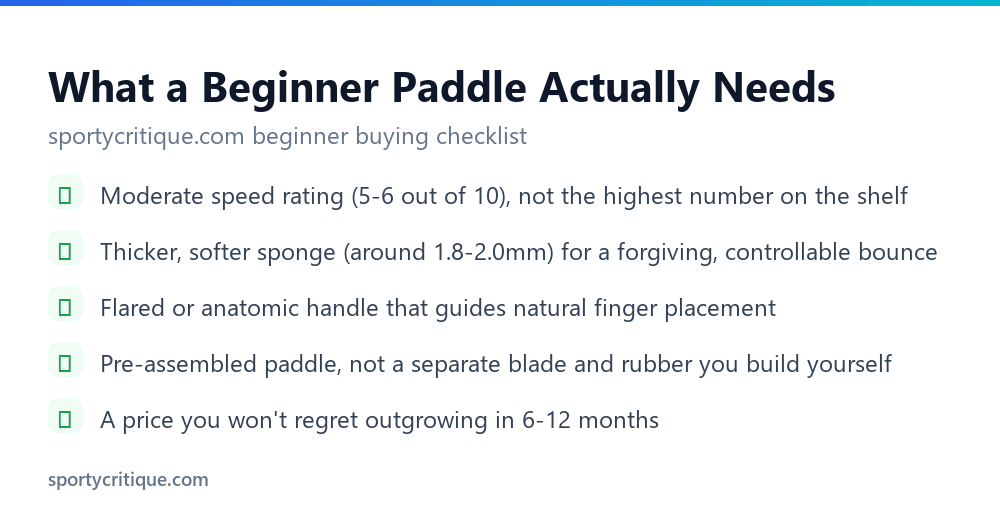
Three things determine whether a paddle helps or hurts a new player: the rubber’s speed and spin rating, the sponge thickness underneath it, and the blade’s own stiffness. Manufacturers rate rubber on rough 1-10 scales for speed, spin, and control. Beginner-appropriate rubber sits in the middle of the speed scale and the lower half of the spin scale, prioritizing a wide, forgiving sweet spot over raw output.
Sponge thickness compounds this. A thick, soft sponge (in the 1.8-2.0mm range that most beginner sets use) absorbs pace and gives a slower, more controllable response off contact. Thinner, harder sponges under tournament-grade rubber snap the ball back faster than a new player’s timing can handle, which is part of why an expensive paddle in inexperienced hands often plays worse than a cheap one, not better.
⚠️ Watch out: Don’t buy based on the speed number alone. A rubber rated 8 or 9 out of 10 for speed will send mishits flying off the end of the table just as fast as clean hits, and a beginner mishits often. A rating in the 5-6 range keeps those same errors playable.
Our picks for beginners
The JOOLA Family Premium Ping Pong Paddles Set of 4 with 10 Training Balls and Case is a reasonable anchor for a household or classroom just starting out. It ships as a set of four paddles plus ten training balls and a case, which matters more than it sounds: buying four matched paddles at once means everyone in a family or friend group has the same forgiving rubber, rather than one good paddle and three mismatched hand-me-downs. The rubber leans toward control rather than raw speed, which is the right lean for players who haven’t built a consistent stroke yet.
The STIGA Performance 4-Player Ping Pong Paddle Set covers similar ground from a brand with a long training-equipment track record. It’s a 4-player set with a 5-ply wood blade and a flared handle, which suits a beginner’s grip better than a straight handle since the flare naturally guides finger placement. STIGA markets this specifically as a skill-development set rather than a competition racket, and the rubber matches that framing: moderate speed, enough spin to feel real, and a wide margin for error.
If two paddles is all you need and budget is the main constraint, the Franklin Sports 2 Player Table Tennis Paddle and Ball Set is a legitimate entry point at roughly a quarter of the price of the sets above. It won’t hold up to daily serious play and the rubber is basic, but for someone testing whether they even like the sport before spending real money, it removes the cost barrier entirely.
The PRO-SPIN Ping Pong Paddles High-Performance 2-Player Set with Case (stock on this one runs low at times, so check the current listing before counting on it) sits in the same price range as the JOOLA and STIGA sets but is built as a 2-player rather than 4-player kit, which makes sense if you’re specifically shopping for a single practice partner setup rather than a family game night.
Pre-made set vs. building your own
Once you search for paddles online, you’ll run into the idea of buying a blade (the wood handle-and-paddle base) and rubber sheets separately, then gluing them together yourself. That’s how serious and competitive players build their equipment, matching specific blade stiffness to specific rubber characteristics. It is not the right starting point for a beginner.
- ✓Buy a pre-assembled paddle where the rubber is already mounted and ready to play
- ✓Choose a set that includes balls and a case if you’re starting from zero equipment
- ✓Pick a 4-player set if more than one person in the house will be learning
- ✓Replace the paddle once you notice you’re deliberately trying to add spin, not before
- ✕Buy a separate blade and rubber sheets before you know what playstyle you even have
- ✕Assume the most expensive beginner-marketed paddle is automatically the best one
- ✕Judge a paddle purely by its listed speed and spin numbers without checking the sponge thickness
- ✕Keep switching paddles every few weeks; consistency with one paddle builds feel faster than paddle-hopping
How to actually use the first few weeks with a new paddle
The single biggest mistake new players make isn’t paddle choice, it’s trying to hit hard before they can hit consistently. Spend the first sessions just getting the ball back across the net with a soft, controlled stroke, ideally in a sustained rally rather than one hard shot per point. A forgiving beginner paddle rewards this approach; a fast, spinny paddle actively fights against it because small stroke errors get amplified into big, unpredictable bounces.
💡 Pro tip: Practice against a wall if you don’t have a consistent partner yet. A smooth wall and a beginner-rated paddle let you rally hundreds of touches in ten minutes, which builds hand-eye timing far faster than sporadic games against a friend who’s also learning.
When to upgrade
The honest signal that you’ve outgrown a beginner paddle isn’t a calendar date, it’s a specific feeling: you start noticing the paddle’s rubber can’t keep up with spin you’re now capable of generating, or you’re deliberately trying to loop the ball and the thick, soft sponge is absorbing the spin you’re putting into it rather than transmitting it. That usually takes a few months of regular play to reach, not a few sessions.
📊 Note: If you’re already asking whether you should upgrade after a week, the answer is almost certainly no. That question tends to come from paddle-shopping curiosity, not from actually hitting a real performance ceiling.
A word on grip style
Nearly every beginner-oriented set sold in the US uses a shakehand grip, the style where you hold the handle the way you’d shake someone’s hand, rather than the penhold grip common in parts of Asia. Shakehand is the easier grip to learn from a written guide or video since it more closely resembles grips used in racket sports many US players already know, like tennis or badminton. Unless you have a specific reason to learn penhold, the shakehand paddles covered here are the right default.
Common myths that slow beginners down
Setting a realistic budget

Caring for a beginner paddle
Rubber degrades from dust and skin oils faster than most new players expect, even sitting unused in a bag. Wipe the rubber down with a damp cloth after each session and let it air dry before storing the paddle face-to-face with another paddle or in a case, since dust buildup is what actually kills grip and spin over time, not the number of hours played.
Avoid leaving any paddle in a hot car. Heat softens the glue bonding rubber to blade, and repeated heat cycles are one of the more common causes of a beginner paddle’s rubber lifting at the edges within the first year.
What to check before you even hit a ball
When a new paddle arrives, press a thumbnail gently into the rubber on both sides. It should give slightly and spring back, not feel rock-hard or leave a lasting dent. A rubber sheet that’s already hardened in shipping or storage plays noticeably slower and grippier than it should, and it’s worth a return or exchange rather than trying to break it in through play, since table tennis rubber doesn’t improve with age the way some sporting goods do.
Check that both sides of the paddle use the same color convention, typically red on one face and black on the other. That’s not cosmetic. ITTF rules require different colors so an opponent can see which side of the paddle struck the ball, since spin characteristics can differ between the two faces even on a beginner set. It won’t matter for casual games with friends, but it’s a good habit to build early if there’s any chance you’ll eventually play in an organized setting.
Playing with someone at a different skill level
A common beginner scenario is one person picking up the sport while a friend or family member already plays regularly. In that case, both players are usually better served by matched beginner paddles rather than giving the newer player a beginner paddle while the more experienced player keeps a faster, spin-heavy racket. The skill gap already does enough to make rallies short; adding an equipment gap on top of it usually just means the newer player never gets to see the ball long enough to learn anything from the point.
If the more experienced player insists on using their own equipment, the fix isn’t a paddle change, it’s a rules change: slow the pace down deliberately, keep shots to the middle of the table, and treat early sessions as cooperative rallying practice rather than a competitive match. That approach gets a true beginner to a usable stroke faster than any paddle upgrade would.
Bottom line
For a genuine beginner, the right paddle is boring on purpose: pre-assembled, moderate speed, forgiving sponge, and priced so outgrowing it in a year doesn’t matter. The JOOLA and STIGA sets above both fit that description at a fair price, the Franklin set works as a near-free way to test interest, and none of them will hold you back until you’re well past the beginner stage and already know exactly what you’d upgrade to.
What speed rating should a beginner paddle have?
Look for rubber rated around 5-6 out of 10 for speed. Anything higher tends to send mishits, which beginners make often, flying off the table rather than staying in play.
Should a beginner buy a paddle with rubber already attached?
Yes. Building a custom paddle from a separate blade and rubber sheets is a decision for players who already know their own playstyle. A pre-assembled beginner set removes that guesswork entirely.
How long should a beginner paddle last before upgrading?
Most players get 6-12 months of real use out of a beginner set before the rubber starts limiting the spin they’re now capable of generating. There’s no fixed calendar rule, it’s about noticing the equipment holding your technique back, not the other way around.
Is a 4-player set better value than a 2-player set?
Only if more than one person is actually going to use it regularly. Per-paddle cost is usually lower in a 4-player set, but a 2-player set of similar rubber quality isn’t a worse product, it’s just sized for a smaller group.
As an Amazon Associate, we earn from qualifying purchases through links on this page.


