
Best Ping Pong Paddle for the Money: What Each Price Tier Buys


The best ping pong paddle for the money isn’t the cheapest paddle that works, it’s the one sitting right before the price-to-performance curve flattens out. Here’s what four real, currently available paddles actually buy at four different price points.
The best ping pong paddle for the money isn’t the cheapest one, it’s the one where the next price step up stops buying you anything you’d actually notice. For most intermediate players who already have a stroke, that point sits around $40-50, where a paddle like the JOOLA Infinity Balance adds real carbon-assisted speed and control over entry-level rubber without paying tournament-tier prices for marginal gains.
“Best for the money” gets thrown around loosely in gear reviews, usually meaning “cheapest thing that technically works.” That’s not the same question as performance-per-dollar. A $12 paddle and a $45 paddle aren’t competing for the same buyer; the real value question is what each additional dollar actually buys as you move up through the price tiers, and where that value curve flattens out for a given skill level.
This guide compares four real, currently available paddles spanning roughly $37 to $60, with a specific eye on what changes materially at each step rather than just listing options in ascending price order.
- →Value peaks around $40-50 for most intermediate players; below that you’re sacrificing control, above it you’re often paying for marginal refinements
- →A paddle labeled ‘beginning level’ by its own manufacturer, like an entry Butterfly racket, can still be a smart value pick if you’re early in your development
- →Carbon-layer blades (added stiffness from a thin carbon fiber layer inside the wood) show up around the $45-55 range and meaningfully increase speed transfer
- →Past roughly $60 in a pre-assembled paddle, you’re approaching the point where building a custom blade-and-rubber combo starts making more sense than buying another factory paddle
- →Match the tier to your actual skill level; an advanced-rated paddle in a developing player’s hands often plays worse, not better
Table of Contents
Why price and performance don’t scale in a straight line
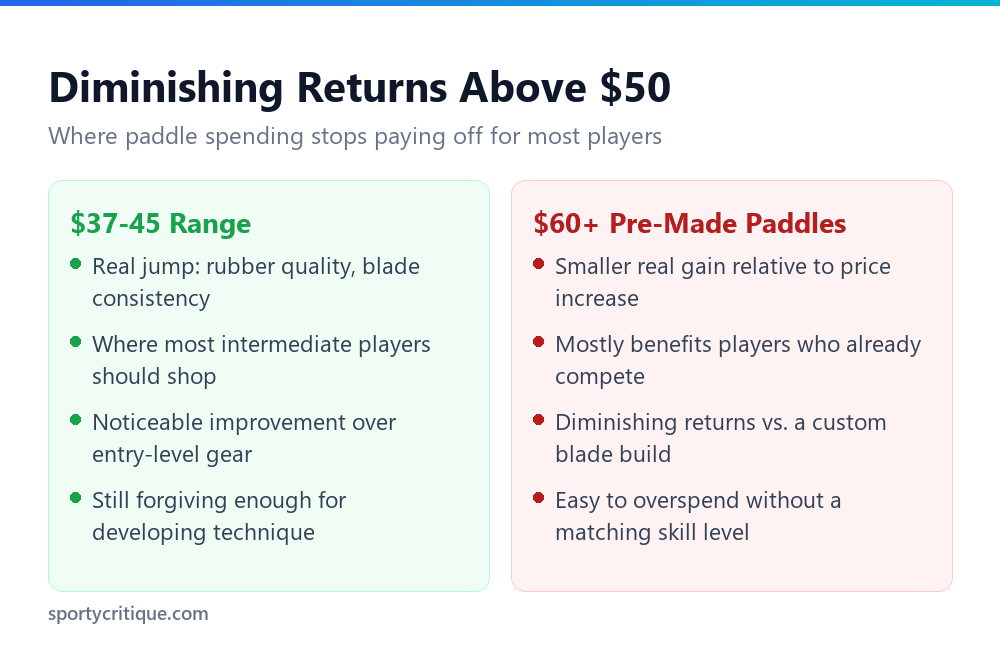
Rubber compound quality, sponge consistency, and blade-ply construction all improve with price, but not evenly. The jump from a $12 recreational paddle to a $35-40 paddle is enormous in real terms, moving from hard, low-grip rubber and a soft, unstable blade to genuine ITTF-approved rubber on a properly pressed multi-ply blade. The jump from $45 to $150, by contrast, is mostly refinement: slightly better rubber topsheet consistency, marginally lighter carbon layers, cosmetic differences. Both jumps cost money; only one of them changes how the paddle plays in a way a mid-level player will actually feel.
Tier 1: entry-branded, around $37
The Butterfly Timo Boll Shakehand Ping Pong Paddle, ITTF Approved is Butterfly’s own beginning-level shakehand racket, and it’s worth taking seriously specifically because it comes from a company whose flagship blades are used by professional players. You’re not getting professional-grade rubber at this price, but you are getting a properly pressed blade and ITTF-approved rubber from a manufacturer with a real quality-control track record, which is a genuine step up from generic off-brand paddles at a similar price.
This tier suits a player who has moved past absolute beginner status, has a real stroke, and wants a name-brand paddle without paying for speed or spin they can’t yet use consistently. It’s a sensible value pick precisely because it doesn’t try to do more than its price should.
Tier 2: carbon-assisted mid-range, around $45
The JOOLA Infinity Balance Advanced Performance Ping Pong Paddle is where the value curve is steepest for an intermediate player. JOOLA markets it as designed to optimize spin and control for high-level training, and the rubber and blade combination genuinely delivers more responsive spin generation than the entry tier without requiring an advanced player’s timing to control it. For someone who already rallies consistently and is working on adding spin to their shots, this is usually the single best-value step up available.
This is also the price point where you start seeing paddles marketed with phrases like “competition ready” and “high-level training,” and here that language is reasonably earned rather than pure marketing inflation. It won’t outperform a true tournament blade-and-rubber build, but it closes most of the practical gap for club-level and serious recreational play.
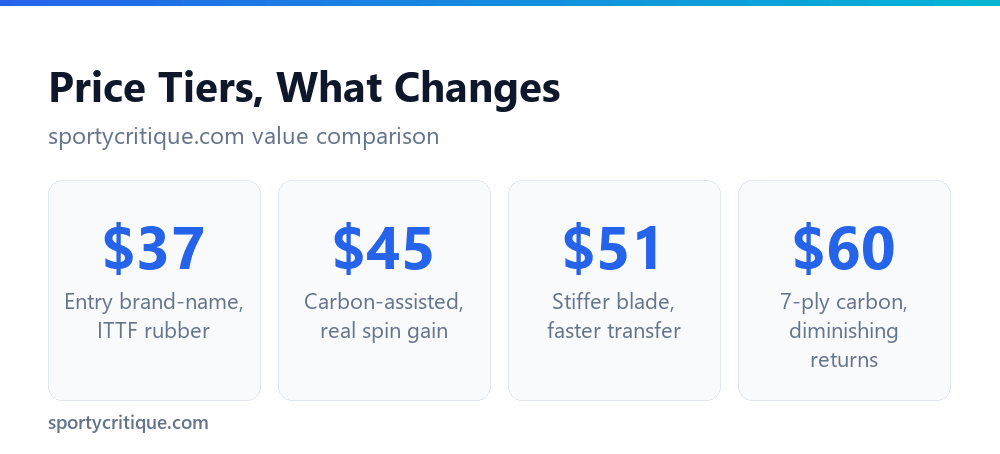
Tier 3: stiffer blade, around $51
The STIGA Alpha Ping Pong Paddle moves into noticeably stiffer blade construction, which increases how much energy transfers from your stroke into the ball. That translates to more available speed on the same swing, which is useful once your technique is consistent enough to control the extra pace rather than just send more mishits off the table. STIGA’s build quality at this tier is consistent enough that the price increase over Tier 2 buys a real, if incremental, performance gain rather than just brand markup.
⚠️ Watch out: A stiffer, faster blade only helps once your stroke is consistent. If you’re still working on control rather than power, Tier 2 delivers more usable performance per dollar than this tier does, even though it costs less.
Tier 4: 7-ply carbon, around $60
The PRO-SPIN ITTF Approved Carbon Fiber Table Tennis Racket, 7-Ply Blade represents close to the practical ceiling for a pre-assembled, off-the-shelf paddle before you’re better off building a custom blade-and-rubber combination instead. Its 7-ply construction with a carbon fiber layer and 2.0mm sponge delivers real speed and spin ceiling, ITTF-approved and legal for sanctioned play. The honest caveat: most players who aren’t already competing at a club or tournament level won’t extract the full value of this tier, and the jump from Tier 3 is smaller in practice than the price difference suggests.
- ✓Match the tier to where your technique actually is, not where you want it to be
- ✓Treat Tier 2 (around $45) as the default value pick for most intermediate players
- ✓Reserve Tier 4 for players who already compete or train seriously and know they’ll use the ceiling
- ✓Re-evaluate your tier every year or two as your skill actually changes, not on a fixed schedule
- ✕Buy the most expensive paddle assuming it will make you play like the player who uses it professionally
- ✕Assume the cheapest paddle in a lineup is always the worst value; sometimes it’s exactly matched to a real need
- ✕Judge value purely on listed speed/spin numbers without checking sponge thickness and blade ply count
- ✕Skip straight to a $150+ blade-and-rubber build before you’ve used a mid-tier factory paddle long enough to know what you’re missing
Where the value curve actually flattens
Based on the four tiers above, the steepest genuine improvement per dollar sits between Tier 1 and Tier 2, roughly $37 to $45. The improvement from Tier 2 to Tier 3 is real but smaller, and the improvement from Tier 3 to Tier 4 is smaller still relative to the price gap. That’s the practical shape of “best for the money”: not a single product, but a point on a curve where most players should stop climbing unless they have a specific reason tied to actual competitive play.
What you’re actually paying for as price climbs
Notice how little the sponge thickness actually moves across three of the four tiers. That’s a useful tell: a lot of what you’re paying for above the entry tier isn’t a dramatically different sponge, it’s better rubber topsheet consistency, a stiffer or more carefully pressed blade, and in the top tier, an added carbon layer that stiffens the whole blade rather than just the surface. None of that is fake value, but it’s also not the kind of night-and-day jump the price difference alone might suggest.
How to sanity-check a paddle’s real value in person
Specs on a listing page only tell part of the story. If you can try a paddle before buying, at a club, a friend’s set, or a sporting goods store display, do two quick checks. First, tap the rubber lightly with your fingernail and listen: a crisp, higher-pitched sound generally indicates a stiffer, faster setup, while a duller thud suggests a softer, more control-oriented build. Second, hold the paddle by the handle and give it a gentle shake; noticeable flex in the blade itself, not just the handle, is normal in cheaper 5-ply wood and less common in stiffer carbon-layer builds.
Neither check replaces actually hitting with the paddle, but both are useful when you’re standing in front of several similarly priced options and need a quick way to tell them apart before committing to an online order.
A note on sets versus single paddles
Every product compared above is a single paddle, not a multi-paddle set. That’s deliberate: value comparisons across price tiers only make sense when you’re comparing like for like, one paddle’s rubber and blade quality against another’s. Multi-paddle family sets solve a different problem, outfitting more than one player at once, and they belong in a separate comparison rather than mixed into a single-paddle price ladder.
Does grip style change the value math?
Not meaningfully. All four paddles above use a shakehand grip, and shakehand-versus-penhold is a personal preference question, not a value question. If you specifically play penhold, expect a narrower selection at each price tier since fewer manufacturers stock penhold versions of their higher-end lines, but the tier logic covered here still applies once you find a comparable penhold option.
💡 Pro tip: If you’re unsure which tier fits you, buy one step below what you think you need rather than one step above. A paddle that’s slightly under your current level is still usable and rarely holds you back for long; a paddle that’s ahead of your level actively makes learning harder in the meantime.
Bottom line
For most players with a real stroke who aren’t yet competing seriously, the JOOLA Infinity Balance around $45 is the strongest value pick of the four, delivering the steepest real performance jump over entry-level gear. The Butterfly entry paddle is the smarter buy if you’re not there yet, and the STIGA and PRO-SPIN options above it are worth the extra money only once you have a specific, current reason to use what they add.
What’s the actual best price range for value in a ping pong paddle?
Roughly $40-50 for most intermediate players. That’s where carbon-assisted blades and real ITTF-approved rubber start appearing without tournament-tier pricing.
Is a more expensive paddle always better value?
No. Value is performance gained per dollar spent, and that gain shrinks noticeably above roughly $50-60 for players who aren’t already competing at a club or tournament level.
Should I buy an entry-level branded paddle or a generic mid-range one?
A name-brand entry paddle from a manufacturer with a real professional line, like Butterfly or JOOLA, usually beats a generic paddle at the same price on rubber and blade consistency, even though both are labeled ‘beginner’ or ‘entry.’
When does it make more sense to build a custom paddle instead of buying pre-made?
Once you’re regularly shopping above roughly $60-75 for a pre-assembled paddle, you’re usually better off pricing a separate blade and rubber sheets, since that route gives more control over the exact specs for the same or less money at that performance level.
As an Amazon Associate, we earn from qualifying purchases through links on this page.


