
The Best Ping Pong Paddle for Speed Trades Control for Pace


Searching for the best ping pong paddle for speed usually turns up a list of paddles called “fast” without much explanation of what that word is doing. A fast paddle wins the point before your opponent has time to react, and it costs you touch to get there. Here’s what a manufacturer’s speed rating is actually built from, and three paddles that earn that rating for real, checked against live Amazon listings rather than an old spec sheet.
The three speed-rated paddles worth buying right now are the Killerspin Jet 800 Speed N2 ($99.99, confirmed in stock), the Killerspin Diamond TC, and the STIGA Titan. All three post a speed number near the top of their brand’s own rating scale. None of them are a good first paddle if you’re still building consistent contact, since a fast blade amplifies timing mistakes instead of hiding them.
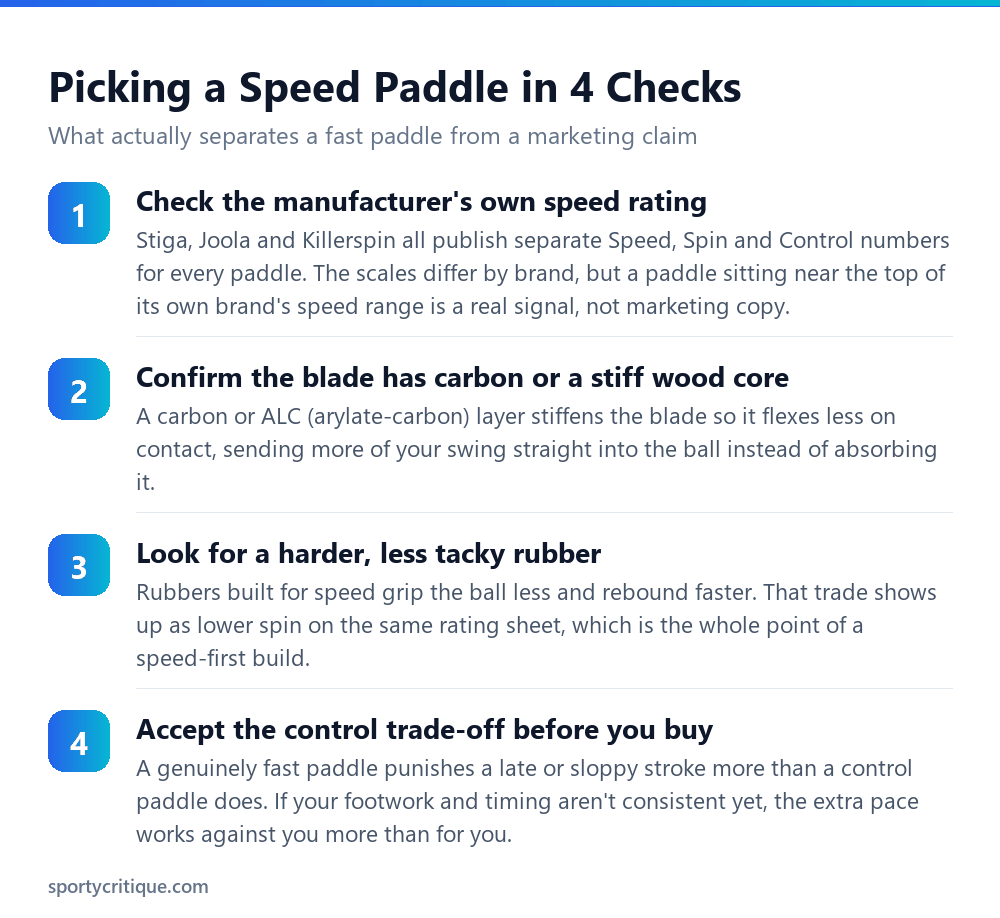
Every table tennis brand of any size, Stiga, Joola, Killerspin, DHS, rates its paddles on three separate numbers: Speed, Spin, and Control. The scales aren’t standardized across brands (Stiga and Joola tend to use a 0-100 range, Killerspin uses roughly 0-10.9), but within one brand’s lineup, the numbers are comparable and genuinely mean something. A paddle rated near the top of its own brand’s speed scale is built with a stiffer blade, often carbon-reinforced, paired with a harder, less tacky rubber. Both choices send more energy into the ball and less into spin or forgiveness.
That last part matters more than most buying guides admit. Speed and control sit on opposite ends of the same paddle. A blade stiff enough to return your swing energy at full strength also returns your mistakes at full strength. If you’re an attacking or counter-hitting player who already has a repeatable stroke, that trade is worth making. If you’re still working out your timing, a high-speed paddle will make your bad shots worse before it makes your good shots better.
- →Speed, Spin, and Control are separate manufacturer-rated numbers, not marketing adjectives
- →The rating scale differs by brand, so compare within a brand’s own lineup, not across brands
- →A stiffer, often carbon-reinforced blade is what actually produces a higher speed rating
- →Harder, less tacky rubber trades spin for faster rebound, which is why fast paddles often show lower spin numbers
- →A high-speed paddle punishes inconsistent technique more than a control paddle does
Table of Contents
What a speed rating is actually measuring
When a manufacturer lists a paddle’s speed number, it’s describing how much of your stroke’s energy the blade and rubber return to the ball on contact, not how fast you personally can swing. A soft, flexible blade absorbs part of that energy as it bends, which is exactly what a control paddle is built to do. A stiff blade barely flexes, so almost all of the swing’s force transfers straight through. Layer a harder rubber on top of that stiff blade, and the ball comes off faster still, because the rubber isn’t gripping and slowing it down the way a tacky spin rubber would.
Why attacking players want this and beginners usually don’t
An attacking or counter-hitting style is built around ending the point early: a hard drive, a flat smash, a fast block that catches an opponent off guard. A high-speed paddle supports that game because it needs less swing effort to produce a ball that’s already difficult to react to. The same paddle is a liability for a player who hasn’t grooved consistent contact yet, since the same stiffness that rewards a clean stroke punishes a late or mistimed one just as sharply.
⚠️ Watch out: A fast paddle does not fix inconsistent footwork or a late backswing. If your shots are landing short or long more often than you’d like on a control-rated paddle, switching to a speed paddle usually makes that problem worse, not better, because there’s less margin for a mistimed hit.
Our speed-rated picks, checked against live listings
We pulled current pricing and stock status directly from Amazon for each paddle below rather than reusing old numbers. One of the three came back out of stock and one returned without confirmed pricing, both of which we’re noting rather than papering over.
Killerspin Jet 800 Speed N2
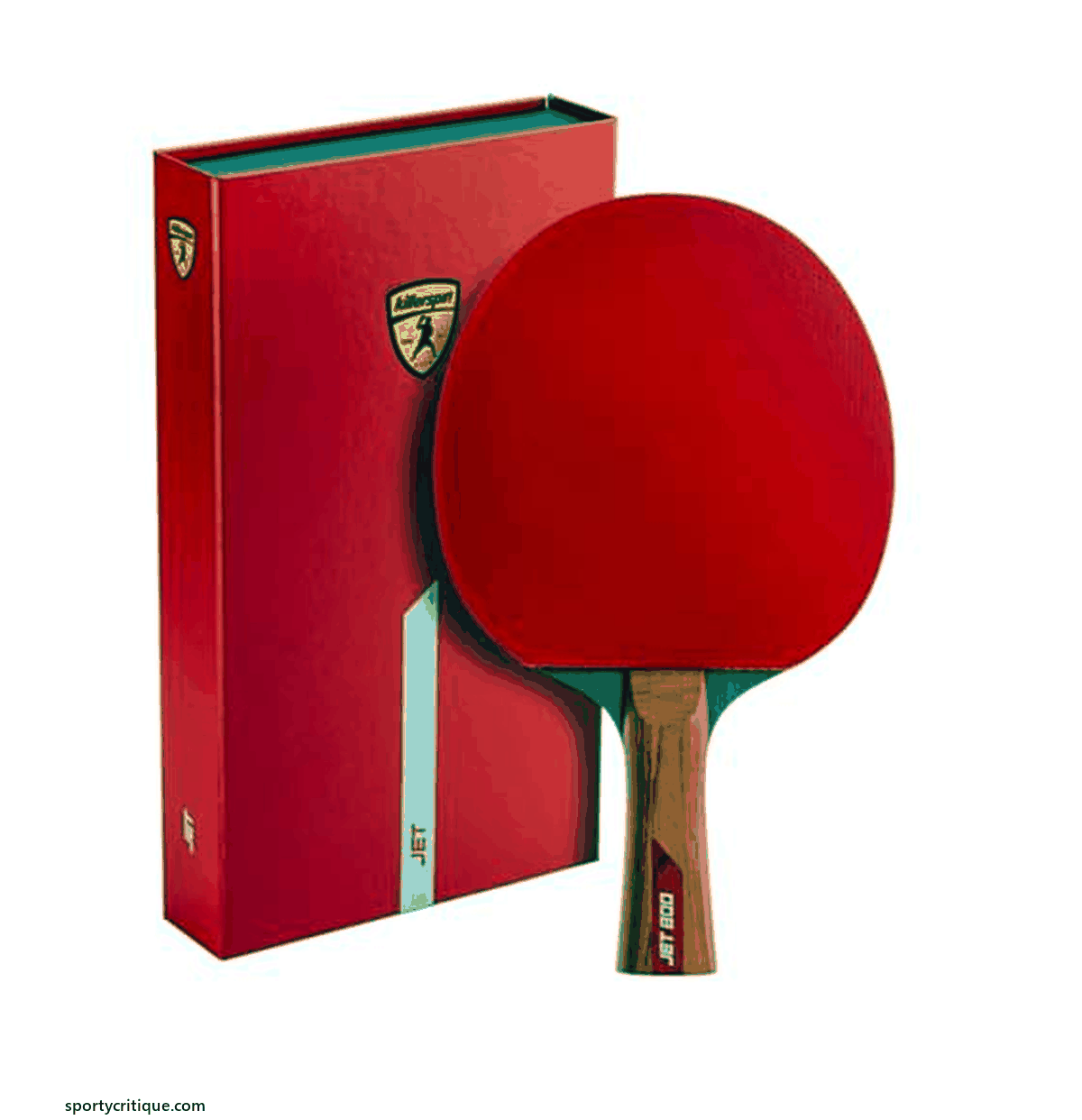
The Killerspin Jet 800 Speed N2 is built around a 7-ply composite wood blade with Killerspin’s Nitrx-4Z rubber, and the brand’s own listed numbers put it at roughly 9 out of 10.9 for both speed and spin, with control trailing at around 7.5. That’s an unusually even speed-and-spin combination for a paddle marketed on speed alone, which is part of why it holds up for counter-hitters who still want to loop occasionally. Live pricing checked at $99.99 with a status of “In Stock.”
The flared handle has a reinforced grip built into it, which matters more on a fast paddle than a control one: a hand that shifts even slightly mid-rally changes the angle a stiff blade presents to the ball far more than it would on a softer, more forgiving setup.
Killerspin Diamond TC
The Killerspin Diamond TC pairs 5 wood plies with 2 titanium-carbon plies, and Killerspin lists it at the very top of its speed scale, around 10 out of 10.9, with control down near 7.9. Titanium-carbon construction is stiffer than the standard carbon used in most mid-range paddles, which is why the speed number sits above the Jet 800 despite a similar overall build philosophy. We could not confirm live pricing or stock for this ASIN at the time of writing, so check the listing directly before ordering.
STIGA Titan
The STIGA Titan runs a 5-ply ultra-light blade with a 2mm sponge, and Stiga’s own performance chart rates its speed at 80 on their 0-100 scale, a solid step up from their control-oriented models without reaching the 95-plus territory of their tournament carbon blades. That said, this ASIN showed as “Currently unavailable.” when we checked, so treat it as a spec reference for what a mid-tier Stiga speed build looks like rather than a guaranteed buy today.
Reading the trade-off table
Speed paddle versus a spin-and-speed build
A pure speed build like the three above still keeps spin secondary. If you want a paddle where spin and speed are both pushed high at once, typically at real cost to control, that’s a different category, and we cover it separately.
Do you actually need a speed-first paddle?
- ✓You already have a repeatable, grooved stroke on both forehand and backhand
- ✓You play a counter-hitting or attacking style and want to end points early
- ✓You’re comfortable adjusting your grip pressure shot to shot
- ✓You’ve outgrown a control or all-round paddle and find yourself wanting more pace
- ✕You’re still working on consistent contact and placement
- ✕Your shots frequently land short or long on your current paddle
- ✕You rely heavily on spin to set up points rather than flat pace
- ✕You’re buying your first real paddle and don’t yet know your style
💡 Pro tip: If you’re unsure whether you’re ready for a speed-first paddle, borrow one for a session before buying. The difference in how much the ball “gets away from you” on a mistimed shot is far more noticeable in hand than any spec sheet number will tell you.
Shakehand versus penhold: does grip style change the pick
Most of the speed-rated paddles sold in the US, including all three above, ship in a shakehand handle by default, and shakehand is the more common grip among American and European players who grew up playing table tennis casually before picking up a rated paddle. Penhold players, more common in East Asian competitive circuits, generally want the same blade stiffness and rubber hardness for a speed build, just mounted on a shorter, rounder handle. If a specific paddle you’re considering only lists a shakehand (FL) option, check the manufacturer’s site directly; several brands sell a penhold (CS) version of the same blade separately rather than bundling it with the paddle listing on Amazon.
Handle shape affects how a speed paddle feels more than most buyers expect going in. A flared handle, the shape on both Killerspin paddles above, widens toward the base and locks the hand in place during a hard swing, which matters more on a stiff, fast blade than on a softer control build where grip slippage is less punishing. A straight handle gives more freedom to shift grip pressure mid-rally, which some attacking players prefer specifically because it lets them loosen up for a fast block and tighten again for a smash without changing paddles.
Grip and stance adjustments a fast paddle rewards
A stiffer, faster paddle responds more to small grip changes than a control paddle does. Loosening your grip slightly on contact absorbs some of that extra rebound and helps keep flat drives from sailing long, while tightening it briefly on a smash lets the blade’s stiffness work for you instead of against you. Standing a half-step closer to the table than you would with a control paddle also helps, since a fast blade rewards taking the ball earlier, on the rise, rather than waiting for it to drop.
📊 Note: None of the paddles above were physically tested for this guide. The speed and control figures cited are each manufacturer’s own published performance ratings, and pricing and stock status were pulled from live Amazon listings at the time of writing rather than assumed.
Maintenance that actually affects speed
A speed-rated rubber loses its edge faster than most players expect. Dust and skin oil fill in the surface texture that lets the rubber grip and rebound the ball cleanly, and a dirty sheet measurably slows a fast paddle down within a few weeks of regular play. Wiping the rubber with a damp microfiber cloth after each session, and letting it fully air dry before storing the paddle in a case, keeps a speed build performing closer to its rated number for longer. Cheap sponge-and-cleaner kits work fine here; the type of cleaner matters far less than doing it consistently.
When a speed paddle stops being worth it
Rubber on a heavily used speed paddle typically needs replacing well before the blade does, usually somewhere between six months and a year of regular play, depending on how often you clean it and how hard you hit. A speed rubber past its prime doesn’t just get slower, it gets inconsistent, sending some balls long and others short off what feels like the same stroke. If you notice that happening, replacing just the rubber sheets is almost always cheaper than replacing the whole paddle, and it’s the more common fix among players who’ve already found a blade they like.
What actually makes a ping pong paddle fast?
A stiffer blade, often with a carbon or titanium-carbon layer, combined with a harder, less tacky rubber. The blade returns more of your swing’s energy instead of absorbing it, and the rubber grips the ball less, so it rebounds faster instead of gripping for spin.
Is a high speed rating good for a beginner?
Usually not. A fast paddle punishes inconsistent timing more than a control-oriented paddle does, since there’s less blade flex to absorb a slightly late or early hit. Most beginners get better results from a mid-range or control-leaning paddle while they build consistent contact.
Can the same paddle be fast and spin-heavy at once?
To a degree. The Killerspin Jet 800 Speed N2, for instance, is rated close to even on speed and spin by the manufacturer’s own numbers. A true spin-and-speed build that pushes both higher, at real cost to control, is its own separate category of paddle.
Are speed ratings comparable across different brands?
Not directly. Stiga and Joola generally rate paddles on a 0-100 scale, while Killerspin uses roughly 0-10.9. Compare speed numbers within one brand’s own lineup, not across brands, since the scales aren’t standardized industry-wide.
As an Amazon Associate, we earn from qualifying purchases through links on this page.


