Best Lacrosse Gloves (For Every Position and Budget)


The best lacrosse gloves depend on your position and level, but STX Stallion 75 is the strongest all-around pick for most players — genuinely protective at a beginner-friendly price, with a 4.7-star rating built on real fit reviews. Players wanting elite-level feel and durability should look at STX RZR 2, while goalies need a dedicated glove like STX Cell VI Goalie Gloves built for blocking impact rather than stick control.
Table of Contents
What actually separates a good pair from a bad one

Palm flexibility — a glove too stiff in the palm genuinely costs you stick feel and control, while one too soft leaves knuckles exposed to real impact; the best gloves strike a balance rather than maximizing padding at any cost.
Cuff length — longer cuffs protect the wrist and lower forearm more thoroughly, but can restrict wrist motion for players who rely on quick stick movement; shorter cuffs trade some protection for mobility.
Ventilation — mesh panels across the back of the hand matter considerably more than most first-time buyers expect once a full season of practices and games is factored in, since a glove that traps heat and moisture breaks down faster and becomes genuinely unpleasant to wear.
Break-in time — premium leather-palmed gloves need real break-in time before they feel natural, while synthetic-palm gloves are generally ready to perform well right out of the box, a real consideration if a season starts soon.
Position-specific needs — goalies need dedicated gloves built around blocking and catching shots safely, genuinely different in construction from field-player gloves optimized for stick handling and passing.
Palm flexibility is the single biggest factor in how a glove actually performs on the field — a glove with more total padding isn’t automatically the better choice if that padding comes at the cost of genuine stick feel and control.
Our picks
As an Amazon Associate, we earn from qualifying purchases through links on this page.
STX Stallion 75 is the pick most beginner and youth players should start with — it’s specifically built and marketed for players new to the position, and its 4.7-star rating with 231 reviews and a “Top Reviewed for Fit” badge suggests it genuinely delivers on comfort and sizing, which matters more for a first pair than chasing top-tier padding specs.
STX RZR 2 sits at the premium end of the lineup, built for players who already know their preferences and are looking for maximum durability and performance rather than a budget-friendly starter option.
STX Cell VI lands in between — a genuinely solid mid-range option for a club or travel-team player who’s outgrown beginner gear but isn’t ready to spend elite-tier money yet.
For goalies specifically, field-player gloves aren’t the right tool — STX Cell VI Goalie Gloves is built around absorbing shot impact safely rather than optimizing stick feel, which is exactly the tradeoff a goalie actually needs.
Choosing the right pair
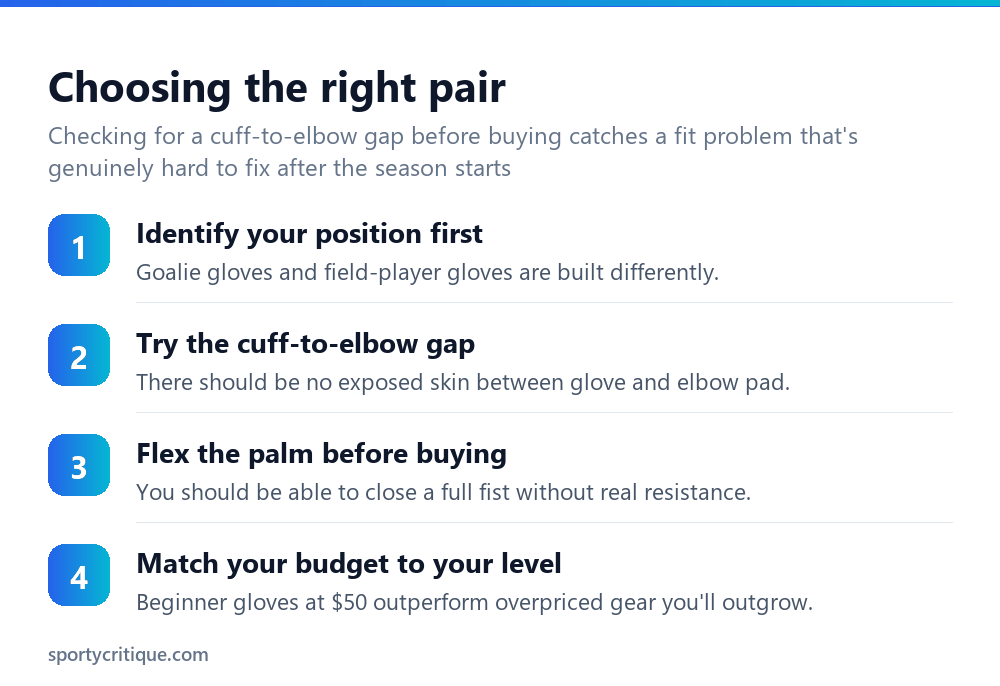
Identify your position first — goalie gloves and field-player gloves are built around genuinely different priorities, and buying the wrong category means real compromise regardless of brand or price.
Check the cuff-to-elbow gap — there should be no exposed skin between where the glove’s cuff ends and where an elbow pad begins; a gap here is a common, avoidable injury risk that’s easy to check for before buying.
Flex the palm before buying — you should be able to close a full fist around a stick without real resistance from the glove itself; if a display model or a friend’s pair is available to test, do it before committing to a purchase.
Match your budget to your actual level — a beginner or recreational player genuinely doesn’t need elite-tier gloves, and youth players in particular will outgrow gear before it wears out, making a mid-tier or beginner option the more sensible spend.
A worked example: outfitting a first-year travel player
Say a player who’s been in a youth recreational league for a season is moving up to a competitive travel team, where the pace and physicality are genuinely a step up from what their current beginner gloves were built to handle.
Rather than immediately buying the most expensive pair available, the sensible upgrade path is a mid-tier glove like STX Cell VI — genuinely more protective and durable than an entry-level pair, without the premium price tag of top-of-the-line gloves that a still-developing player may not yet need the full performance ceiling of.
Before buying, they’d try the glove on with the same stick they actually use in games, checking that a full fist closes around the grip without real resistance — a glove that fits well in isolation can still feel wrong once an actual stick is in hand, which is why testing with real equipment matters more than trusting size charts alone.
They’d also factor in growth room specifically for a still-growing player — sizing up slightly is a reasonable tradeoff at this age, since a season or two of growth can otherwise mean replacing gloves again sooner than the gear itself would have actually worn out.
Leather vs. synthetic palms
Leather palms generally offer superior initial grip and a more natural feel once broken in, but require genuine break-in time and can lose some performance if they get wet and dry out stiff, which matters for anyone playing in variable weather conditions.
Synthetic palms are ready to perform well essentially immediately, hold up better against moisture, and are generally easier to clean, though some players feel they never quite match a well broken-in leather palm’s actual grip feel. For a player short on practice time before a season starts, synthetic is genuinely the more practical choice; for a player with time to properly break in a leather pair well before it matters, the tradeoff can be worth it in the long run for the grip feel it eventually provides once the break-in period is genuinely finished and the leather has properly softened up over time.
Sizing lacrosse gloves correctly
Lacrosse gloves are sized in inches, typically ranging from around 10 inches for younger youth players up to 13 inches for adults, and sizing runs by wrist-to-fingertip measurement rather than a simple small/medium/large scale. A glove that’s too large genuinely reduces stick control since the fingers don’t reach the stick’s grip surface precisely, while one too small restricts the fist-closing motion checked above — when between two sizes, most players and coaches recommend sizing up slightly rather than down, since a slightly loose glove is a smaller performance cost than one that’s genuinely too tight.
A quick way to judge break-in progress on a new leather pair: if a full fist closure around a stick grip still feels genuinely stiff after a few practices, the gloves likely need more wear time before game use, rather than assuming the sizing itself was wrong.
Caring for lacrosse gloves between games
Letting gloves fully air-dry between uses, rather than stuffing a still-damp pair directly into a closed bag, is the single biggest factor in how long they actually last — trapped moisture breaks down both the padding and any leather components considerably faster than normal wear alone would. For a genuinely deeper clean, most manufacturers specifically advise against machine washing, since it can damage padding and seams; a damp cloth wipe-down and full air-dry is the safer routine most seasons.
- ✓Identify your position before choosing between goalie and field-player gloves
- ✓Check for a cuff-to-elbow gap before buying to avoid an exposed-skin injury risk
- ✓Flex the palm and test a full fist closure before committing to a pair
- ✓Size up slightly if between two sizes rather than sizing down
- ✓Let gloves fully air-dry between uses to extend their real lifespan
- ✕Buying field-player gloves for a goalie or vice versa
- ✕Ignoring a visible gap between glove cuff and elbow pad
- ✕Choosing a glove based on padding alone without checking palm flexibility
- ✕Sizing down when between two sizes, restricting stick-hand motion
- ✕Storing gloves damp in a closed bag, accelerating padding breakdown
Frequently asked questions
What are the best lacrosse gloves for beginners?
STX Stallion 75 is specifically built for beginner and youth players, with a strong reputation for fit at a genuinely affordable price.
Do goalies need different gloves than field players?
Yes. Goalie gloves are built around absorbing shot impact safely, while field-player gloves prioritize stick feel and control — the two aren’t interchangeable.
How should lacrosse gloves fit?
You should be able to close a full fist without real resistance, and there should be no exposed skin between the glove’s cuff and an elbow pad.
What size lacrosse gloves should I buy?
Gloves are sized in inches by wrist-to-fingertip measurement, roughly 10″ for younger youth players up to 13″ for adults. Size up slightly if between two sizes.
Can I machine wash lacrosse gloves?
Most manufacturers advise against it, since it can damage padding and seams. A damp cloth wipe-down and full air-dry between uses is the safer routine.
How much should I spend on lacrosse gloves?
Match spend to your actual level — beginners and youth players don’t need elite-tier gloves, especially since youth players will outgrow gear before it wears out.
- →Pair your gloves with the right head: best lacrosse heads for middies
- →Learn to hold your stick properly: how to hold a lacrosse stick
- →Keep your full kit clean: how to wash lacrosse gear