How to Hit a Badminton Backhand (Fix the Grip First)

A good badminton backhand starts with your grip, not your swing. Rotate your racket so your thumb presses flat on the back bevel of the handle. Turn your shoulder toward the shuttle early. Then snap your wrist, not your whole arm, to generate power. Most weak backhands come from one mistake: using the wrong grip and swinging with the arm instead.
Table of Contents
The 3 parts of a good backhand
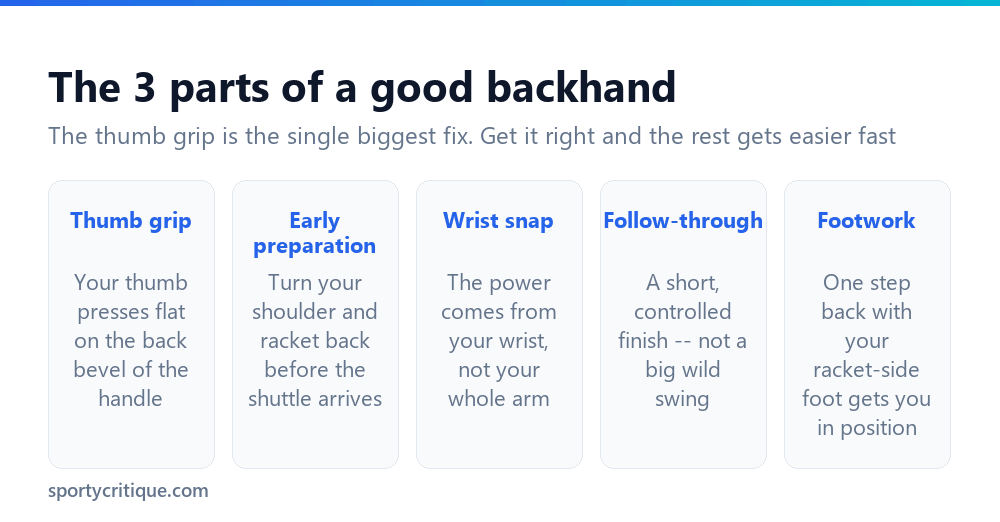
Thumb grip. Your thumb presses flat against the back bevel of the handle. This one change gives your wrist the leverage it needs. Without it, you’re swinging with your arm alone.
Early preparation. Turn your shoulder and pull your racket back before the shuttle arrives. Wait too long and you’ll rush the shot every time.
Wrist snap. The power comes from a short, sharp flick of the wrist. Not a big arm swing. A tight wrist snap generates more speed than most players expect.
Follow-through. Keep it short and controlled. A big wild swing throws off your balance and slows your recovery.
Footwork. One step back with your racket-side foot gets you into position. Skip this and you’ll always be reaching.
Most players hit a weak backhand for one reason: the wrong grip. Fix the grip first. Everything else gets easier after that.
Hitting the backhand, step by step
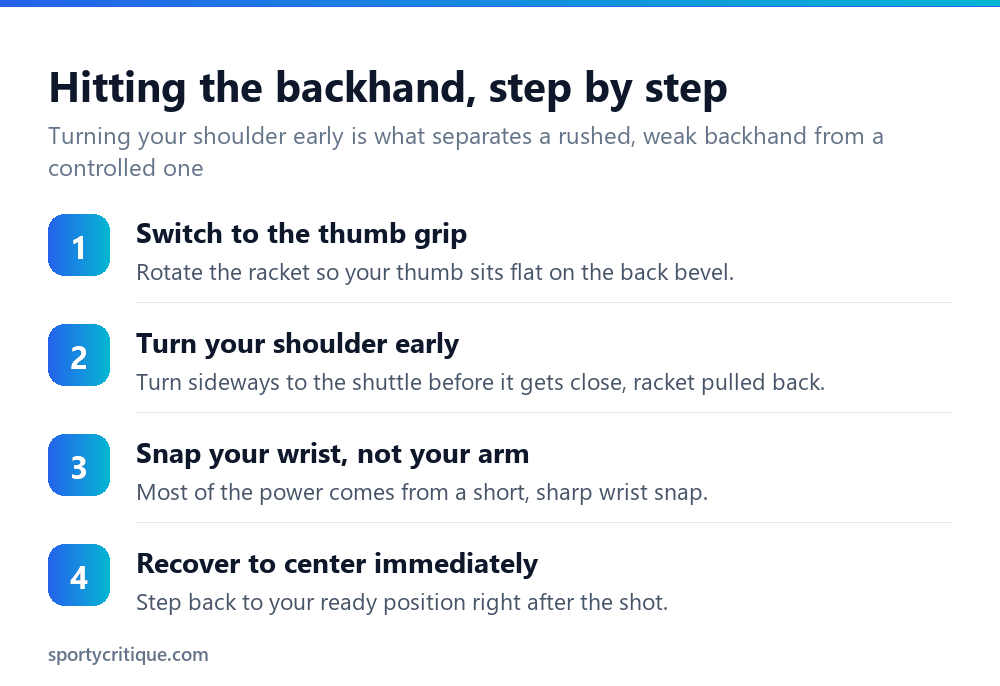
Switch to the thumb grip. Rotate the racket in your hand so your thumb sits flat on the back bevel, not wrapped around the handle like your forehand grip.
Turn your shoulder early. As soon as you see the shuttle coming to your backhand side, turn sideways and pull the racket back. Don’t wait.
Snap your wrist, not your arm. Most of the power in a good backhand comes from a short, sharp wrist snap right before contact.
Recover to center immediately. Step back to your ready position the instant you finish the shot. Standing still after a shot is how you get caught flat-footed on the next one.
Why the thumb grip matters so much
Your forehand grip has your palm wrapped around the handle. That grip has no power on the backhand side. The wrist just can’t snap properly.
The thumb grip changes that. Your thumb becomes a lever against the back of the handle. That lever is where backhand power actually comes from. Try it without a shuttle first. Just rotate your grip and feel the difference in how your wrist moves.
A quick way to check your grip is correct
Here’s a fast test. Hold your racket in the thumb grip. Now try to snap your wrist without moving your forearm.
If your whole forearm moves along with the wrist, your grip is probably still too tight, or your thumb isn’t positioned correctly. A proper thumb grip lets your wrist move almost independently of your arm. That independence is exactly where backhand power comes from.
A grip that keeps slipping
If your racket twists in your hand mid-swing, an old or worn grip is often the real problem, not your technique. Yonex Overgrip ($10, 4.7 stars, 794 reviews) is a cheap fix. Wrap a fresh layer over your handle and the thumb grip becomes much easier to hold consistently, shot after shot.
As an Amazon Associate, we earn from qualifying purchases through links on this page.
A common timing mistake to watch for
Even with a good grip, timing can still throw off your backhand. Watch for one specific mistake: contacting the shuttle too late, when it’s already dropped below waist height.
A late contact point forces you to hit up and weak, no matter how good your technique is. Move earlier. Meet the shuttle higher, ideally around shoulder height, for a flatter, faster shot with real pace on it.
This one adjustment alone fixes a surprising number of weak backhands, even when the grip and swing are already correct. Try it in your very next practice session and pay close attention to exactly where you’re actually making contact with the shuttle each and every single time you swing through the shot.
Backhand clear vs. backhand drop
Once the basic swing feels natural, you’ll want two versions of it. A backhand clear sends the shuttle deep, high, to the back of the court. It needs a fuller wrist snap and more shoulder turn.
A backhand drop just clears the net and drops fast. It uses the same setup, but a much softer, shorter wrist action right at contact. Practice both from the same starting position. The setup looks identical until the very last moment, which is exactly what makes it hard for an opponent to read.
The most common backhand mistake beginners make
New players almost always make the same mistake. They try to muscle the backhand using arm strength, the same way they’d swing a tennis racket.
Badminton doesn’t work that way. The racket is light. The shuttle is light. You don’t need arm strength at all. You need wrist speed, and wrist speed only happens with a relaxed grip and a loose arm.
If your arm feels tired after backhand practice, that’s a real warning sign. A properly hit backhand should feel light, almost effortless, not like a workout for your arm.
Practicing without a partner
Don’t have someone to feed you shuttles? You can still build a solid backhand alone.
Start with shadow swings. No shuttle, no racket even, just your empty hand practicing the grip switch and wrist snap. Do this for 5 minutes a day. It builds the muscle memory faster than most people expect.
Next, add the racket. Toss a shuttle up yourself and hit it against a wall. A flat wall a few feet away works fine. This lets you practice the full motion, timing included, completely alone.
Once that feels natural, find any partner, even a beginner, just to feed you shots. You don’t need a coach for this drill. Consistent reps matter more than who’s feeding them.
How long the awkward phase actually lasts
Most players feel clumsy with a new grip for about two to three weeks. That’s normal. Don’t quit during this phase.
Your hand needs time to build new muscle memory. The old grip feels comfortable because you’ve used it for years. The new one will feel wrong at first, even when you’re doing it correctly.
A good sign you’re on the right track: your backhand power slowly starts to increase over those weeks, even while it still feels unfamiliar. Trust the process and keep the reps consistent.
Fixing a weak backhand
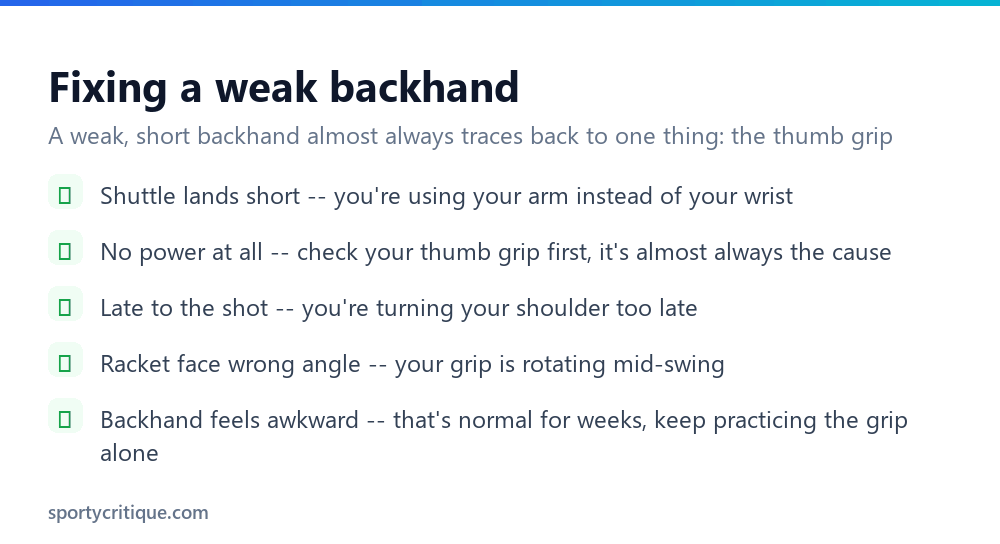
Shuttle lands short. You’re using your arm instead of your wrist. Go back to shadow-swinging the wrist snap alone.
No power at all. Check your thumb grip first. This is almost always the actual cause, even when it feels like a swing problem.
Late to the shot. You’re turning your shoulder too late. Watch the shuttle earlier and start your turn sooner.
Racket face at the wrong angle. Your grip is rotating mid-swing. A fresh overgrip often fixes this by giving your thumb something to hold onto.
It just feels awkward. That’s normal for the first few weeks. Keep practicing the grip alone, even without a shuttle, until it feels natural.
- ✓Switch to the thumb grip before anything else
- ✓Turn your shoulder as soon as you see the shuttle coming
- ✓Snap your wrist instead of swinging your whole arm
- ✓Recover to center immediately after every shot
- ✓Practice the grip alone before adding a shuttle
- ✕Using your forehand grip for backhand shots
- ✕Waiting until the last second to turn your shoulder
- ✕Swinging with your arm instead of snapping your wrist
- ✕Standing still after the shot instead of recovering
- ✕Skipping grip practice and going straight to full swings
Frequently asked questions
How do I hit a badminton backhand?
Switch to the thumb grip, turn your shoulder early, and snap your wrist for power instead of swinging your whole arm.
Why is my badminton backhand so weak?
It’s almost always the grip. Check that your thumb is pressed flat on the back bevel of the handle, not wrapped around it like a forehand grip.
What is the thumb grip in badminton?
A grip where your thumb presses flat against the back bevel of the handle, giving your wrist the leverage it needs for backhand power.
How long does it take to learn a backhand?
A few weeks of regular practice. Start with the grip alone before adding shots, since the grip is what most players get wrong first.
What’s the difference between a backhand clear and drop?
A clear sends the shuttle deep with a fuller wrist snap. A drop just clears the net with a softer, shorter wrist action from the same setup.
Should I use a different grip for backhand and forehand?
Yes. The thumb grip for backhand is different from your regular forehand grip, and switching between them quickly is a skill worth practicing on its own.
- →Build the legs that get you to every shot: badminton leg workout
- →Check your grip isn’t holding you back: common badminton grip mistakes
- →Pair it with solid footwork: badminton footwork basics