Best Badminton Shoes: 4 Verified Picks by Fit and Priority

Running shoes and court shoes are not interchangeable for badminton, and the difference isn’t marketing. Badminton demands sudden lateral stops and lunges that a straight-line running shoe’s sole and support simply aren’t built for.
Short answer: Lateral stability, a non-marking gum rubber sole, and a fit matched to your actual foot width matter more than brand name or price. Four currently-listed, verified models covering different segments: Yonex Power Cushion Eclipsion Z Mid (high-end stability), Yonex Power Cushion 39 Wide (wide-fit), Yonex Power Cushion Cascade Axle (all-around mid-tier), and Victor Professional SHA610G (rebound-focused). Verified as currently listed via a live Amazon product check on 10 September 2026; exact pricing wasn’t returned by that check and should be confirmed on the linked listing before buying.
⚠️ Watch out: This guide verifies that each recommended shoe is a real, currently active Amazon listing, checked directly via Amazon’s own product API rather than assumed from a third-party site. It does NOT state specific current prices, since the live check didn’t return pricing for these listings and this site doesn’t publish a number it can’t verify. Check the linked listing for current price before buying.
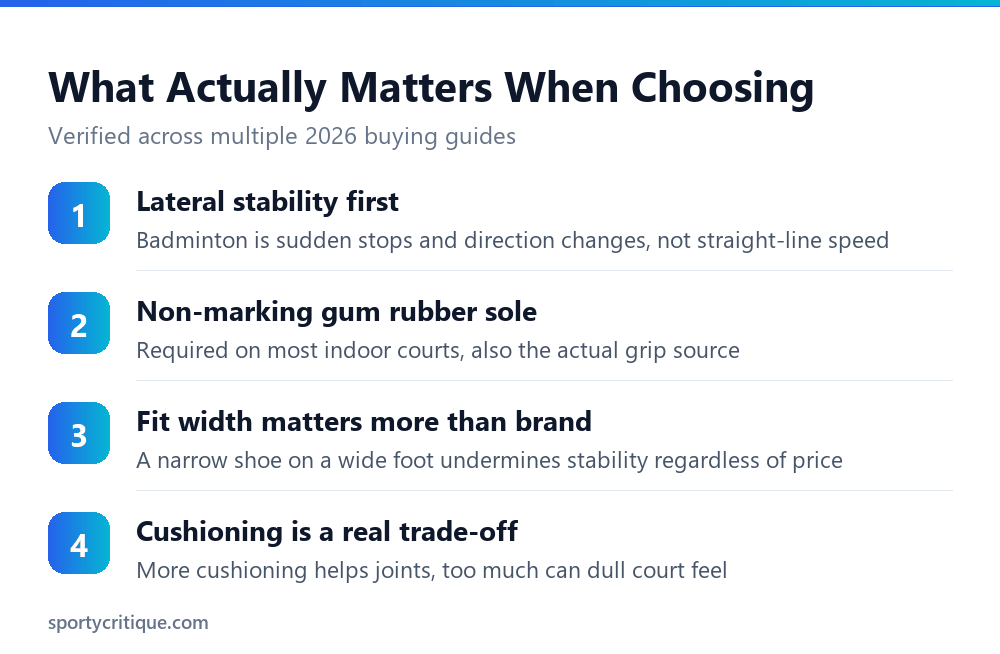
Table of Contents
Why Badminton Needs Its Own Shoe Category
Badminton footwork is built around explosive lateral lunges, sudden stops, and quick direction reversals covering a relatively small court area, closer in demand to tennis or squash than to running or general court sports. A shoe built for forward motion, like a running shoe, generally lacks the lateral support to prevent ankle roll during a hard sideways lunge, and its sole compound is usually optimized for road or treadmill grip rather than the specific traction an indoor badminton court surface needs. Dedicated badminton shoes address both: reinforced lateral support built into the upper and midsole, and a non-marking gum rubber outsole designed specifically for indoor court grip.
The Four Verified Options
Yonex Power Cushion Eclipsion Z Mid: The Stability Pick
This model sits at the higher end of Yonex’s badminton shoe lineup, built around Yonex’s Power Cushion shock-absorption technology, a cushioning system the brand markets specifically for reducing joint impact during repeated hard landings. For a player training or competing frequently enough that landing impact accumulates over a season, this kind of dedicated cushioning system is a genuine consideration, not just a marketing claim, repeated hard stops on a hard indoor court surface are a real cumulative stress on knees and ankles over time.
Check current price and availability (Yonex Power Cushion Eclipsion Z Mid, Amazon)Yonex Power Cushion 39 Wide: For Wider Feet Specifically
A dedicated wide-fit option matters more than it might seem, since a standard-width badminton shoe on a truly wide foot tends to undermine exactly the lateral stability the shoe category exists to provide, a foot that isn’t properly seated and secured in the shoe’s width can shift slightly during a hard lateral lunge regardless of how good the shoe’s underlying support technology is. Players who’ve found standard-width badminton shoes uncomfortable or unstable specifically at the midfoot are the clearest audience for a wide-specific model like this one rather than sizing up in a standard-width shoe, which changes length without actually solving a width problem.
Check current price and availability (Yonex Power Cushion 39 Wide, Amazon)Yonex Power Cushion Cascade Axle: The All-Around Pick
This model’s toe-assist shape design is aimed at a specific, common discomfort point, pressure concentrated on the big toe during hard forward lunges, redistributing that pressure while adding midfoot and heel support. For a recreational-to-club level player who wants one solid pair rather than segment-specific shoes for different needs, this kind of general-purpose comfort and support balance is usually the more practical starting point than either the highest-end stability model or a narrowly wide-fit-specific one.
Check current price and availability (Yonex Power Cushion Cascade Axle, Amazon)Victor Professional SHA610G: The Rebound-Focused Pick
Victor’s SHA610G uses the brand’s Energy Max material, described as a highly elastic compound aimed at increasing energy rebound during play, a different emphasis than pure shock absorption. For a player whose game relies more on quick repeated bursts than on absorbing hard landings, a rebound-oriented shoe like this one is a reasonable alternative philosophy to the cushioning-first approach Yonex’s Power Cushion line emphasizes, neither approach is objectively superior, they suit somewhat different playing styles and priorities.
Check current price and availability (Victor Professional SHA610G, Amazon)A Model That’s No Longer Available: What This Means
During research for this guide, the Victor SH-501D, a frequently recommended budget/beginner option in older articles and forum threads, was checked live and confirmed “Currently unavailable” on Amazon. It’s excluded from the recommendations above for that reason rather than silently dropped without explanation. This is a useful reminder that budget-tier recommendations in this category churn over time, the same pattern this site has documented directly in other sport-equipment categories, and any list, including this one, is worth re-checking periodically rather than trusted indefinitely.
Indoor Court Restrictions on Sole Color and Marking
Many indoor badminton facilities specifically require non-marking soles, and some go further and restrict certain sole colors that are known to leave visible scuff marks on specific court surfaces. All four models covered here use gum rubber or comparable non-marking compounds standard across dedicated badminton shoes, but it’s still worth checking a specific facility’s own posted footwear policy before a first visit, particularly for a shared or rented court where scuff marks are a genuine maintenance cost the facility cares about enforcing against.
Cushioning Philosophy: Yonex vs. Victor
The two brands represented in this guide take genuinely different approaches worth understanding before choosing between them on anything other than fit. Yonex’s Power Cushion line, used in three of the four models here, emphasizes shock absorption and impact reduction as its primary design goal, aimed at players prioritizing joint protection over a long season of frequent play. Victor’s Energy Max material, used in the SHA610G, instead emphasizes elastic rebound, returning more of the energy from each landing back into the next movement rather than primarily absorbing it. Neither philosophy is objectively correct, and the right choice depends on whether a player’s priority is reducing cumulative joint stress or maximizing quick-burst responsiveness.
Fit Testing Before You Commit
Since fit width is one of the two most important factors alongside lateral stability, and shoe sizing actually varies between brands and even between models from the same brand, buying badminton shoes without any in-person fit reference is a real risk worth managing deliberately. Checking a brand’s own sizing chart against a shoe already owned and comfortable, rather than assuming a standard shoe size translates directly, reduces the chance of needing an exchange. For an actually wide or narrow foot, prioritizing a brand and model explicitly marketed for that fit, like the wide-specific Yonex model above, over hoping a standard-width shoe happens to work, is the more reliable approach.
💡 Pro tip: If ordering online without a fitting option, check the retailer’s return policy specifically for worn shoes before buying, some athletic shoe retailers restrict returns once a shoe shows outdoor or court wear, which matters if the only way to actually test lateral stability is to wear them during play.
It’s also worth ordering with enough time before an important tournament or league match to actually break the shoes in during regular practice, rather than wearing a brand-new pair for the first time in a competitive setting where an unexpected fit issue has real consequences.
📊 Note: None of these four models have been tested by this site’s own reviewers. This guide verifies real, currently-listed products and reports the manufacturer’s own stated design priorities, not a hands-on comparison of how each actually feels on court. For that kind of experiential detail, independent owner reviews on the retailer’s own listing page remain the better source.
Socks and Insoles: The Overlooked Half of the Fit
A shoe’s own fit engineering only accounts for part of how secure and stable a foot actually feels during play, socks and insoles matter more than casual players tend to assume. A cushioned, moisture-wicking athletic sock reduces slippage inside the shoe during hard lateral movement, and an aftermarket insole can meaningfully improve arch support for a player whose foot shape doesn’t perfectly match a given shoe’s stock insole. Treating socks and insoles as an afterthought after spending real money on a dedicated badminton shoe is a common way to undercut exactly the stability that shoe was chosen for in the first place.
Replacing Badminton Shoes: How Often
Badminton’s lateral stress pattern wears down a shoe’s outsole and lateral support structure differently than straight-line running does, and a shoe that still looks fine from the top can have meaningfully degraded lateral support underneath. Players training or competing multiple times a week should watch specifically for the outsole’s grip pattern wearing smooth at the areas that take the most lateral load, and for any new looseness or reduced support felt specifically during hard lateral movements, rather than waiting for a visibly worn or torn upper before considering a replacement.
- ✓Prioritize lateral stability and fit width over brand name or price alone
- ✓Check a shoe’s current listing status and price directly before buying
- ✓Match wide or narrow feet to a model specifically designed for that fit
- ✓Watch for degraded lateral support even when the shoe looks fine from the top
- ✕Assume a running or general athletic shoe works fine for badminton’s specific demands
- ✕Trust an older recommendation list without checking current availability
- ✕Size up in a standard-width shoe to solve a width problem
- ✕Wait for visible upper damage before considering a lateral-support check
As an Amazon Associate, we earn from qualifying purchases through links on this page.
The Verdict
In short: lateral stability and a properly matched fit width matter more for badminton shoes than brand name or price tier alone. The four models covered here, verified as currently active Amazon listings, cover distinct real needs: stability-focused, wide-fit, all-around comfort, and rebound-focused play. Exact current pricing wasn’t available through this review’s live product check, so confirm it directly on the linked listing before buying, and treat any badminton shoe recommendation, this one included, as worth re-verifying periodically given how often specific models cycle in and out of availability.
Common Questions
Do you really need dedicated badminton shoes?
Yes, badminton’s lateral lunges and sudden stops demand support and a sole grip pattern that running or general athletic shoes typically aren’t built to provide.
What matters most when choosing badminton shoes?
Lateral stability and a properly matched fit width, ahead of brand name, cushioning level, or price.
What’s the best badminton shoe for wide feet?
The Yonex Power Cushion 39 Wide is built specifically for wider feet, confirmed as a currently active listing.
How often should badminton shoes be replaced?
Watch for outsole wear at high-load areas and any new looseness during lateral movement, rather than waiting for visible upper damage.
Is the Victor SH-501D still available to buy?
No, confirmed “Currently unavailable” via a live check on 10 September 2026, which is why it’s excluded from this guide’s recommendations.
The Short Version
- →Lateral stability and fit width matter more than brand or price for badminton shoes.
- →Non-marking gum rubber soles are built specifically for indoor court grip.
- →Four models were verified as currently active Amazon listings on 10 September 2026.
- →Exact current pricing wasn’t available through this check, confirm on the linked listing.
- →The Victor SH-501D is confirmed unavailable and excluded from recommendations.
- →Re-check any shoe recommendation periodically, since specific models cycle in and out of stock.