Best Badminton Racket for Power and Control: Balanced Picks


A badminton racket for power and control is a real, specific balance-point category, not just marketing language stuck on any racket listing. Here’s what actually makes a racket balanced between the two, and which pick fits players who rally across the whole court instead of favoring one style.

A genuinely balanced power-and-control racket is a real, specific weight distribution, roughly even or just slightly head-heavy, not the marketing label every racket listing slaps on itself. It gives up some of the raw smash power of a true head-heavy racket and some of the fast-reset maneuverability of a true head-light one, in exchange for not being bad at either. That tradeoff is the right call for players who rally across the whole court instead of committing to one style.
Almost every badminton racket on the market claims to offer “power and control” somewhere in its description, which makes the phrase close to meaningless as a filter. What actually separates a balanced racket from a power racket or a control racket is its balance point, where the racket’s weight sits along its length, and that’s a measurable spec, not a marketing claim. This guide is about rackets built around that literal middle ground, not just any racket with the word “control” in its title.
- →Balance point, not branding, is what actually determines a power-vs-control tradeoff
- →A true balanced racket sits near even, sometimes just slightly head-heavy
- →You give up some smash power and some net-speed compared to specialized rackets at either end
- →This is the right call for players who play across the whole court rather than one style
- →String tension and shaft flex adjust the feel further, but balance point is the foundation
Table of Contents
What balance point actually measures
Every badminton racket has a balance point, the spot where it sits level if you rest it on a single finger. Manufacturers describe rackets as head-heavy, even, or head-light depending on where that point falls relative to the racket’s midpoint. Head-heavy rackets carry more mass out toward the string bed, which adds momentum to a full swing and makes smashes hit harder. Head-light rackets shift mass back toward the handle, which makes the racket easier to whip through fast exchanges at the net but gives up some of that smash momentum.
A balanced racket sits close to the middle of that spectrum. It’s not simply “in between” as a vague description, it’s a specific, checkable weight distribution that shows up in the racket’s actual spec sheet, usually alongside its overall weight in grams and its shaft flex rating. When a listing gives you grams and flex without mentioning balance at all, that’s usually a sign the racket wasn’t specifically engineered around this middle ground.
Our pick for this angle

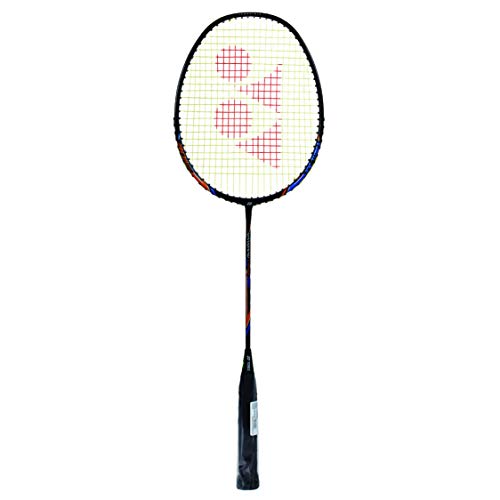
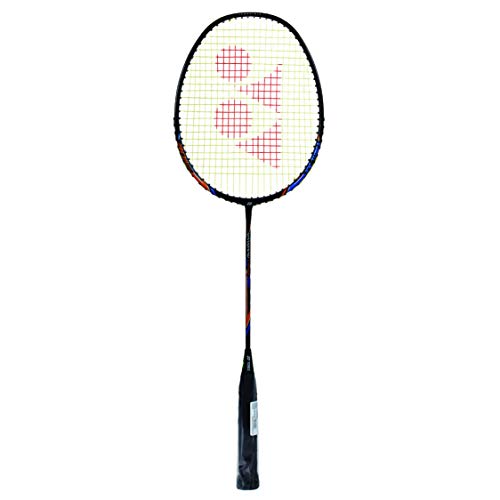
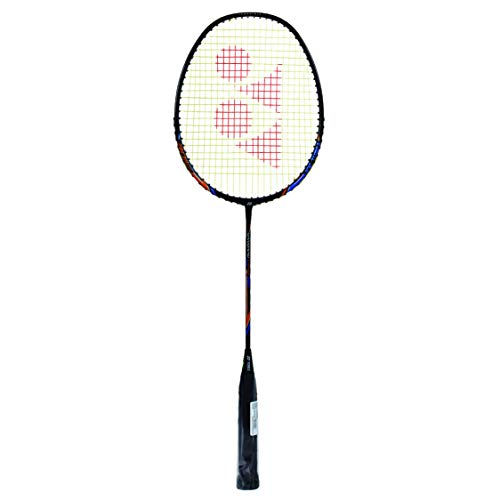
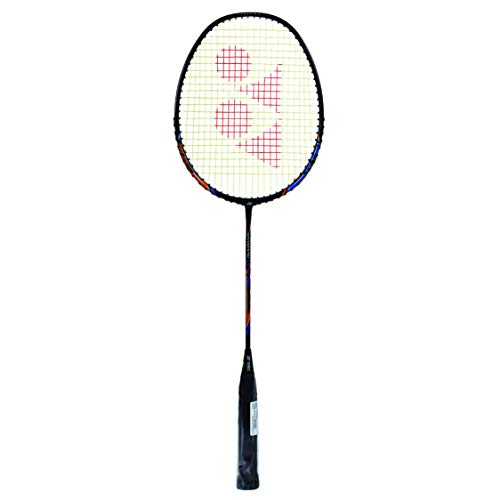
The YONEX Muscle Power 22LT Carbon Graphite Badminton Racket is built as an intermediate-level racket at 83 grams with a full racket cover included and a maximum string tension of 30 lbs, per the current listing. That weight sits in the middle of the typical adult racket range, heavier than the true head-light control rackets built for fast net exchanges, lighter than the heaviest dedicated power frames. It’s aimed at players who’ve moved past a beginner set and want one racket that doesn’t force them to choose between smashing and rallying at the net.
The “Muscle Power” name signals a lineage built around generating pace, but the LT designation on this specific model points to a lighter build within that family, which is what pulls its actual feel back toward the middle rather than the head-heavy end of the spectrum. If you’ve tried a full-weight power racket and found it tiring to reset between shots, this is the kind of adjustment that addresses that directly, without giving up as much smash pace as switching all the way to a dedicated control racket would.
⚠️ Watch out: Stock on specific colorways and models like this one can run low, the listing showed limited units remaining at last check. If it’s sold out when you look, the underlying spec profile to search for is the same: 82-85 grams, intermediate-level, roughly even to slightly head-heavy balance, 30 lbs max tension.
A budget-friendly balanced option
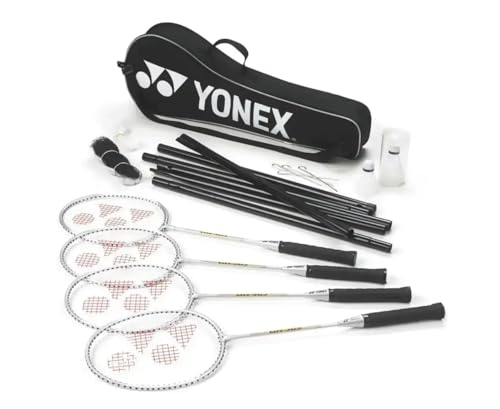
If $80 for a single racket is more than you want to spend to find out whether a balanced frame suits your game, the Badminton Racket Set of 2, Professional Graphite Shaft is a reasonable lower-cost way to test the idea. It’s sold as a set of two graphite-shaft rackets with shuttlecocks, overgrips, and a carry bag included, positioned for backyard and casual play rather than serious competitive training. The build quality and consistency won’t match a purpose-engineered single racket, but it’s a legitimate way to figure out whether you actually prefer a middle-ground feel before committing more money to it.
Who this actually fits
- ✓You play both singles and doubles and don’t want two different rackets
- ✓Your rallies mix backcourt clears with net exchanges in the same point
- ✓You’re past beginner level but not training for tournament-specific tactics
- ✓You’d rather have one racket that’s good everywhere than great in one spot
- ✕You play almost exclusively doubles at the net and rarely go to the backcourt
- ✕You’re chasing maximum smash power specifically for attacking doubles play
- ✕You’re a beginner who hasn’t developed a consistent swing yet, see our beginner guide instead
- ✕You already know you favor one extreme and just want to confirm that racket type
String tension changes the feel too
Balance point sets the foundation, but string tension shifts how a balanced racket actually plays in your hand. Lower tension, in the low-to-mid 20s in pounds, gives more trampoline effect off the strings, adding a bit more free power without changing the frame itself. Higher tension, closer to the racket’s rated maximum, trades that trampoline effect for more precise directional control. A balanced-frame racket strung toward the lower end of its range will feel like it leans slightly more toward power; the same frame strung near its max will feel like it leans slightly more toward control. That’s a cheaper way to fine-tune the feel than buying a second racket.
Doubles versus singles with a balanced racket
In doubles, where points are often decided at the net in fast exchanges, a true head-light racket usually still has an edge over a balanced one for pure reaction speed. In singles, where you’re covering the full court and need both backcourt clears and net returns from the same racket, the balanced middle ground tends to make more practical sense, since you’re not specializing in one zone of the court the way a doubles net player can. If you split your time between both formats, a balanced racket is the single frame least likely to feel wrong in either setting, even if it isn’t the single best choice for either one in isolation.
💡 Pro tip: If you’re not sure which balance you actually prefer, borrow or demo a head-heavy and a head-light racket before buying a balanced one purely on principle. Some players find they strongly prefer one extreme once they’ve actually felt both, which makes a specialized racket the better buy instead.
Grip size and how it interacts with balance
Grip size doesn’t change a racket’s balance point, but it changes how that balance feels in your hand during a fast exchange. A grip that’s too thick makes any racket, balanced or not, feel harder to whip through quick wrist-driven shots, which can make a genuinely balanced frame feel more head-heavy than its spec suggests. Most adult rackets ship in a G4 or G5 grip size; if your hand runs smaller, building up an overgrip changes the feel less than starting with too large a handle and trying to compensate.
Shaft flex is the other half of the equation
Balance point describes where the weight sits; shaft flex describes how much the frame bends under load, and the two work together to shape how a racket actually plays. A stiffer shaft transfers energy more directly and rewards a fast, technically clean swing with a crisper hit, while a more flexible shaft does part of the work for you, whipping through the shot with less swing speed required but sacrificing some precision on placement. A balanced-weight racket with a medium flex, which is what most rackets built around this power-and-control middle ground use, tends to be the most forgiving combination for an intermediate player who hasn’t fully settled into one playing style yet.
Extra-stiff shafts paired with a balanced frame exist, but they’re usually aimed at players with an already fast, technically consistent swing who want precision without sacrificing the balanced weight distribution. If you’re still developing swing consistency, a medium-flex shaft is the safer starting point regardless of how balanced the frame’s weight distribution is.
How to verify balance before you buy
If a listing doesn’t explicitly state head-heavy, even, or head-light somewhere in its description or spec sheet, that’s usually a sign the balance wasn’t a deliberate design choice worth advertising, and you should treat the “power and control” phrase in the title with some skepticism. For rackets that do list a balance spec, cross-check the stated weight, most balanced adult rackets fall in the roughly 80-88 gram range, against the balance description. A racket under 80 grams calling itself balanced is more likely leaning head-light in practice, while one pushing past 90 grams is more likely to feel head-heavy no matter what the listing claims.
Bottom line
A balanced racket is the right call for players whose game genuinely spans the whole court, not a safe default for anyone unsure what to buy. If your rallies are actually concentrated at the net or you’re chasing maximum smash pace, a specialized racket at either end of the balance spectrum will serve you better than splitting the difference.
What does ‘balanced’ actually mean on a badminton racket?
It refers to the racket’s balance point, where its weight sits along the frame. A balanced racket sits near even, sometimes slightly head-heavy, rather than clearly favoring the head-heavy power end or the head-light control end of the spectrum.
Is a balanced racket good for beginners?
It can work, but a true beginner racket usually prioritizes a larger sweet spot and lighter overall weight over balance point specifically. See our dedicated beginner racket guide if you’re new to the sport.
Does a balanced racket lose power compared to a head-heavy one?
Yes, somewhat. It won’t match a dedicated head-heavy racket’s smash pace, but it also won’t lose as much net-play speed as a head-heavy racket does compared to a head-light one. That tradeoff is the entire point of choosing balanced.
How do I know if a racket is really balanced and not just labeled that way?
Check the manufacturer’s own spec sheet or listing for a balance point description, usually head-heavy, even, or head-light. Marketing phrases like ‘power and control’ in the title or description aren’t a reliable substitute for that spec.
As an Amazon Associate, we earn from qualifying purchases through links on this page.