How to Return a Badminton Smash

A hard smash gives you a fraction of a second, nowhere near enough time for a full swing. The players who handle it well aren’t reacting faster, they’re doing less, on purpose.
Short answer: Set a defensive stance before the smash arrives, feet shoulder-width apart, knees bent, racket up and in front of your body. Use a backhand grip, since it reaches more of the court with less repositioning than switching to forehand. Meet the shuttle early with a short, compact block rather than a full swing, then choose a soft net shot, a high deep lift, or a flat counter-drive depending on how loose the smash actually was. Based on aggregated coaching sourcing checked on 10 September 2026.
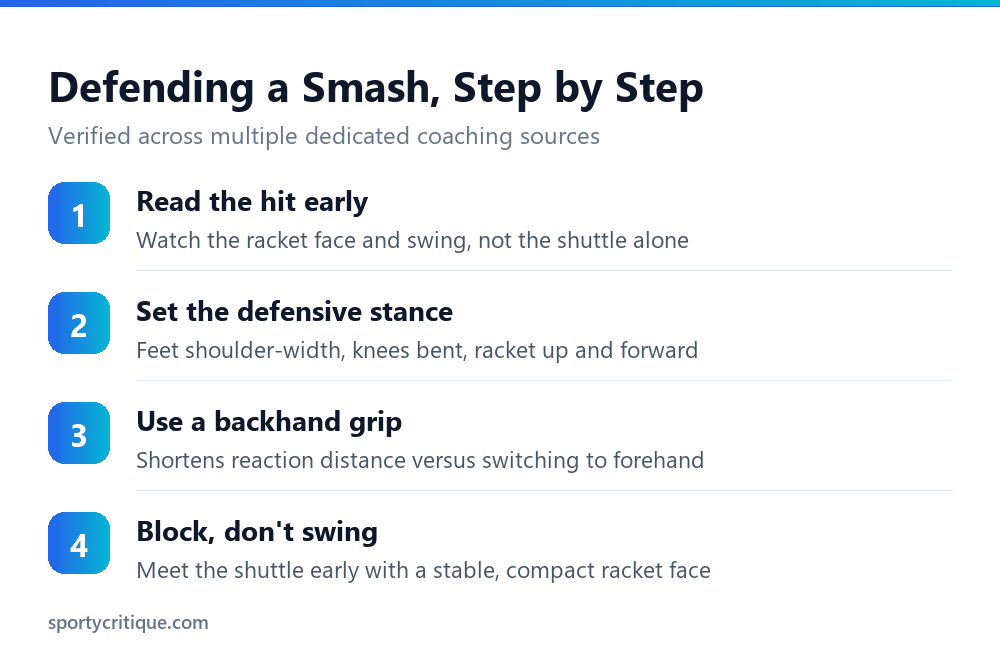
Table of Contents
Why a Full Swing Doesn’t Work Here
A smash travels fast enough that the usual stroke-production instinct, a full backswing generating power, is exactly the wrong response. There simply isn’t time to wind up before the shuttle arrives, and attempting a full swing anyway tends to produce a late, mistimed contact rather than a controlled return. The defensive return is built around doing the opposite: a short, compact racket motion that prioritizes being in the right position at the right moment over generating any power of your own. The smash itself already supplies the pace, your job is redirecting it, not adding to it.
The Defensive Stance, Set Before the Smash Arrives
Good smash defense starts before the smash is even hit, in the stance you’re already holding as your opponent sets up their attack. Face the direction the smash is coming from, keep your feet roughly shoulder-width apart, and bend your knees enough that you can move quickly in any direction rather than standing upright and flat-footed. Hold your racket up and in front of your body rather than down at your side, since lifting it from a low position costs time you don’t have once the shuttle is already in the air toward you.
📊 Note: This stance works regardless of where the smash is actually aimed, forehand side, backhand side, or straight at your body, which is exactly the point. You’re not guessing a direction and committing early, you’re staying balanced enough to react to wherever it actually goes.
Why the Backhand Grip Specifically
Coaching sources consistently recommend defaulting to a backhand grip when defending a smash, rather than switching between forehand and backhand grips depending on where the shuttle is headed. The reasoning is about reaction time: a backhand grip lets you cover a wider area of the court, including shots that would otherwise require a forehand, without needing to physically change your grip in the split-second before contact. Every fraction of a second spent adjusting a grip is time not spent getting your body and racket face into position, and against a smash’s speed, that trade-off consistently favors staying in one grip rather than chasing perfect technique on each individual shot.
Meeting the Shuttle Early: The Block
The actual contact technique is a block, not a hit. Keep the backswing short, hold the racket with a relatively light grip until the moment of impact, and meet the shuttle as early as possible with a stable racket face rather than trying to overpower the shot. A light grip until contact matters specifically because a tense, tightly-gripped racket transmits more of the smash’s pace directly into an uncontrolled rebound, while a light grip that tightens only at the moment of contact absorbs more of that pace and gives you actual control over where the shuttle goes next.
💡 Pro tip: After every block, consciously recover your racket back to the ready position in front of your body before the next shot arrives. A block that isn’t followed by an immediate reset leaves you out of position for whatever comes next, which matters especially in a fast doubles exchange.
Choosing the Right Reply
Reading which of these three replies actually fits takes practice, and it’s a genuinely different skill from the block itself. A soft net shot on a tight, well-placed smash is usually the safest choice, since attempting anything more ambitious against a well-executed smash risks an unforced error. A looser or slightly mistimed smash, one with less pace or a less precise angle, is a real opportunity to counter-drive flat and seize the initiative back rather than just surviving the point defensively. When neither option feels available, a high, deep lift resets the rally and buys time to recover position, at the cost of giving your opponent another attacking opportunity.
Reading the Smash Before It’s Hit
Part of effective defense happens before the shuttle is even struck, by watching an opponent’s racket preparation and swing path rather than waiting to react to the shuttle itself once it’s already in flight. A racket face angled steeply downward during the swing generally signals a hard, direct smash, while a flatter angle or a slower swing motion can signal a deceptive slower smash or a disguised drop shot instead. Training yourself to watch the racket and body cues during an opponent’s swing, rather than fixating on the shuttle alone, buys real reaction time that pure reflexes can’t provide on their own.
A Natural Equipment Factor Worth Knowing About
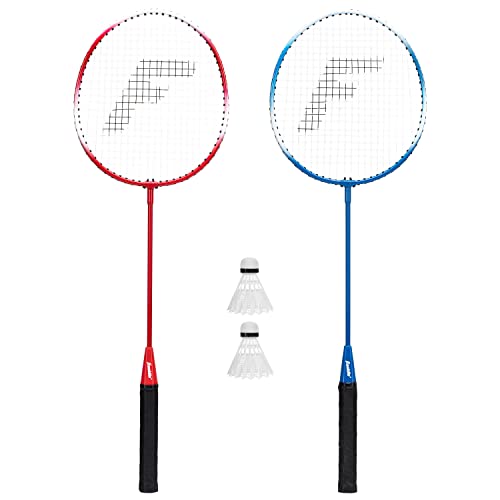
Since the block technique depends on a light grip that only tightens at the moment of contact, the actual grip surface on your racket handle matters more for this specific skill than it might for other strokes. A worn, slick overgrip makes it harder to maintain that light-then-firm grip transition cleanly, since a slipping grip forces you to hold on tighter throughout the whole motion just to keep control of the racket, which works against the technique’s whole premise. Replacing a worn overgrip is a small, inexpensive maintenance step that directly supports this specific defensive skill.
Check current badminton racket overgrip options (Amazon)As an Amazon Associate, we earn from qualifying purchases through links on this page.
Singles vs. Doubles: Does Defense Change?
The core mechanics of the block, stance, grip, and compact contact, apply the same way in both formats, but the court coverage expectation differs meaningfully. In singles, one player is responsible for defending the entire width of the court against a smash, which places even more weight on the backhand grip’s wider reach and on recovering quickly to a central ready position between shots. In doubles, defensive responsibility is typically split between two players side-by-side, which means each player covers a narrower zone but needs clear, practiced communication about who takes a smash aimed toward the middle of the court, a situation where hesitation between partners costs the point as often as a technical error does.
Common Mistakes That Undermine Good Positioning
Even a player who understands the stance and block conceptually often loses points to a few specific, avoidable habits. Standing too upright with straight legs is one of the most common, since it costs the extra split-second needed to drop into a real defensive crouch once the smash is already airborne. Holding the racket too low, down near the waist rather than up in front of the chest, is another, forcing an upward racket movement that eats into the already minimal reaction window. A third common mistake is watching the shuttle exclusively rather than the opponent’s racket and body during their swing, which delays the read described earlier and leaves less time to actually execute the stance and block once the smash is confirmed underway.
⚠️ Watch out: A defensive stance held too rigidly, feet planted and knees locked rather than loose and ready to spring, defeats its own purpose. The stance needs to be a ready position you can move out of instantly, not a fixed pose.
Practicing Smash Defense Without Live Smashes
Since a live smash is fast enough that learning the technique in real time during a match is a difficult way to build the skill, dedicated practice drills matter here more than for many other badminton techniques. A coach or practice partner feeding a steady series of smashes specifically for defensive-return practice, rather than mixing it into general rally play, lets the stance, grip, and compact block motion become familiar under repetition before facing a real, unpredictable smash in match conditions. Shadow practice, physically rehearsing the stance transition and block motion without a shuttle at all, is a reasonable supplement when a practice partner isn’t available.
- ✓Set the defensive stance before the smash is even hit, not after
- ✓Default to a backhand grip rather than switching grips mid-point
- ✓Keep the grip light until the moment of contact, then firm briefly
- ✓Read the opponent’s racket angle and swing for an early cue
- ✕Attempt a full swing against a smash’s speed
- ✕Grip the racket tightly throughout the entire block motion
- ✕Fixate on the shuttle alone while ignoring the opponent’s setup
- ✕Skip the recovery step back to ready position after blocking
How This Fits Into a Broader Defensive Game
Smash defense is one piece of a larger defensive skill set that also includes handling drops, clears, and net play, and it’s worth not treating it in complete isolation from those related shots. A player who defends smashes well but recovers slowly into position for the shot that follows, whatever their opponent does with the return, hasn’t actually solved the underlying problem, since a single well-executed block that leaves you out of position for the next shot often just delays losing the point rather than actually winning it back.
The Short Version, Restated
Returning a smash well is about preparation and reduction, not raw speed: a defensive stance set before the smash arrives, a backhand grip held by default, and a short, compact block that meets the shuttle early rather than swinging through it. Which reply follows, a soft net shot, a counter-drive, or a deep lift, depends on how tight or loose the smash actually was. None of this replaces dedicated practice against real repeated smashes, since the technique’s timing is difficult to build purely by reading about it.
Common Questions
How do you return a badminton smash?
Set a defensive stance before it arrives, use a backhand grip, and meet the shuttle early with a short, compact block rather than a full swing.
Why use a backhand grip to defend a smash?
It covers more of the court without needing a mid-point grip change, saving reaction time a smash’s speed doesn’t allow for.
Should you swing hard when blocking a smash?
No, a short, compact block with a light-then-firm grip controls the return; a full swing tends to mistime the shot.
What should you do after blocking a smash?
Choose a soft net shot on a tight smash, a counter-drive on a loose one, or a high deep lift to reset when under pressure.
How can you practice smash defense effectively?
Dedicated feed drills from a coach or partner, plus shadow practice of the stance and block motion, build the timing better than reacting to smashes only during rally play.
The Short Version
- →Set the defensive stance before the smash is hit, not after.
- →Default to a backhand grip rather than switching grips mid-point.
- →Meet the shuttle early with a short, compact block, not a full swing.
- →Keep the grip light until contact, then briefly firm.
- →Choose the reply, net shot, counter-drive, or lift, based on how loose the smash was.
- →Dedicated feed drills build this timing faster than rally play alone.