Best Hockey Helmets for Adult Rec League

Seeking the best hockey helmet for adults playing rec league comes down to a shorter list than the gear wall makes it look: confirm HECC certification, get the fit right without relying on foam pads to fake it, and pick a price tier based on how often you actually skate, not on what the beer-league captain with the sponsor deal is wearing.
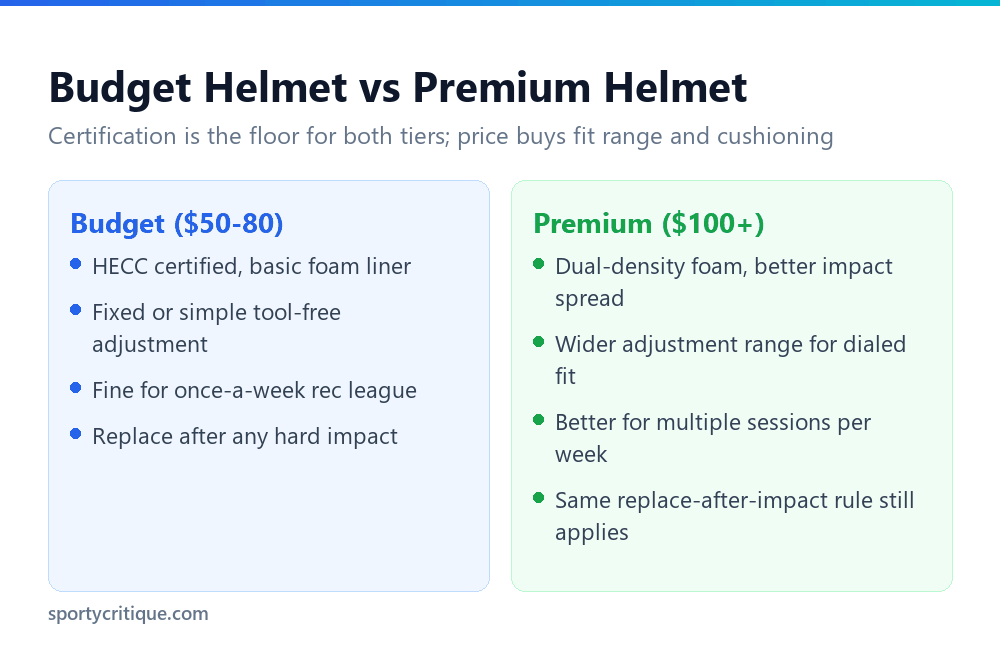
For most adult rec league players, a HECC-certified helmet in the $50-80 range, such as the Bauer Re-Akt 55 or a CCM Tacks 70 combo with cage, covers once or twice a week skating without cutting corners on real protection. Players skating three or more times a week, or anyone who’s taken a hard hit in an older helmet, get a genuine benefit from stepping up to a $100+ helmet like the Bauer Re-Akt 70, which uses a more advanced dual-density foam liner for better impact spread.
- →HECC certification is non-negotiable; it’s the actual safety standard, not a marketing sticker
- →Fit determines protection more than price does; a $50 helmet that fits beats a $150 helmet that doesn’t
- →Budget tier ($50-80) is genuinely fine for once or twice a week rec league play
- →Premium tier ($100+) earns its price through fit adjustment range and foam quality, not just branding
- →Replace any helmet after a hard impact regardless of price or visible damage; the foam absorbs the hit once
Table of Contents
Certification Comes Before Everything Else
Every helmet worth considering for organized rec league hockey needs to carry HECC certification (Hockey Equipment Certification Council), which most rinks and leagues require before letting you on the ice at all. This isn’t a nice-to-have spec buried in the fine print, it’s the baseline safety testing standard for the sport in North America, and a helmet without it, no matter how good it looks or how cheap it is, shouldn’t be on the shortlist.
Beyond HECC, some helmets also carry CSA or CE certification depending on where they’re designed and sold. These aren’t competing standards so much as regional equivalents; a helmet certified under multiple standards isn’t automatically safer than one that only carries HECC, but it does suggest wider testing coverage.
Fit Matters More Than the Price Tag
A helmet’s foam liner is engineered to work at a specific compression, which means a helmet that’s too large and stuffed with extra padding to compensate doesn’t protect the same way as one that actually fits your head circumference. Measure around your head about an inch above the eyebrows before shopping, and check that number against the manufacturer’s actual size chart rather than guessing based on a size you wore five years ago or in a different brand, since sizing isn’t standardized across manufacturers.
💡 Pro tip: Try a helmet on and shake your head side to side and front to back before buying. It should move with your head, not slide independently over your skin. If you can feel it shift separately from a head shake, it’s too big regardless of what the size label says.
⚠️ Watch out: Never buy a hockey helmet used or secondhand unless you know its full impact history. Foam liners compress permanently after a hard hit even when there’s no visible crack, and a helmet that looks fine can already be offering far less protection than a new one.
Cage, Visor, or Full Shield: The Rec League Debate
Most adult rec leagues either require or strongly encourage a full cage or shield, and for good reason: beer-league games see plenty of accidental high sticks and deflected pucks from players without elite stick control, which is exactly the situation a cage protects against best. A half-shield or visor gives a clearer field of view and feels less claustrophobic to some players, but it leaves the lower face exposed in a way a full cage doesn’t.
If your league doesn’t mandate one or the other, a full cage is the safer default for casual and intermediate rec players specifically because the skill level in most rec leagues is mixed, and a cage protects against the unpredictable stick and puck contact that mismatched skill levels tend to produce.
Three Real Picks Across Price
At the budget end, the Bauer Re-Akt 55 is a HECC-certified helmet under $50, which makes it the cheapest certified option from a major manufacturer worth trusting on the ice. It skips some of the finer fit-adjustment range of pricier models, but for a player skating once or twice a week in a casual league, it covers the basics without cutting the certification corner some no-name budget helmets do.
In the middle tier, the CCM Tacks 70 Combo with Cage bundles a certified helmet with a facemask cage in one purchase, which is genuinely convenient for a new rec league player who doesn’t already own a cage and doesn’t want to shop two separate product categories. It’s positioned by CCM as a recreational-level helmet with the fit features you’d actually want at this price point.
At the premium end, the Bauer Re-Akt 70 steps up to a more advanced foam construction and a wider tool-free adjustment range, which matters more for players skating several times a week where the cumulative comfort and fit precision pays off over a season rather than a single game.
What a Higher Price Actually Buys
Past the $100 mark, the money mostly goes toward foam construction (dual-density layers that spread impact force across a wider zone) and adjustment mechanics (finer control over both circumference and depth, not just a single tool-free dial). It does not buy you a meaningfully higher certification standard; a $50 HECC-certified helmet and a $200 HECC-certified helmet both cleared the same baseline safety test. The premium tier is about fit precision and comfort over repeated use, not a different safety category.
How Hockey Helmet Sizing Actually Works
Most adult hockey helmets are sized small, medium, and large, each covering a range of head circumference in inches or centimeters rather than a single fixed number, with a tool-free dial or adjustment strap fine-tuning fit within that range. Measure around your head roughly an inch above the eyebrows, at the widest point, using a soft tape measure or a string you then measure against a ruler. Match that number to the specific model’s chart rather than a generic S/M/L guess, since the actual circumference range for “medium” varies noticeably between brands and even between different helmet lines from the same brand.
A helmet sitting correctly should ride level, about a finger-width above the eyebrows in front, without rocking when you shake your head. If it tilts back to expose your forehead or sits so low it blocks upward vision, that’s a sizing or adjustment problem to fix before ever stepping on the ice, not something to just get used to over time.
Ear Covers, Chin Strap, and Comfort Details
Ear covers vary from simple perforated plastic shells to softer, ventilated designs, and they matter more for rec league comfort than most players expect, since a hard or poorly-shaped ear cover digging in over a two-hour session is a real annoyance during a recreational game where you’re presumably there to enjoy yourself. Try helmets on with the chin strap actually buckled and tightened to game position rather than just resting the shell on your head in the store, since ear cover pressure only becomes obvious once the strap is snug.
The chin strap itself should sit snug enough that the helmet doesn’t shift under a hard head shake, but not so tight it’s uncomfortable within the first period. A four-point strap system generally distributes pressure more evenly than a basic two-point strap, which is one of the quieter upgrades that separates mid-range and premium helmets from the cheapest options on the market.
When to Replace a Helmet
- ✓Replacing a helmet immediately after any hard impact, even without visible cracking
- ✓Checking HECC certification on every helmet before comparing price or brand
- ✓Re-measuring head size before buying a new helmet, even if you know your old size
- ✓Buying a cage or shield rated for compatibility with your specific helmet model
- ✕Assuming a helmet is fine after a hit just because it looks undamaged
- ✕Buying a helmet a size too big and relying on extra padding to fill the gap
- ✕Skipping certification checks on a cheap helmet because the price seemed reasonable
- ✕Mixing a cage from one brand with a helmet from another without checking fit compatibility
Common Myths About Adult Helmets
Shopping by League Rules, Not Just Preference
Check your specific league’s equipment rules before buying anything, since requirements vary more than players expect between a casual drop-in session and a registered adult league with insurance requirements. Some leagues mandate a full cage outright, some allow a visor for players over a certain age threshold, and some leave it entirely up to the player. Buying a helmet-and-cage combo before confirming your league even requires a cage is a common way to spend money on a piece you didn’t need, or worse, to show up with a visor when the league requires full facial protection.
A Quick Word on Youth-to-Adult Transitions
Adults returning to hockey after a long break sometimes default to whatever size feels familiar from years ago, which is a mistake since head size and helmet lineups both change. Always re-measure and check the current size chart for the specific model you’re buying rather than assuming last decade’s size still applies, especially if you’re switching brands along with coming back to the sport. Adult head shape can also change over years away from the game, so treat the comeback purchase as a fresh fitting rather than a like-for-like swap.
Do I really need a HECC-certified helmet for beer league?
Yes, and most organized leagues will require it before letting you on the ice. HECC certification is the baseline safety testing standard for hockey helmets in North America, not an optional premium feature.
Is a $50 hockey helmet actually safe for adult rec league?
Yes, as long as it’s HECC certified and fits correctly. Certification standards apply equally across price tiers; the extra cost of premium helmets goes toward fit range and foam construction for frequent use, not a higher safety bar.
Should I buy a helmet and cage separately or as a combo?
A combo, like the CCM Tacks 70 Combo, is the simpler and often cheaper route for a new rec league player who doesn’t already own a cage. Buying separately only makes sense if you want a specific cage brand or style not offered in a combo package.
How do I know when to replace my hockey helmet?
Replace it after any hard impact, even without visible damage, since the foam liner compresses permanently once it absorbs a hit. Outside of impacts, most manufacturers suggest reassessing fit and condition every few seasons of regular use.
As an Amazon Associate, we earn from qualifying purchases through links on this page.